What to Know About Cast Iron Plumbing Before You Remodel

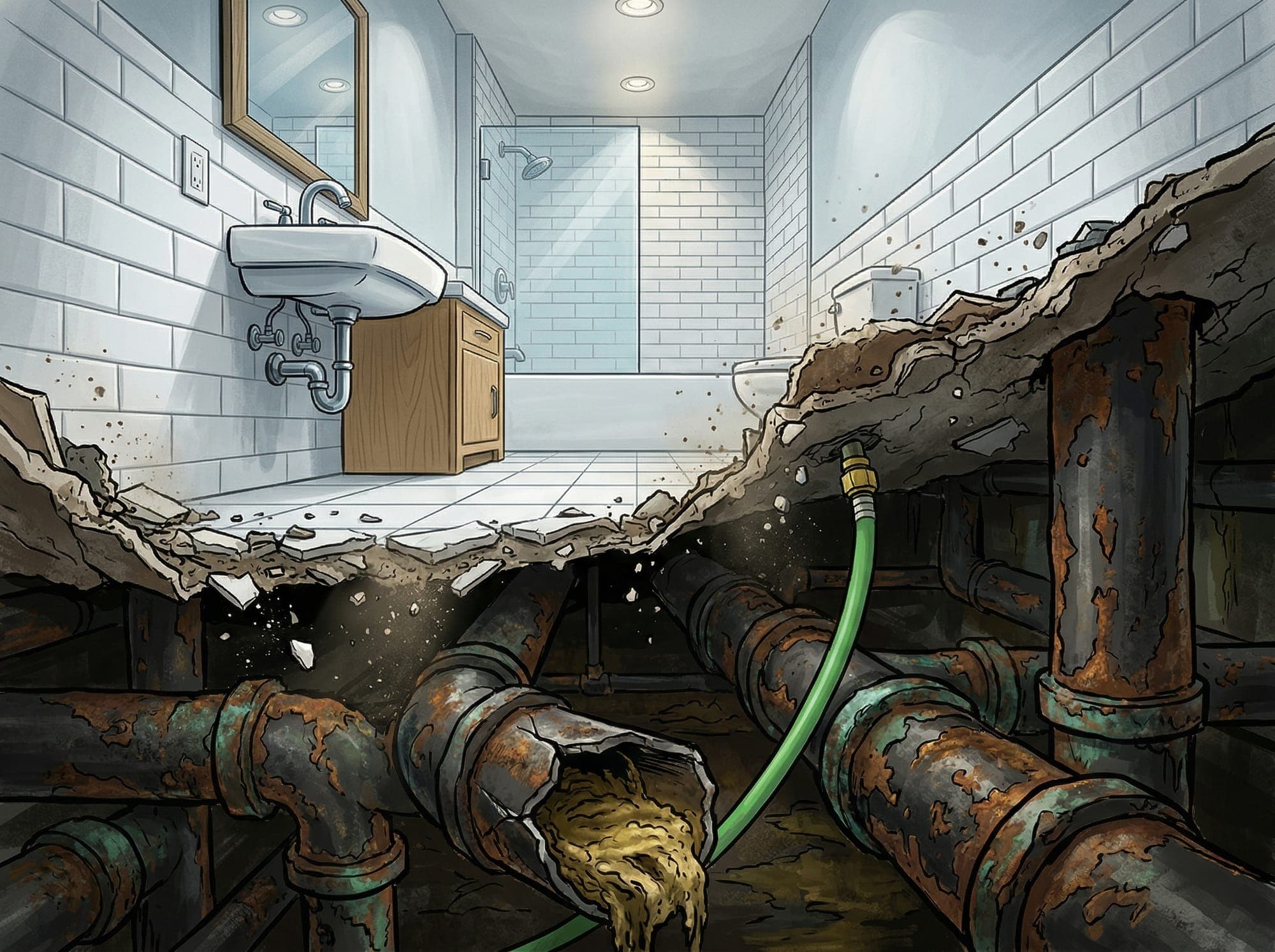
Cast iron drain plumbing is the wastewater piping system used in most Pinellas County homes built between the 1920s and mid-1970s — a heavy-gauge cast-iron alloy that corrodes from the inside out after 50-80 years of service. In St. Petersburg's historic Old Northeast, Roser Park, Kenwood, Snell Isle, Crescent Lake, and Bahama Shores neighborhoods, cast iron drain replacement is one of the highest-frequency scope-expansions during kitchen and bathroom remodels because the pipes fail exactly when adjacent finish work opens the walls.
If your St. Petersburg home was built before 1975 — anywhere from the pre-1925 stock in Old Northeast and Roser Park to the 1950s ranches in Crescent Lake and Bahama Shores — there's a good chance you have cast iron drain plumbing, and a better chance it's not in the shape you think. After 50 to 80 years of use in Pinellas County's sandy, shifting, mineral-heavy soil, cast iron pipes corrode from the inside out. The question isn't whether to deal with them. It's whether you deal with them now, while your contractor already has the walls open, or later, when it means tearing into a finished remodel you just paid for.
Here's what you should know before your kitchen or bathroom project starts.
How to Tell if You Have Cast Iron Pipes
Most homes built in the St. Pete area between the 1940s and mid-1970s — including waterfront neighborhoods like Venetian Isles and Snell Isle, 1950s-era neighborhoods like Crescent Lake, and historic districts like Old Northeast, Historic Uptown, Kenwood, and Roser Park where cast iron drains are 100+ years old — used cast iron for drain and waste lines. Supply lines (the ones that bring water to your faucets) were usually copper or galvanized steel. But the drains — the pipes that carry wastewater out — those are almost certainly cast iron if your home is from that era.
You can check a few ways:
- Look under the house. If you have a crawl space, look for dark, almost black pipes with raised ridges at each joint. Cast iron is thick, heavy, and unmistakable once you've seen it.
- Check exposed pipes. Garage ceilings, utility closets, and behind access panels often have visible drain lines. Cast iron will look dark gray or black with a rough texture.
- Check your home's age. Built before 1975 in Pinellas County? Assume cast iron drains unless someone already replaced them. PVC (white plastic) became standard in Florida residential construction in the late 1970s.
- Get a camera scope. A plumber can run a camera through your drain lines for a few hundred dollars. This is the only way to see what's happening inside the pipe — and it's the single best pre-remodel investment you can make.
What Goes Wrong With Old Cast Iron
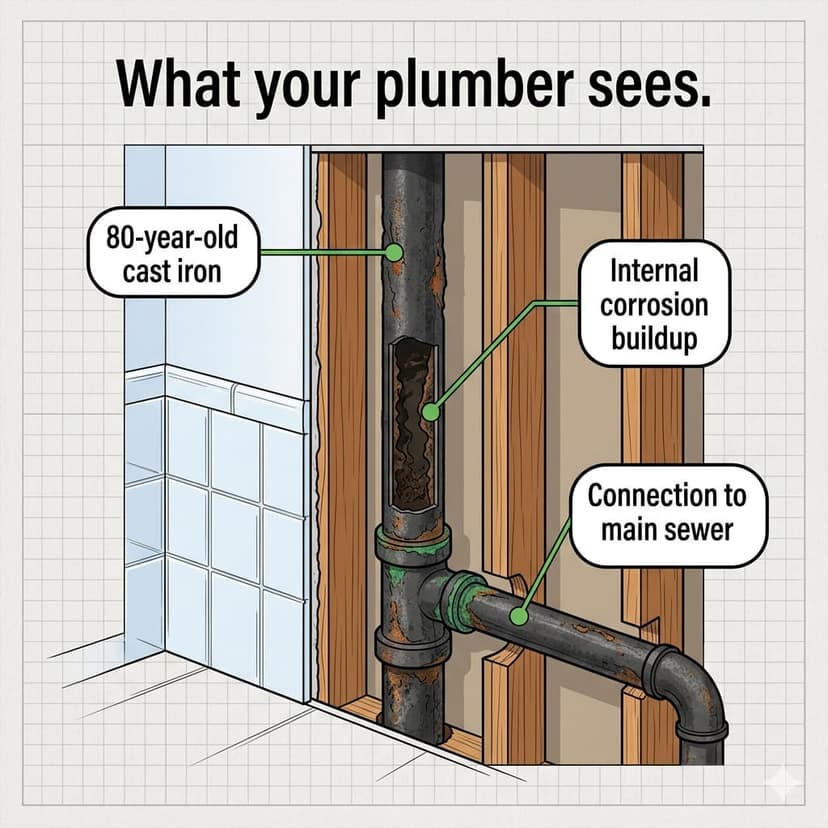
Cast iron was a solid material when it was installed. The problem is what happens over 50 to 80 years of daily use.
Buildup and Corrosion
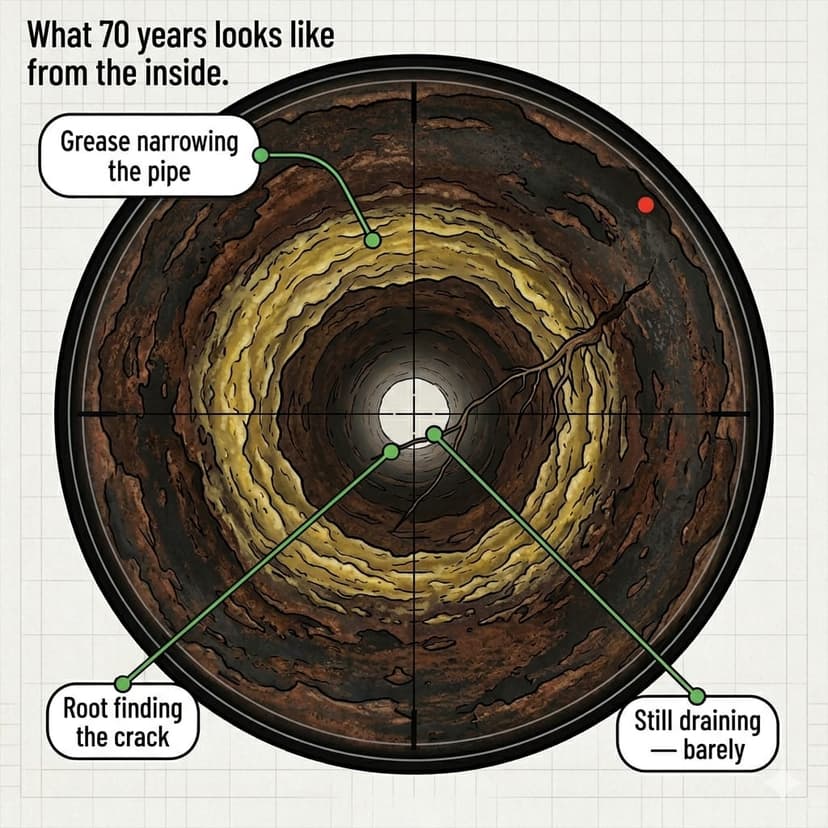
Decades of grease, soap, food waste, and bathroom products coat the inside of the pipe. Jeremy Wharton, owner of Revolution Contractors, puts it bluntly: “You've got 80 years of bacon grease in there.” That buildup narrows the pipe diameter and slows drainage — sometimes to the point where your drains barely work.
Chemical Damage
Drano, drain cleaners, and other high-pH solvents are the worst thing you can pour down cast iron. They eat through the iron itself, causing rust, thinning, and cracking from the inside. Fifty years of pouring drain cleaner into a cast iron pipe does more damage than the grease does.
Bellying and Sagging
Florida's sandy, shifting soil can cause underground pipe sections to sag over time. Water pools in the low spot, sediment collects, and the pipe corrodes faster at that point. This is especially common in St. Pete neighborhoods with older housing stock built on fill — Snell Isle (built on dredged-fill from Coffee Pot Bayou in the 1920s), Venetian Isles (1950s–60s waterfront fill), and the lower-elevation pre-1950 housing in Old Northeast and Crescent Lake. Soil movement under a slab is silent until the pipe cracks; a camera scope catches it before the crack does.
Root Intrusion
Tree roots find the smallest crack or loose joint in a cast iron pipe and grow into it. Once inside, they create blockages and accelerate the pipe's deterioration. A camera scope will show roots immediately.
Cracks and Breaks
Eventually, corroded cast iron cracks. When it does, you get sewage leaking under your slab or into your crawl space. By the time you smell it, the damage is already significant.
How Long Does Cast Iron Last in Florida — Actually
The 50-to-75-year design life is a national average for cast iron drain-waste-vent (DWV) systems. In St. Petersburg, two factors push that timeline shorter:
The first is Pinellas County's mineral-heavy water and corrosive sandy soil. Cast iron exposed to high-mineral water from the inside and salt-air-influenced soil from the outside corrodes faster than the same pipe in a Midwest basement.
The second is housing stock age. A pre-1925 home in Old Northeast or Roser Park has cast iron drains that are now 100-plus years old — well past any reasonable service life. A 1950s ranch in Bahama Shores, Crescent Lake, or Euclid-St. Paul's is at the 70–75-year mark, hitting the upper bound of the design life right now. Even a 1970s-built ranch is 50-plus years old. None of these are “wait and see” situations any more — the question is when, not if.
What that means in practice: if you're remodeling a kitchen or bathroom in any pre-1975 St. Pete home, scope the drains during pre-construction. The camera scope is the cheapest data point you'll buy on the entire project.
Why You Should Handle It During a Remodel — Not After
This is the single most important thing to understand: the cheapest time to replace cast iron plumbing is when your walls are already open.
During a kitchen remodel or bathroom renovation, your contractor is already doing demolition. The walls, floors, and ceilings are exposed. Your plumbing is visible and accessible. Adding pipe replacement at this stage is incremental work — the demo is already done, the space is already open, and the crew is already on site.
If you skip it and close everything up, replacing those same pipes later means:
- Tearing out the new tile, drywall, and finishes you just paid for
- Paying for demolition a second time
- Living through a second round of construction
- Spending two to three times what it would have cost during the original project
As Jeremy puts it: “Usually on any remodel of any size, that cast iron gets replaced because the best time is now, while walls are open.”
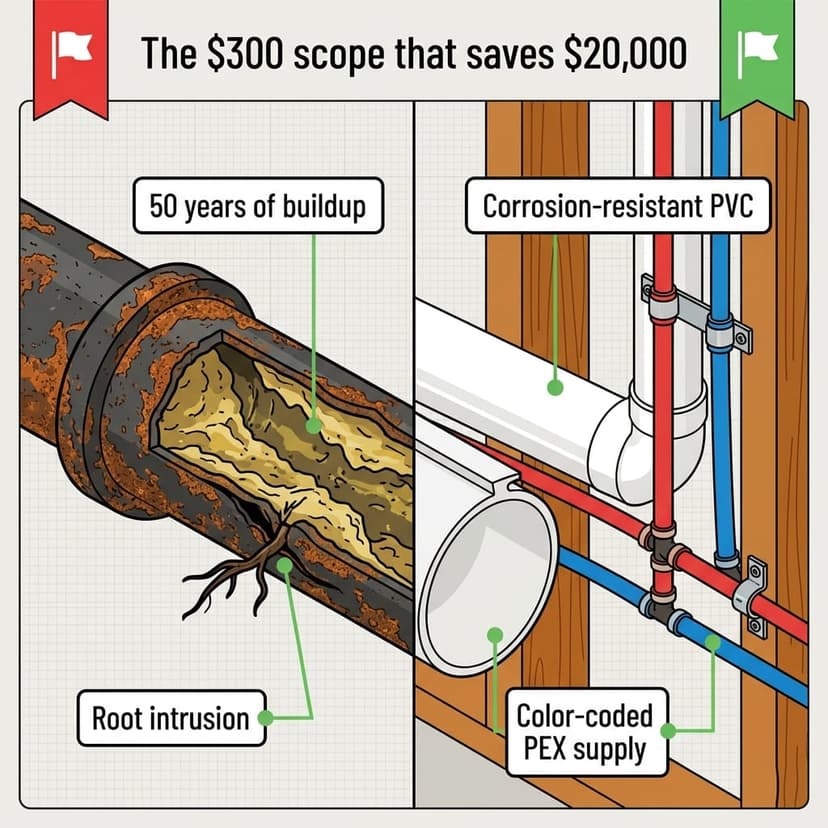
A $300 Decision That Saves Thousands
A camera scope costs a few hundred dollars. That one step tells you exactly what condition your pipes are in before construction starts — not after your plumber discovers a problem mid-project. At Revolution, we almost always scope the drain lines during pre-construction so there are no surprises once hammers start swinging.
Ready to find out what's behind your walls before your remodel starts? Whether your home is a 1920s bungalow in Old Northeast or Kenwood, a 1950s ranch in Crescent Lake or Bahama Shores, or a waterfront build in Snell Isle or Venetian Isles, the camera scope answers the same question: what's actually in your drain lines right now. Contact Revolution Contractors for a pre-construction consultation. We'll scope your pipes, assess your systems, and give you a real budget — not a guess. Call us at (727) 888-6161.
What Cast Iron Replacement Actually Costs
Let's talk real numbers for the St. Pete market.
| Scope | Typical Cost Range |
|---|---|
| Camera scope (diagnostic) | $200–$400 |
| Single bathroom drain replacement | $2,500–$5,000 |
| Kitchen drain replacement | $3,000–$6,000 |
| Full house drain replacement (to the street) | $10,000–$20,000 |
| Slab penetration (cutting concrete for under-slab pipes) | $1,500–$4,000 additional |
These numbers come from real projects in Pinellas County. The range depends on your home's layout, how much pipe needs replacing, whether drains run under a concrete slab, and how far the main line extends to the street connection.
One question that comes up: trenchless lining (CIPP, or cured-in-place pipe) versus full cast iron replacement. Trenchless lining costs roughly $17,000 for a 2,000-square-foot home in the St. Pete market — comparable to a full traditional drain replacement at $10,000–$20,000. The trade-off is timing: trenchless lining is the right call when walls are already finished and you're trying to avoid demolition. When you're already mid-remodel with walls open, traditional replacement is almost always cheaper because the access cost is zero — the demo is already done. Lining is a tool for “after the remodel is finished and now there's a problem.” Replacement is the tool for “we caught it during pre-construction.”
The key context: when you're already mid-remodel, replacing drain lines during the project adds $3,000 to $8,000 for a typical kitchen or bathroom. Doing the same work as a standalone project — after your remodel is finished — easily doubles or triples that cost because of the demolition and refinishing required to access the pipes. For a full breakdown of what a bathroom remodel costs in St. Petersburg, see our cost guide.
What Goes Back In: PEX and PVC
Nobody puts cast iron back. Modern drain replacements use PVC (white plastic pipe) for waste and drain lines. For supply lines, PEX tubing has become the standard.
PEX Advantages Over Old Copper or Galvanized Supply Lines
- Flexible — runs through walls with fewer fittings and joints
- Corrosion-resistant — won't deteriorate in Florida's mineral-heavy water
- Color-coded — red for hot, blue for cold — so future contractors know what they're looking at
- Faster to install — fewer joints means less labor time and lower cost
PVC Advantages for Drain Lines
- Smooth interior — resists the buildup that destroyed your cast iron
- Lightweight and durable
- Easy to repair if something goes wrong decades from now
How Revolution Handles Cast Iron Discovery
Most contractors treat cast iron plumbing as a “surprise” — something that gets discovered mid-project and dropped on the homeowner as an unexpected change order. That's not how we work.
Pre-construction scope. We get a camera down the drain lines before construction starts, not after. This happens during our pre-construction process while we're sharpening the budget and locking in costs.
Why the Camera Scope Is the Cheapest Data Point on the Project
Jeremy Wharton, owner of Revolution Contractors, on the camera scope economics: “It's only a few hundred bucks for a plumber to scope pipes with a camera, so that's usually the solution. We almost always get a camera down the pipes to know what we're dealing with and tell the story to homeowners.”
A few hundred dollars buys a definitive answer to four questions that otherwise become surprises mid-project: Is the pipe corroded? Is it bellied or sagging? Are roots intruding through cracked joints? Is the cast iron material still structurally sound, or thinned to the point of imminent failure? Without the scope, those questions get answered the day demolition starts — and the answer arrives as a change order in the middle of a remodel that's already moving fast.
Most St. Pete plumbers will run a scope as a standalone diagnostic for $200–$400, scheduled inside a week. The scope output is a recorded video file you keep — useful documentation if you sell the house, file an insurance claim later, or want a second opinion on a plumber's recommendation.
Transparent pricing. We work on a time-and-materials basis, which means pipe replacement gets priced openly and added to the budget before it becomes a problem. You see the plumber's bid, you see our markup, and you approve it before any work starts. No hidden costs. No padded change orders.
Same crew, start to finish. Our 20-plus in-house W-2 carpenters handle the demolition that reveals the plumbing and the rebuild after the licensed plumbing subcontractor finishes the pipe work. That's one accountable crew that knows the project from pre-construction scope through final tile — not a rotating cast of subcontractors trying to piece together what the last guy did. We coordinate the plumber, sequence the inspection, and own the rebuild — so you have one number to call, not three. If you're planning a whole home remodel, cast iron replacement gets folded into the scope from day one.
Weekly budget updates. You'll see exactly what the pipe replacement costs as part of your weekly budget review. If the scope changes during construction — say the camera shows the main line to the street also needs replacement — we discuss it, price it, and get your approval before touching anything. Learn more about how our remodeling process works.
Frequently Asked Questions
How Do I Know if My House Has Cast Iron Plumbing?
If your home was built before 1975 in the St. Pete area, you almost certainly have cast iron drain lines. Look for dark, heavy pipes in your crawl space, garage ceiling, or behind access panels. A camera scope ($200–$400) gives you a definitive answer about what's in your walls and what condition it's in.
Can Cast Iron Plumbing Be Repaired Instead of Replaced?
Sometimes. Epoxy lining can extend the life of cast iron that's corroded but not cracked. But if your pipes are bellied, cracked, or have root intrusion, replacement is the only real fix. And if you're already mid-remodel with walls open, replacement is almost always more cost-effective than a repair that might fail in a few years.
How Long Does Cast Iron Plumbing Last?
Cast iron pipes were designed to last 50 to 75 years. Many homes in St. Petersburg are now hitting 70 to 80 years — well past their intended lifespan. Pipes that have been exposed to drain cleaners, heavy grease, or Florida's corrosive soil conditions may fail sooner.
Will My Homeowner's Insurance Cover Cast Iron Replacement?
Typically not for normal wear and deterioration. Insurance may cover damage caused by a sudden pipe failure — like a slab leak that damages flooring — but the pipe replacement itself is usually considered maintenance. Check your policy, but plan on cast iron replacement being an out-of-pocket cost.
How Long Does Cast Iron Pipe Replacement Take During a Remodel?
For a single bathroom or kitchen, a plumber can usually complete the replacement in one to two days. A full-house replacement to the street may take three to five days. When done during a remodel, this work happens in the rough-in phase — before tile, drywall, or finishes go in — so it doesn't add significant time to the overall project.
Should I Replace All the Cast Iron at Once or Just the Section Near My Remodel?
If the camera scope shows deterioration throughout the system, replacing everything at once is almost always the smarter financial move. You're already paying for demolition and access. Leaving corroded cast iron in place means you'll likely face a more expensive standalone repair within a few years. Jeremy's recommendation: “If we're already in there, deal with it now.”
What's the Difference Between Supply Lines and Drain Lines?
Supply lines bring clean water to your fixtures (faucets, showerheads, toilets). Drain lines carry wastewater out. In older St. Pete homes, supply lines were typically copper or galvanized steel, while drain lines were cast iron. Both may need replacement during a remodel, but cast iron drains are the more urgent concern because they carry corrosive waste and deteriorate faster.
How Much Does a Camera Scope Cost in St. Petersburg?
Most Pinellas County plumbers run a drain camera scope as a standalone diagnostic for $200 to $400, scheduled inside a week. You get a recorded video file showing the inside of every drain line — root intrusion, corrosion, bellies, cracks, all visible. Jeremy Wharton, owner of Revolution Contractors: “It's only a few hundred bucks for a plumber to scope pipes with a camera, so that's usually the solution.” For a pre-1975 St. Pete home about to undergo a kitchen or bathroom remodel, this is the single highest-ROI line item on the entire project.
Should I Get Cast Iron Lined (Trenchless) or Fully Replaced?
It depends on whether your walls are open. During a kitchen or bathroom remodel, full replacement is almost always cheaper than trenchless lining (CIPP) because the demolition cost is already absorbed into the project. After the remodel is finished and the cast iron starts failing, trenchless lining becomes the cost-effective option because it avoids tearing into new tile and drywall. Trenchless typical St. Pete pricing runs around $17,000 for a 2,000-square-foot home. Full traditional replacement is $10,000–$20,000 — but during a remodel, the incremental cost drops to $3,000–$8,000.
Related Reading
- Bathroom Remodel Cost in St. Petersburg — full bathroom remodel cost guide with detailed breakdown by scope and component
- Kitchen Remodel Cost in St. Petersburg — what to budget for a full kitchen renovation
- How the Home Remodeling Process Works — what to expect from pre-construction through final walkthrough
- Lead Paint and Asbestos in Older St. Pete Homes — another hidden issue in pre-1978 homes
- Historic Renovation Service — full historic-district scope where cast iron triage usually happens
- Remodeling in Old Northeast St. Pete — where most of our cast-iron triage happens
- Home Remodeling in Old Southeast — cast iron on pier-and-beam in Key West cottages and 1920s bungalows
- Home Remodeling in Euclid-St. Paul's — 1920s Craftsman bungalows with cast iron drains, knob-and-tube wiring, and no flood zone
- Home Remodeling in Bahama Shores — 1950s ranch homes with galvanized steel supply lines (not cast iron) and AE flood zone considerations
- 1970s Ranch Home Remodel — hidden issues, design ideas, and cost tables for St. Pete's most common housing stock
- Home Remodel Checklist — everything to check before your renovation starts, including plumbing
- Home Remodeling in Old Northeast — pre-1925 historic stock with original cast iron drains, lath-and-plaster walls, and review-board considerations
- Home Remodeling in Historic Uptown — Round Lake National Register district with 1920s bungalows and 80+-year-old cast iron drains
- Home Remodeling in Crescent Lake — 1950s ranches at the 70–75-year mark, the upper bound of cast iron design life
Revolution Contractors is a general contractor based in St. Petersburg, FL — a hybrid coordinating design with independent architects and designers — with 20+ in-house W-2 carpenters and remodel experience across Pinellas County's pre-1975 housing stock — Old Northeast bungalows, Snell Isle waterfront builds, Crescent Lake ranches, Historic Uptown stock, Roser Park's pre-1925 homes, and the 1950s neighborhoods in Bahama Shores and Euclid-St. Paul's. We scope cast iron plumbing during pre-construction on every remodel in older homes — so you know what you're dealing with before the first wall comes down. We operate on Time & Materials with weekly budget reporting. Contact us or call (727) 888-6161 to talk through your project.