Whole Home Remodel in St. Pete: What It Actually Costs, How Long It Takes, and How to Phase It

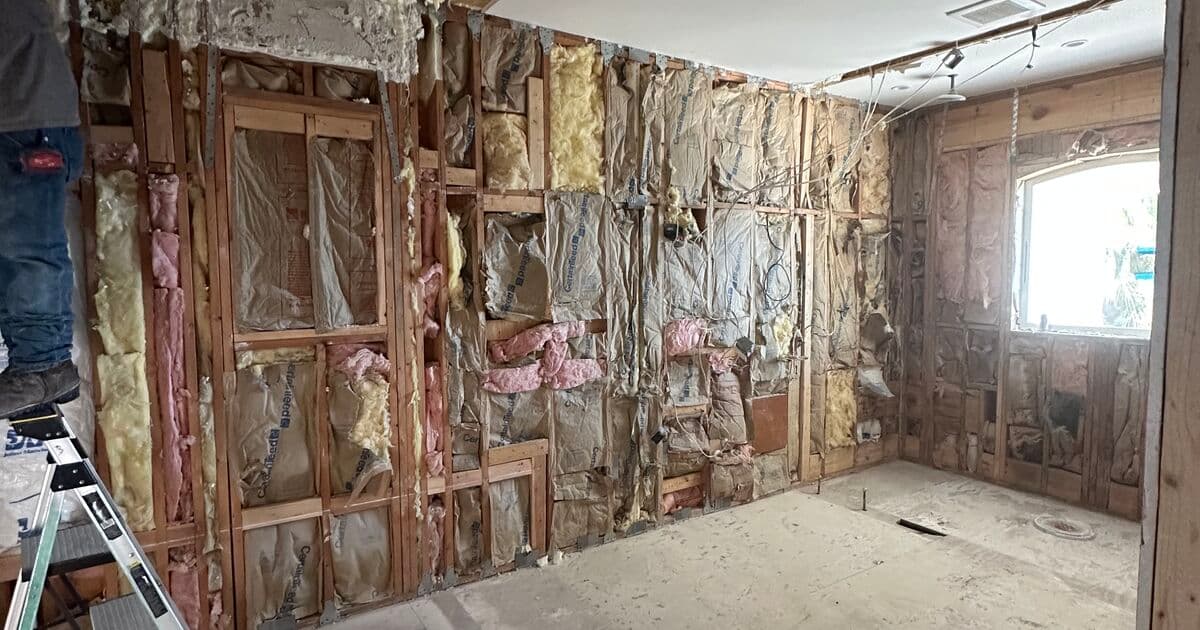
A whole home remodel means renovating most or all of your house under one plan, one budget, and one timeline. If you're considering a whole home remodel in St. Petersburg, you're looking at a project that touches every major system — plumbing, electrical, HVAC, structural framing, and finishes — in a coordinated sequence rather than room by room over several years. It's the most cost-efficient way to modernize an older home, and in St. Pete's 1950s-1970s housing stock — the 1920s bungalows of Old Northeast, post-war Snell Isle ranches, mid-century Crescent Lake homes, and waterfront cottages in Shore Acres — it's often the smartest move. Before you start calling whole home renovation contractors in St. Petersburg, read this first.
This guide covers what counts as whole-home scope, what it costs in the St. Pete market, realistic timelines, permit requirements in Pinellas County, and how to phase the work if you plan to live in place during construction.
What Counts as a Whole Home Remodel vs. a Partial Renovation
The distinction isn't that every square inch gets touched. It's that the project is conceived and executed as a unified scope. A whole home remodel typically involves 12 to 15 trade sequences — demo, structural work, plumbing, electrical, HVAC, insulation, drywall, paint, cabinetry, tile, flooring, and finish carpentry — moving through the house in a planned order.
A partial remodel tackles one room or system at a time. You do the kitchen this year, the bathrooms next year, maybe the electrical the year after. Each project requires its own mobilization, its own permits, and its own disruption.
A whole home remodel opens everything at once while the walls are already exposed. Your electrician rewires the whole house in one pass instead of three. Your plumber replaces all the drain lines — especially important if your St. Pete home still has cast iron pipes from the 1950s. Your HVAC contractor sizes one system for the whole finished layout, not a patchwork of additions.
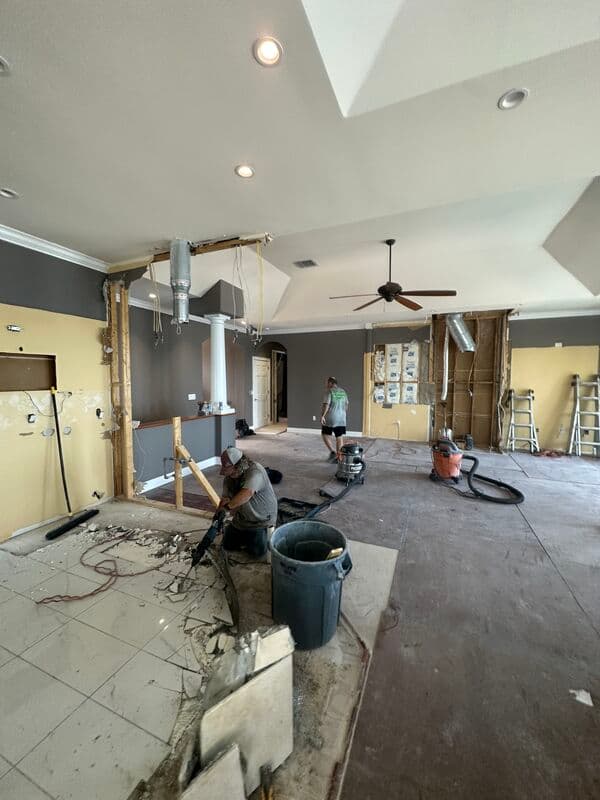
The result: lower cost per square foot, fewer total weeks of disruption, and systems that actually work together instead of being cobbled across decades.
What a Whole Home Remodel Costs in St. Petersburg
Cost depends on three things: your home's size, the depth of renovation, and what your walls are hiding. Here are realistic ranges for the St. Pete market in 2026:
| Home Size | Mid-Range Remodel | Full Gut Renovation |
|---|---|---|
| 1,500 SF | $150,000 - $225,000 | $225,000 - $450,000 |
| 2,000 SF | $200,000 - $400,000 | $400,000 - $600,000 |
| 2,500 SF | $250,000 - $500,000 | $500,000 - $750,000+ |
Per square foot: Cosmetic refreshes run $15 to $60/SF. Mid-range remodels with systems upgrades land at $60 to $150/SF. Full gut renovations — down to the studs, new everything — run $150 to $300+/SF.
At the upper end of the full-gut tier — custom millwork, designer-tier kitchens, primary-suite expansions, and waterfront-grade finish packages — the work blurs into our luxury home remodeling in St. Pete guide. That guide covers the design-build coordination, allowance structure, and finish-tier decisions that separate a high-end whole-home remodel from a standard mid-range scope.
Why St. Pete runs higher than national averages: Florida's hurricane code requires impact-rated windows and upgraded roof connections. Salt-air environments demand corrosion-resistant materials. And if your home sits in a FEMA flood zone, the 50% rule can add $50,000 to $200,000+ in elevation costs alone.
The biggest cost variable is what's behind the walls. Older St. Pete homes regularly reveal galvanized water lines, undersized electrical panels, termite damage to framing, and deteriorated cast iron drains. These aren't surprises if you investigate before committing — but they're budget-breakers if you don't. Our home remodel checklist walks you through what to check before calling any contractor.
How we handle budget on large-scope projects: At Revolution, whole home remodels run on Time & Materials — open-book construction with a transparent 30% markup on labor and 15% on materials, where you see every invoice, every material receipt, and every labor hour. You get weekly budget reports comparing actuals to estimates, and our superintendents hold a standing weekly call with each client to walk through the numbers — the actuals versus the estimate — so there are no surprises. By the time we break ground, roughly 75% of line items are locked in on cost, bringing overall budget certainty to 90 to 95%. The remaining 5 to 10% covers conditions we can't see until we open the walls and any decisions you make along the way. No padded contingency hiding inside a fixed number. See our pricing page for the full markup breakdown.
When a whole-home remodel tips into teardown territory: If the existing foundation needs flood-zone elevation, the framing has accumulated termite damage across multiple bays, and the whole-home gut scope is approaching 60–70% of replacement value, the math often points to demolition and new construction instead. Our custom home building process guide walks through the eight-phase sequence for a new build in Pinellas County — lot evaluation, schematic design, permitting, foundation, framing, dry-in, finish, and closeout — including how flood-zone elevation timing and Pinellas permit review change the schedule.
Ready to Talk Scope and Budget?
Call (727) 888-6161. We'll walk your property and give you a realistic range — no commitment, no sales pitch.
Realistic Timeline: How Long a Whole Home Remodel Actually Takes
The honest answer most contractors won't give you: plan for 9 to 15 months from your first design meeting to move-in day.
| Phase | Duration |
|---|---|
| Design and engineering | 4 - 12 weeks |
| Permitting (Pinellas County) | 3 - 8 weeks |
| Demo and structural | 3 - 6 weeks |
| Rough-in (plumbing, electrical, HVAC) | 4 - 8 weeks |
| Insulation, drywall, paint | 3 - 6 weeks |
| Finish work (cabinets, tile, flooring, trim) | 4 - 8 weeks |
| Final inspections and punch list | 1 - 3 weeks |
Total construction time for a typical 1,500 to 2,500 SF whole home remodel: 6 to 12 months. Add 2 to 4 months of pre-construction on the front end.
What actually causes delays: Cabinet and appliance lead times (8 to 16 weeks in 2026), hidden conditions discovered during demo, permit revision requests from the building department, and scope changes after construction starts. Budget a 10 to 20% time contingency on top of your construction schedule.
Why in-house labor matters for timeline: When your contractor subs out every trade, schedule slips compound. The framing crew has another job. The tile guy pushes you a week. Suddenly your 6-month project is 10 months. We keep 20-plus W-2 carpenters on payroll — with 401K matching and paid holidays — plus four superintendents overseeing the field. They work for us, not for whoever's paying most that week. When we start, we keep moving.
Jeremy puts it bluntly when clients ask what to expect: “Inspections are scheduled in order by the superintendent who notifies our office to schedule for the next day. The hardest part of a whole-home remodel for homeowners is that it's super invasive and always costs more than they want, no matter how careful we are at budgeting.” That honesty is the point. Whole home remodels are coordinated chaos, and the contractor's job is to keep it predictable, communicated, and on-budget — not to pretend the chaos doesn't exist.
Permit Requirements for Multi-Trade Projects in Pinellas County
A whole home remodel requires multiple permits — and understanding the process upfront prevents surprises.
Permits you'll need:
- General building permit (combination permit covering structural work)
- Electrical permit
- Plumbing permit
- Mechanical/HVAC permit
- Roofing permit (if the roof is modified)
- Notice of Commencement (recorded before work begins — required by Florida law)
Plan review timeline: 10 to 30 business days depending on project complexity. Florida law (HB 267) requires a response within 30 business days for residential structures under 7,500 SF. Plans submitted in 2026 must comply with the Florida Building Code 2026 7th edition revisions — primarily updates to wind-load tables for coastal exposure categories and energy code thresholds, both of which can affect window/door specifications and insulation values for whole-home scope.
When you need structural engineering: If load-bearing walls are being removed, the foundation is modified, roof trusses are altered, or the home is in a flood zone requiring elevation — sealed structural plans from a licensed engineer are required. For whole home remodels, this is almost always the case.
The FEMA 50% rule: If your renovation cost equals or exceeds 50% of your home's assessed structural value (excluding land), the entire structure must meet current flood code — including elevation to base flood elevation. St. Petersburg tracks this cumulatively over a rolling 12-month window. On a whole home remodel that's already touching every system, you need to know this number before you start.
We handle all of this. Permits are part of the job. We pull them, we manage the inspection schedule, we deal with the building department. You shouldn't have to learn permit bureaucracy to renovate your own house. See our process page for the full pre-construction-through-punch-list workflow.
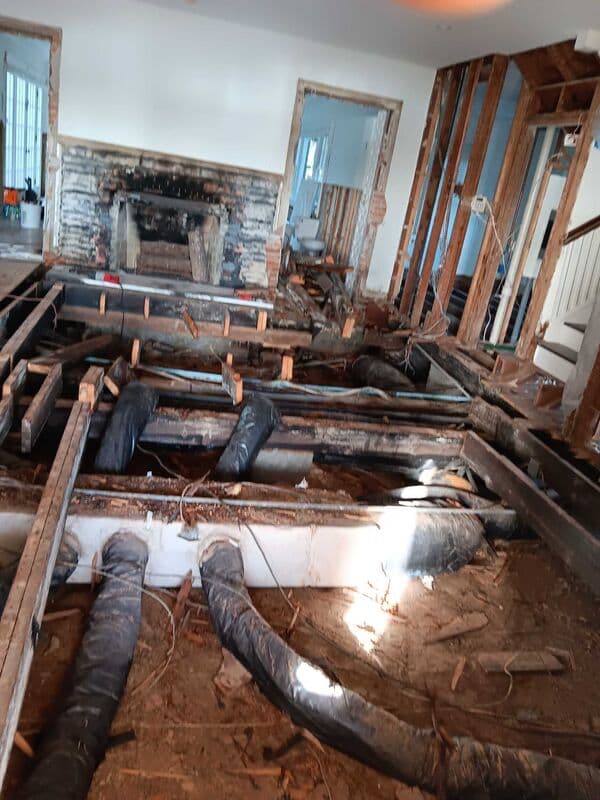
Before
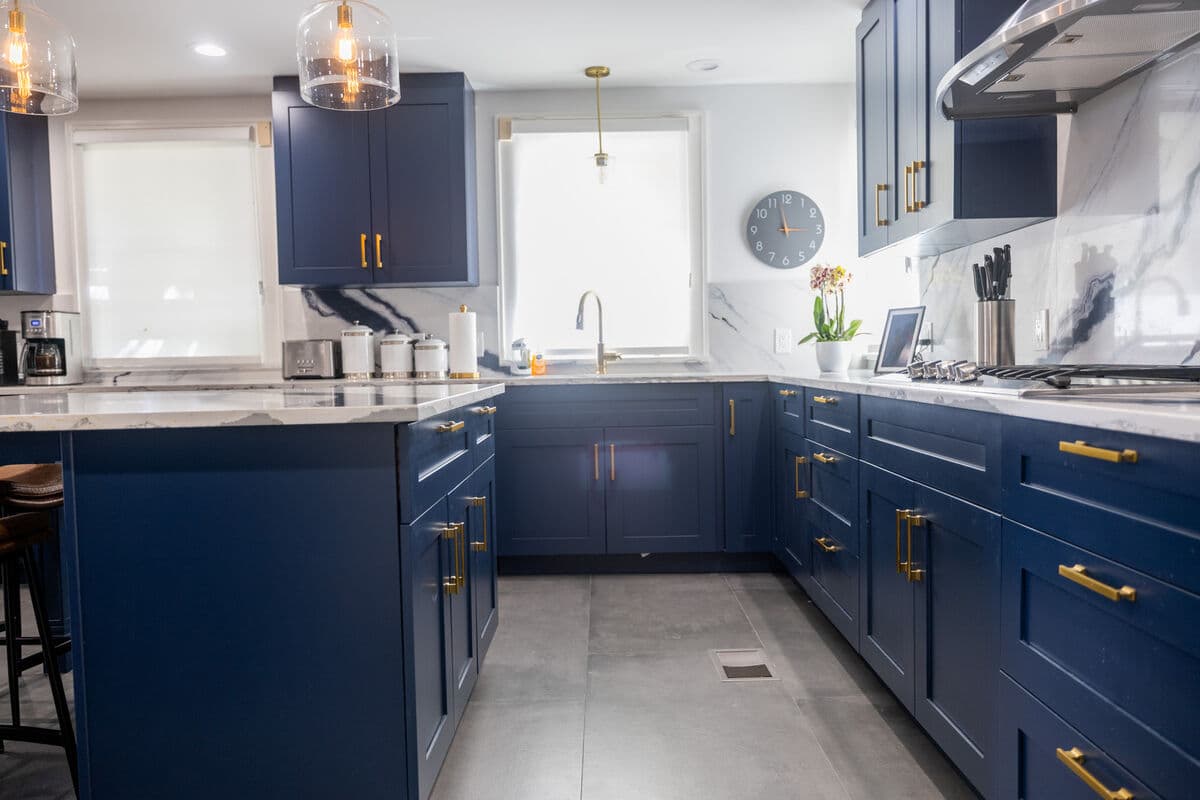
After
Phasing Strategy: How to Live in Your Home During a Whole Home Remodel
Not everyone can or wants to move out for 6 to 12 months. Phasing lets you stay in the house while construction moves through it in planned zones.
Here's how Jeremy describes our phasing sequence: “Phasing is demo, then foundation and framing changes, MEPs — mechanical, electrical, plumbing — windows, doors, roof, then drywall and finishes. We coordinate trades through BuilderTrend, our project-management tool for communication, scheduling, and estimation. Many of our subcontractors use it too.” That sequence holds whether the project is gut-renovation or zone-by-zone live-in-place; what changes is which zones get worked on which weeks.
How zone-based phasing works:
- Phase 1: Demolish and rebuild the kitchen and main living areas. You set up a temporary kitchen (microwave, mini-fridge, hot plate) in a bedroom or garage.
- Phase 2: Move into the finished kitchen and living areas. Construction shifts to bathrooms — but never all bathrooms at once. You always keep one functional bathroom.
- Phase 3: Bedrooms and secondary spaces. You rotate between finished rooms as each zone completes.
- Phase 4: Exterior, paint, landscaping, and final punch list while you're living in the finished interior.
The cost of phasing: Living in place adds 5 to 15% to total project cost. Repeated protection of finished areas, working around your schedule, and sequential mobilization instead of parallel trades all add time and labor. But it saves you $2,500 to $4,000 per month in temporary housing — which on a 9-month project is $22,500 to $36,000.
When moving out makes more sense: If the project involves structural work that affects the entire building envelope, if all plumbing and electrical must be replaced simultaneously, or if the home is too small (under 1,200 SF) to maintain a livable buffer zone.
Coordination is everything. Phasing requires a superintendent who manages trade sequencing down to the day. Which is why in-house labor matters — we're not calling paper-contractor subs and hoping they show up in the right order. We have four superintendents and 20+ W-2 carpenters running the schedule directly, and BuilderTrend keeps every trade on the same page about what's happening this week and what's queued for next.
Frequently Asked Questions
How much does a whole home remodel cost in St. Petersburg?
For a typical 1,500 to 2,500 SF home, expect $150,000 to $500,000 depending on scope and finish level. Full gut renovations of larger homes with structural work and flood zone compliance can reach $750,000 or more, and luxury whole-home remodels with custom cabinetry and high-end finishes can land $1M to $1.7M+. The biggest variable is what's behind the walls — older homes built in the 1950s through 1970s (1920s bungalows in Old Northeast, Shore Acres waterfront cottages, Snell Isle ranches) frequently need complete plumbing and electrical replacement. Revolution prices on Time & Materials with a transparent 30% flat markup, weekly budget reports, and ~75% of line items locked before construction starts.
Is it cheaper to remodel my whole house at once or room by room?
Whole home remodeling is more cost-efficient per square foot. You pay for one mobilization, one set of permits, and one round of systems work while walls are open. Room-by-room remodeling means opening and closing walls repeatedly, separate permits each time, and HVAC systems that never get properly sized for the final layout.
Can I live in my house during a whole home remodel?
Yes, with proper phasing. Zone-based phasing moves construction through your home in stages — you always maintain a functional bathroom and a living space. It adds 5 to 15% to project cost but saves thousands in temporary housing. Your contractor needs strong trade coordination to make this work without dragging out the schedule.
How long does a whole home remodel take?
Plan for 9 to 15 months total — 2 to 4 months of pre-construction (design, engineering, permitting) plus 6 to 12 months of construction. The actual timeline depends on home size, scope depth, permit complexity, and material lead times. Cabinet orders alone can take 8 to 16 weeks in 2026.
Do I need permits for a whole home remodel in Pinellas County?
Yes — multiple permits. Any structural change, electrical work, plumbing modification, HVAC replacement, or roofing work requires a permit in Florida. A whole home remodel typically requires a general building permit plus separate electrical, plumbing, and mechanical permits. A Notice of Commencement must be recorded before work begins.
What hidden costs come up during a whole home remodel?
The most common in St. Pete: cast iron drain pipe replacement ($8,000 to $15,000), galvanized water line replacement, undersized electrical panel upgrades (100-amp to 200-amp), termite damage to structural framing, and asbestos or lead paint remediation in pre-1978 homes. A thorough pre-renovation investigation catches most of these before you commit.
What's the difference between Time & Materials and fixed-bid for a large remodel?
Fixed-bid means the contractor estimated your entire project, added a margin for risk, and gave you one number. If the project costs less than estimated, they keep the difference. Time & Materials means you pay actual costs plus a transparent markup, with weekly budget reports. For whole home remodels where full scope isn't known until walls are opened, T&M typically saves money because you're not paying for worst-case estimates that never materialize.
Related Services
Planning a whole home remodel in St. Petersburg? Here's where to start:
- Home Remodel Services — Our full approach to whole home renovations
- Our Process — Pre-construction through punch-list, step by step
- Pricing & Markup — 30% flat markup, open-book T&M, weekly budget reports
- Kitchen Remodel — Often the centerpiece of a whole home project
- Bathroom Remodel — Coordinate bathroom upgrades within your whole-home scope
- Home Remodeling Process — Detailed walkthrough of trade-by-trade sequencing
- 1970s Ranch Home Remodel — Hidden issues, costs, and design ideas for St. Pete's most common housing stock
- Home Remodel Checklist — What to investigate before committing
- Cast Iron Plumbing in Older Homes — The hidden cost most St. Pete homeowners discover during demo
Ready to Start Your Whole Home Remodel?
Call (727) 888-6161 to schedule a property walk. We'll assess your home's condition, talk through scope options, and give you a realistic budget range — no obligation.