Home Remodel Sequencing in St. Petersburg: How a Pinellas GC Phases the Work

A home remodel in St. Petersburg moves through a defined sequence: pre-construction feasibility, design + permitting, office-to-field handoff, then construction with weekly client review. The numbers we hear most often from homeowners — “how long until I can break ground?” and “how locked is the budget when we start?” — both have specific answers, and they're not the answers most online checklists give. Pre-construction in St. Pete typically runs 1-3 weeks for consultation, 4-12 weeks of architectural work, then 3-8 weeks in permitting depending on project size. That's the real timeline for a 1900s bungalow renovation in Old Northeast or a kitchen redo in Crescent Lake.
This isn't a generic “must-do” checklist. It's how Revolution Contractors — a St. Petersburg general contractor with 20-plus W-2 carpenters in-house — actually sequences a remodel, with the verbatim phasing language we use internally. Every timeline below is something Jeremy (one of the partners) has stated on the record about how we run projects. If you're scoping a remodel in Pinellas County, this is what to expect at each phase and what decisions you'll be asked to make at which step.
What This Guide Does NOT Cover
Before the sequencing detail, here's what's intentionally not in this guide:
- Universal “must-do” lists that apply to every house in every market. The Pinellas housing stock — 1920s bungalows, 1960s concrete-block ranches, 1980s waterfront on stem walls — sequences differently. We'll flag what's St. Pete-specific.
- Insurance-claim or post-storm rebuilds. Revolution doesn't chase insurance-restoration work as a remediator. If your remodel is a storm-damage rebuild routed through an insurance adjuster, that's a different intake — talk to a restoration contractor first.
- DIY-managed projects. This guide describes how a general contractor sequences a remodel. If you're owner-acting as your own GC, the permit and inspection sequence is similar but the coordination work is yours.
- Design-firm-led projects. Revolution coordinates design with independent architects and interior designers — we're a hybrid GC, not a design-build firm with designers on salary. If you're working with a separate design firm already, the sequencing below describes what happens after their drawings hit our intake.
What follows is the construction-side sequence with specific St. Pete + Pinellas County timelines.
In This Article
- Phase 1: Pre-Construction Feasibility (Weeks 1-3)
- Phase 2: Design + Selections (4-12 Weeks)
- Phase 3: Pre-Construction Lock-In (the 75% / 90-95% Rule)
- Phase 4: Permitting Timelines (St. Pete-Specific)
- Phase 5: The Office-to-Field Handoff Meeting
- Phase 6: Construction + Weekly Client Review
- Frequently Asked Questions
Phase 1: Pre-Construction Feasibility (Weeks 1-3)
Most homeowners think the project starts when the contractor shows up with a hammer. It actually starts in pre-construction feasibility — and at Revolution, pre-construction is where ~90% of the budget surprises get eliminated.
Jeremy on the feasibility window: “Pre-construction really depends on how much of the design work is done when the client comes to our door. If it has to be done from scratch — if all we have is an idea — then we're typically going to spend a couple of weeks on feasibility with the client to determine the scope.”
What happens in those first 1-3 weeks:
- Site walk + scope conversation with one of the partners or our general superintendent within 3-5 days of inbound (per our standard sales cadence).
- Initial T&M conversation so the financial model is understood Day 1, not Week 8. We're a Time & Materials shop — open-book pricing with a 30% markup transparent to the client. If you want a fixed-bid number with no visibility into costs, we'll tell you Day 1 and you can self-route to a different contractor.
- Design-stage budget alignment. From Jeremy: “That will also be influenced by budget early on, which is nice because we can be speaking to the budget as we're going through design rather than taking a design someone else drew that might not be realistic for someone's budget.” This is the single biggest reason homeowners get blindsided 6 months in — they paid an architect for drawings that can't be built for their stated budget. We try to head that off Week 1.
- Design-coordination decision. If the project is small (kitchen refresh, single-bath remodel), we may sketch the scope in-house and skip an architect. If it requires a stamped set of plans, we'll pair you with one of the independent architects we work with on a daily basis. We're a hybrid general contractor — we coordinate design but we don't keep architects or interior designers on salary, so the relationship between you and the design professional remains direct.
- Initial deposit of $2,000-$3,000 to formalize the engagement and start substantive estimating work.
- If you're weighing whether to renovate or build a new home from scratch, that decision should happen in this window — the sequencing diverges sharply after Phase 1.
Phase 2: Design + Selections (4-12 Weeks)
The design and selections phase is where the timeline expands. Jeremy on the realistic ranges: “If it's simple drafting, it might only take four to six weeks. If it needs a structural engineer, if it needs to be stamped, if it needs any electrical or plumbing that has to be sent out — most of our architects handle that themselves. But getting a stamped set of plans should be assumed to take three to six months.”
Two timelines, then, depending on what your project actually needs:
- Simple drafting (4-6 weeks): in-scope for kitchen refreshes, single-bath remodels, cosmetic whole-house, anything not touching structure.
- Stamped plans (3-6 months): required for structural changes, additions, custom new builds, anything the building department wants engineer-of-record sign-off on. This is the timeline most homeowners underestimate.
Inside Revolution's office, we have a dedicated selections coordinator whose job is to keep the finishes / fixtures / appliances / cabinetry / countertops / hardware decisions moving in parallel with the architectural drawings. Jeremy on that role: “We have a person in our office that helps folks through that — identifying selections that are needed based on the scope and then pairing that with the allowances to funnel all of that into the estimate that will become the budget at kickoff.”
A note on what design + selections does NOT cover from us: specialty trades. Jeremy is direct on the scope edge: “Are there floating staircases we may need to bring in an outside crew for because our manpower isn't going to be strong enough at that point?” Specialty millwork, floating staircases, exotic stone fabrication — those go to specialty trade partners we coordinate under the same Revolution contract. We'll flag the scope-edge in writing during this phase so there are no surprises later.
By the end of Phase 2 you should have: drafted plans (or stamped plans if structural), 75-90% of selections locked in (with the remaining 10-25% being cosmetic decisions like paint colors that can be deferred to Phase 5/6), and a budget estimate with sub-verification underway.
Phase 3: Pre-Construction Lock-In (the 75% / 90-95% Rule)
This is the most important phase in the whole sequence and the one most contractors skip. Jeremy on Revolution's pre-construction lock-in target — the verbatim numbers:
“By the time we wrap up pre-construction and move into construction, roughly 75% of our line items will be confirmed absolutely on cost. Those are things — materials, vendor orders, subs that are quoting us hard on a fixed basis with a price that's not to exceed. That 75% really brings our budget up to about 90 to 95% of certainty of accuracy with the final budget.”
What “75% locked / 90-95% certain” means in practice:
- Sub-quote lock-in. From Jeremy on the methodology: “Every sub that's going to be on site is working under a strong estimate that they've committed to. Every bit of finishes and selections that we can identify beforehand using an allowance, and then filling in the blanks for what finishes and fixtures the client actually wants — those are all going to be affecting the estimate as we move through the design and permitting phase.” In plain language: the framers, electricians, plumbers, HVAC sub, drywallers, painters all give us hard numbers before we break ground. They don't get to come back at week 6 with a “surprise.”
- Allowance-to-selection conversion. Anything left as an “allowance” (a placeholder dollar amount for a finish you haven't picked yet) gets converted to a hard line item once you make the selection. By kickoff, almost all allowances are gone.
- Pencil-sharpening rotations. Jeremy's framing for the iterative budget refinement: “In the pre-construction phase, there are multiple pencil-sharpening rotations as we address the budget and the finishes and the scope itself. Depending on how many times we need to get in and out of that traffic circle, that pre-construction phase will encompass that.” Most projects go through 2-4 rotations before the budget is locked.
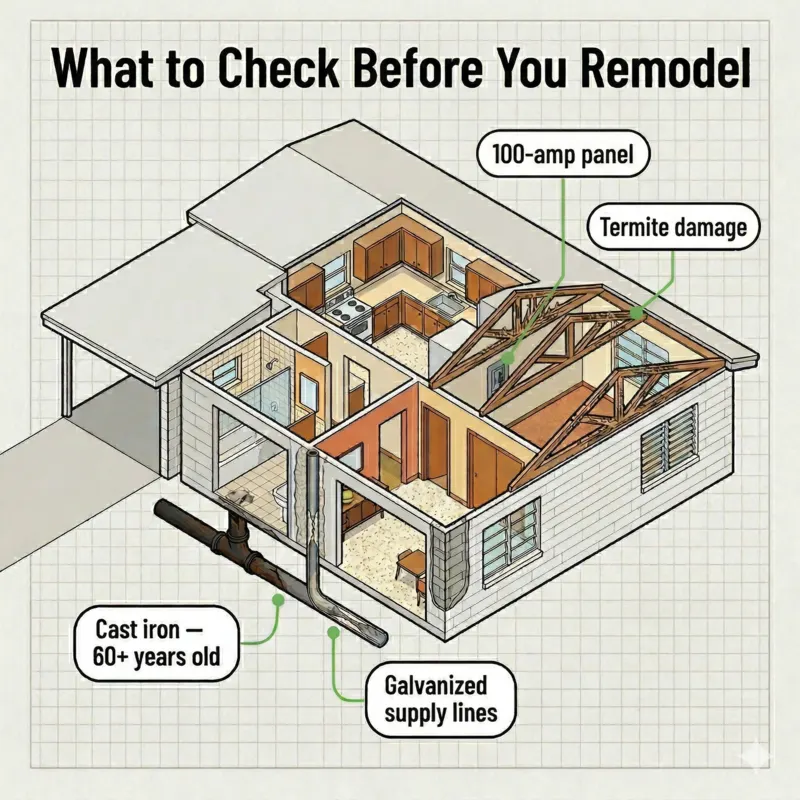
What the remaining 5-10% covers: hidden conditions (cast iron drain lines that turn out to be collapsing, pre-1978 lead paint or asbestos discovered during demo, structural surprises in 100-year-old framing) and client-driven changes during construction. From Jeremy on the variance drivers: “Things that would influence that would be the condition of the property and obviously any underlying issues that are hidden from us in the pre-construction phase. And then, of course, any changes that a client makes along the way.”
Older Pinellas housing stock concentrates these hidden conditions. If you own a 1920s bungalow in Old Northeast, a 1950s ranch in Crescent Lake, or a 1960s concrete-block ranch in Shore Acres, the pre-construction process should include a plumbing camera scope and a lead/asbestos test before the budget gets locked. We schedule those in Phase 1-2 for older homes specifically.
Talk To Us About Sequencing Your Remodel
Call (727) 888-6161. We'll walk your property and map the realistic feasibility-to-permit-to-mobilization timeline before you commit to anything.
Phase 4: Permitting Timelines (St. Pete-Specific)
Permit timelines in Pinellas County depend on (a) the jurisdiction (City of St. Petersburg vs. unincorporated Pinellas County vs. one of the beach municipalities) and (b) the project size and scope. Jeremy on the specifics:
“A small project might take between three and five weeks in permitting, and then up to potentially four to six months for a custom new build that has multiple clarifications and comments that need to be addressed by the building department. A large addition/remodel project between $100,000 and $500,000 is typically going to take one to two months in and out of permitting.”
Translated to project-type expectations (see our St. Petersburg home addition service for the full addition-scope permit and construction shape):
| Project type | Typical St. Pete permit timeline |
|---|---|
| Kitchen permit | 2-5 weeks |
| Bathroom permit | 2-5 weeks (plus shower-pan inspection) |
| Addition permit (under $100K) | 3-5 weeks |
| Large addition/remodel ($100K-$500K) | 1-2 months |
| Custom new build | 4-6 months |
| Historic district add-on (any project) | +2-4 months for HARC review |
| HOA add-on (condo/community) | +1-2 weeks |
Process steps inside the permit phase:
- City portal setup for the application. From Jeremy: “we are creating an application for permit with the city assuming it's city of st pete we have to open up a portal for them that takes a few days.” That's a multi-day setup before the application even submits.
- Notice of Commencement filing with the permit packet. Required Florida-statewide; sets the formal legal relationship between contractor and homeowner.
- Plan review + comments. Building department sends comments back; the architect or our office responds. Each comment cycle adds 1-2 weeks.
- Permit issued. From Jeremy on what happens immediately after: “Once the permit comes through, depending on who needs to be mobilized in the first stages, it's generally within a week or so we're going to be on site working — whether that's demo, site work for new foundation, getting ready for the masons and foundation guys.”
St. Pete-specific factors that extend the timeline:
- Historic district properties. Old Northeast, Old Southeast, Roser Park, Kenwood, Granada Terrace, Driftwood, parts of Crescent Lake. From Jeremy: “In the actual historical areas, there is an additional level of review for permitting that in St. Pete is extremely inefficient... very easily adds two to four months, and possibly more if there needs to be any sort of variance or board hearing that accompanies the application.” The historic review board issues a Certificate of Appropriateness (COA) before the building permit application can move forward. See our historic renovation service hub for the full HARC process.
- FEMA flood zones. If your renovation triggers the FEMA 50% rule (improvements over 50% of the structure's assessed value), the permit becomes a substantial-improvement permit and the entire structure has to be brought to current flood code — including elevation to base flood elevation. That changes the project scope significantly. Common in AE zones in Shore Acres, Snell Isle, and parts of Old Northeast; VE zones on the beaches.
- HOAs. From Jeremy: “Most HOAs require an application and want to see the permit before work starts — adds a week or two but mostly an annoyance.”
Phase 5: The Office-to-Field Handoff Meeting
Most homeowners don't know this meeting happens. It's the single most important pre-construction event at Revolution and it's invisible to anyone who isn't inside the company.
Jeremy on the field walk: “Sandwiched in toward the end of pre-construction, we're also going to do a field walk with our supervision. That's going to be our project manager, our general superintendent who is responsible for all project smoothness, and then our on-site superintendent that will be dedicated to that project, responsible for day-to-day building and operations. So that'll usually have the clients plus four or five of us attending, and that's late in the pre-construction phase.”
Why 4-5 of us, in person, on your jobsite, before construction starts? Because, from Jeremy: “It essentially functions as a handoff meeting from the office — the sales guys, the estimating — to the field crew that's going to actually carry off the project.”
Who's in the room:
- The clients (you).
- The project manager — the office-side owner of the budget, schedule, and selections.
- The general superintendent — Jay, who oversees all of our active jobsites and is responsible for project smoothness across the whole company.
- The on-site superintendent — the day-to-day field lead dedicated to your project specifically.
- Often one of the partners (Jeremy or Thad) for larger projects.
Why this is load-bearing: it's the moment where everything the office promised gets translated to the field crew that has to deliver it. It's where the gap between “what was sold” and “what gets built” gets closed before it can open.
Reference for our field structure (per Jeremy): “the company itself is divided kind of roughly into field operations, office operations and sales and marketing... we're all from the field operations, which is controlled by Brent. And then Jay's underneath him as a general, kind of a general manager, general superintendent, loosely, and then superintendents under them.” Four superintendents on the field side, 20+ W-2 carpenters and apprentices in-house. Your field walk pulls 3-5 of them at once.
Other Phase 5 milestones, sequenced after the field walk:
- Notice of Commencement executed with the permit packet.
- Large vendor + material deposits billed by the office.
- Permit pickup (often within days of the field walk if everything's tracking).
- ~1 week mobilization after permit pickup before active site work begins.
Phase 6: Construction + Weekly Client Review
Construction is the longest phase but the one with the clearest cadence. The single most important standing event during construction is the weekly client call.
Jeremy on the cadence: “How often do we meet with clients during the project? If a client is in town and invested in the project, there are usually going to be multiple meetings and conversations per week. We endeavor to have a standing weekly call with each client each week in order to review the budget — the actuals of the project versus the budget — to make sure we're staying on track, that we're not having any surprises. If there are any changes that need to happen, any unforeseens, any client decisions that need to be affected that will affect the budget or the timeline, those are discussed at that point.”
What happens on the weekly call:
- Actuals vs. budget review. Every line item on the budget is shown with this week's actuals. Open-book — you see what we paid the framing sub, what materials cost, what our hours are.
- Variance discussion. Anything off-track gets explained in the meeting, not in a surprise invoice three weeks later.
- Change-to-scope decisions. From Jeremy: “Because we use a time materials contract, we've shifted our process away from using formal change orders and we're just using a change to scope. We're still identifying what that looks like and is called formally, but essentially we are touching base with the clients.” No paperwork friction — change-to-scope decisions get logged in BuilderTrend with contemporaneous client acknowledgment so there's an audit trail.
- Upcoming-week preview. Which trades are on site, when, what decisions you'll need to make.
Jeremy on the call structure: “So really looking for one 30,000-foot conversation per week, typically handled by the superintendent. If there are larger concerns, more strategic concerns, or any issues that a client has, that conversation is going to be had by either the project manager or one of our partners.”
Construction phase sequencing for a whole-home remodel (per Jeremy): “Phasing is demo, then foundation and framing changes, MEPs (mechanical, electrical, plumbing), windows, doors, roof, then drywall and finishes.” That sequence is mostly fixed; what varies is the duration of each phase.
Billing cadence: biweekly (every 2 weeks). From Jeremy: “the expectation is that our billing cycle runs every couple, two weeks or so, depending on the project.”
End-of-project sequence:
- Punch list triggered by the on-site superintendent when remaining work is “billable last bits, not warranty work” (Jeremy's framing).
- Internal walkthrough by management before the client final walk.
- Client final walkthrough — the last check-off before close-out.
- One-year bumper-to-bumper warranty on workmanship from final walk; appliance and fixture warranties stored in our database for client access.
One last thing worth saying out loud, in Jeremy's words: “Any time that we've gotten into trouble, had a project go badly, had a relationship go badly with a client, the issues always can be traced directly back to communication. Homeowners should be honest with themselves about how they want to be involved in the project and then make sure they pick a contractor that's able to meet them on those same terms.” That's not a checklist item. It's the pre-checklist question.
Frequently Asked Questions
How long does a home remodel take from first call to break-ground in St. Petersburg?
Realistic floor for a small project (kitchen or single-bath remodel) is about 10-14 weeks: 1-3 weeks of pre-construction feasibility, 4-6 weeks of simple drafting + selections, 3-5 weeks in St. Pete permitting, and ~1 week of mobilization after permit pickup. Realistic ceiling for a large addition or whole-home remodel is 7-10 months: feasibility, 3-6 months for stamped plans with structural engineering, 1-2 months in Pinellas County permitting (longer in historic districts — add 2-4 months for HARC review), then mobilization.
What's the 75% rule on a Revolution remodel budget?
By the time pre-construction wraps and the project moves into construction, roughly 75% of line items are confirmed absolutely on cost — materials, vendor orders, and subcontractors quoting on a fixed not-to-exceed basis. Per Jeremy: “That 75% really brings our budget up to about 90 to 95% of certainty of accuracy with the final budget.” The remaining 5-10% covers hidden conditions (cast iron drain lines, lead paint, asbestos, structural surprises) and any client-driven changes during construction.
How are permits handled in Pinellas County and the City of St. Petersburg for a residential remodel?
We open a portal application with the City of St. Petersburg (multi-day setup), submit the permit packet with the Notice of Commencement, and respond to plan-review comments. Typical timelines: kitchen permit 2-5 weeks, addition permit 3-5 weeks (under $100K) or 1-2 months ($100K-$500K), custom new build 4-6 months. Historic district properties (Old Northeast, Old Southeast, Roser Park, Kenwood) add 2-4 months for HARC review. HOA-governed properties add 1-2 weeks for HOA permit-application review.
How does Revolution handle changes to scope during construction?
Because we use a Time & Materials contract, we've shifted away from formal change orders to what we call change-to-scope. Decisions get logged in BuilderTrend with contemporaneous client acknowledgment so there's an audit trail. Every change-to-scope item is reviewed during the standing weekly client call alongside actuals vs. budget — no surprise invoices three weeks later. T&M open-book pricing makes this work; fixed-bid contractors typically have to run formal change-order paperwork and re-bid every change.
What's actually the most important question to ask a contractor before signing?
Per Jeremy: “Any time that we've gotten into trouble, had a project go badly, had a relationship go badly with a client, the issues always can be traced directly back to communication. Homeowners should be honest with themselves about how they want to be involved in the project and then make sure they pick a contractor that's able to meet them on those same terms.” That's the question. Not “how many crews do you have” or “what's your insurance.” How do you want to be involved — and can this contractor meet you there?
Talk To Us About Sequencing Your Remodel
We'll walk your property, map the realistic feasibility-to-permit-to-mobilization timeline, and give you a scope and budget before you commit to anything.
Related Articles
- Cast Iron Plumbing in Older Homes: What St. Pete Homeowners Need to Know
- Lead Paint and Asbestos in Older Homes
- FEMA 50% Rule in Florida: What Homeowners Need to Know
- Time & Materials vs. Fixed-Price Contracts
- Home Building Checklist: Your Complete Guide
- 1970s Ranch Home Remodel Guide
- Whole-Home Remodel in St. Pete: Sequencing & Phasing
Our Home Remodeling Services
Ready to put this sequencing into action? Revolution Contractors is a St. Petersburg general contractor specializing in whole-home renovations across St. Petersburg and Pinellas County — from pre-war bungalows to mid-century ranches to waterfront condos. We handle pre-construction feasibility, design coordination with independent architects, permitting, the office-to-field handoff, and construction with weekly client review.
Explore the service hub or call (727) 888-6161 to schedule a property walk.