How Much Does a Bathroom Remodel Cost in St. Petersburg, FL? (Real 2026 Pricing)

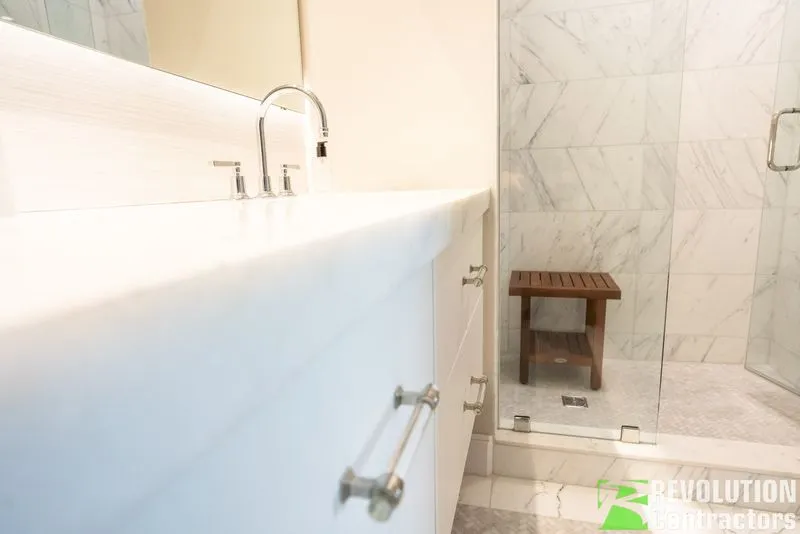
A bathroom remodel in St. Petersburg is a scope-defined renovation of an existing home’s primary or secondary bath: ranging from a cosmetic surface refresh (tile / fixtures / paint) to a full gut with layout change, Schluter Kerdi waterproofing, upgraded MEP, and frameless-glass enclosures. Pinellas County requires permitted work for plumbing relocations, structural changes, and electrical upgrades under the Florida Building Code Residential (Chapter 27 electrical + Chapter 4 plumbing). Historic-district properties in Old Northeast and Roser Park may also require Certificate of Appropriateness (COA) review before permit issuance.
A bathroom remodel in St. Petersburg typically costs between $20,000 and $70,000 depending on scope, and the full bathroom remodel price range runs from $20,000 for a cosmetic facelift on a 5x7 guest bath to $100,000+ for a luxury master with heated floors and custom millwork. A mid-range master bath renovation, new layout, Schluter Kerdi waterproofing, frameless glass, upgraded vanity, lands between $40,000 and $70,000. Those aren’t national averages pulled from a content-farm database. They’re what Revolution Contractors actually bills on projects across Old Northeast bungalows, Shore Acres waterfront homes, Snell Isle waterfront, and downtown St. Pete condos.
Below we break down exactly what drives those ranges: by scope, by component, by cast iron condition, and by the hyper-local factors that generic cost guides miss entirely. Every number here maps back to real St. Pete jobs run under our open-book Time & Materials model, with 20+ W-2 carpenters doing the framing, tile, and waterproofing in-house. No paper-contractor padding, no subbed-out “crew” you’ve never met.
Ready to skip the reading and get a real number on your bathroom? The Revolution bathroom remodel page is the fast path: free 48-hour estimate, Schluter Kerdi standard, open-book T&M. For the day-by-day schedule side of the same project, see the bathroom remodel timeline.
What Determines Your Bathroom Remodel Cost
The single biggest variable is scope: are you updating surfaces and fixtures (a facelift), or gutting the room back to studs and starting over? The gap between those two paths is where 70% of the bathroom remodel price spread lives.
A facelift keeps the existing layout. Same drain locations, same wall framing, same footprint. You’re replacing tile, swapping the vanity, upgrading to a Mansfield or Kohler toilet, new fixtures, maybe converting a tub to a walk-in shower in place. Plumbing and electrical rough-in stay where they are. Permit scope is minor, often just a plumbing permit with one or two mid-construction inspections.
A full gut changes everything. Walls come down. Drains move. On slab-on-grade homes (most St. Pete construction), the concrete gets saw-cut to recess new drain lines. Framing changes to accommodate new niches and a curbless shower pan. Every mechanical system gets touched: supply PEX rough-in, waste and vent reconfiguration, fresh electrical circuits, exhaust ducting, new insulation where walls opened up. As our owner Jeremy puts it: “A bathroom has every system a house can have packed into a small area, so it’s the most expensive room per square foot except for a very high-end kitchen.”
That’s why the price can double from a facelift to a full renovation, even in the same size bathroom. A 5x7 facelift at $22,000 and a 5x7 full gut at $45,000 look identical in photos. What you’re paying for is everything behind the drywall.
Bathroom Remodel Cost by Scope (2026 St. Petersburg Pricing)
Here’s how Jeremy describes the realistic budget range, in his own words: “For a 5x7 bathroom facelift it might be $20-25 grand at the basement for a simple tile setup, replacement of a tub without anything fancy, and probably a vanity out of the box. Depends a little on the plumbing and electrical in place. There’s always an expectation that some of the plumbing supply is going to have to get changed out. From that basement of $20-30 grand for a 5x7, it goes up from there: we’ve had six-figure bathrooms with big Roman tubs, heated tile, body squirters, fogged glass, the whole nine yards. A realistic budget for a master bathroom in St. Pete is $40-70 grand. If we have to create a bathroom where there isn’t one, that’s probably $75-80 grand because all the plumbing has to get pulled in.”
That budget map breaks down by scope as follows:
| Project Scope | Typical Cost Range | What’s Included | Timeline |
|---|---|---|---|
| Cosmetic Facelift (5x7 standard) | $20,000–$30,000 | New tile, tub replacement, box vanity, standard fixtures, paint. Layout stays. | 4–6 weeks |
| Mid-Range Master Bath | $40,000–$70,000 | Layout changes, custom tile to ceiling, frameless glass shower, semi-custom vanity, Schluter Kerdi waterproofing, permit + mid-construction inspections. | 8–14 weeks |
| New Bathroom (where none existed) | $75,000–$90,000 | Full PEX rough-in from stack, new waste and vent, full framing, subfloor to ceiling, full permit set. | 12–16 weeks |
| High-End Luxury Master | $100,000+ | Roman tubs, heated tile floors, body jets, steam shower, custom millwork vanity, fogged smart glass, premium plumbing trim throughout. | 16–20+ weeks |
Ranges include labor and materials for a single standard-size bathroom in a Pinellas County home. They don’t include extensive structural work, cast iron replacement below the slab, or load-bearing wall relocations: each of those is a cost adder described below. They also don’t include outside design fees; Revolution offers design-build, so design coordination is part of our process at no separate line item.
Cost Breakdown by Component
Not every bathroom dollar weighs the same. Here’s where the money actually lands on a typical mid-range master bath remodel ($50K scope) in St. Pete:
| Component | Typical Cost Range | What Drives the Price |
|---|---|---|
| Tile (supply + installation) | $8,000–$20,000 | Coverage (floor + shower walls + tub surround + accent niche), tile size, pattern complexity, wall height. Usually the largest single line item. |
| Cabinetry & Vanity | $3,000–$12,000 | Stock vs. semi-custom vs. custom. Single vs. double vanity. Quartz vs. granite vs. marble top. |
| Plumbing (rough-in + fixtures) | $4,000–$10,000 | New fixture locations cost 2–3x swapping in place. Mansfield basic toilet vs. Toto Washlet. Delta vs. Brizo/Kohler trim. Cast iron replacement is separate (see below). |
| Electrical | $1,500–$4,000 | Recessed LED lighting, heated floor mat circuit, vanity sconces, exhaust fan upgrade, GFCI outlets. |
| Shower Glass | $1,500–$4,000 | Frameless costs 2x framed. Custom shapes add. Low-iron “ultra-clear” glass adds 25–40%. |
| Waterproofing System | $1,800–$2,800 | Schluter Kerdi over 1/2" Hardie backer (our standard) or a Wedi board system. DensShield for lower-exposure walls. Failed shower pans are the most expensive mistake in bathroom construction: this is not where you save. |
| Demolition & Disposal | $1,500–$3,500 | Full gut vs. selective demo. Hazmat surcharge for asbestos tile or lead paint in pre-1978 homes (common in Old Northeast, Kenwood, Snell Isle). |
| Permits & Inspections | $500–$1,500 | Plumbing permit, electrical permit, building permit when framing moves. St. Petersburg Building Department turnaround runs 3–5 weeks. |
| Design, Selections, Project Management | Built into T&M | Not a separate fee. Included in the open-book labor line. |
Tile installation is almost always the biggest line. If you’re tiling shower walls floor to ceiling, the floor, a niche, and a tub deck, you’re looking at real square footage of precision cutting around drains, mixing valves, and corners. Large-format porcelain (12x24, 24x48) covers faster with fewer grout lines. Mosaic and penny-round are beautiful but labor-intensive: budget accordingly.
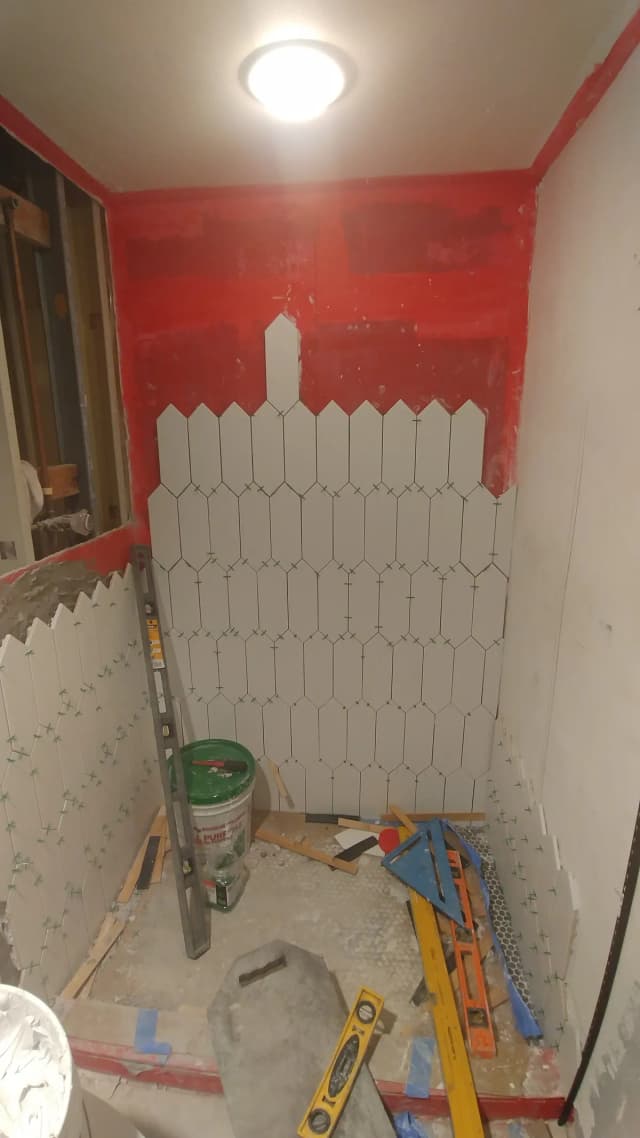
The St. Pete Factor: Local Costs Most Guides Miss
National cost guides don’t account for what makes St. Petersburg bathrooms expensive. Here are the local factors that actually move your bottom line: every one of these comes from jobs we’ve run, not from a content-mill lookup table.
Cast iron drain replacement. If your home was built before the 1970s, and in neighborhoods like Old Northeast, Historic Kenwood, Snell Isle, and Crescent Lake, most were: you likely have cast iron drain pipes. Cast iron corrodes from the inside out. It can look fine on the outside and be 80% closed on the inside. See our cast iron plumbing in older St. Pete homes deep-dive for the full picture.
“We almost always get a camera down the pipes to know what we’re dealing with and tell the story to homeowners,” Jeremy says. A camera scope from a licensed plumber runs $150–$350. It’s the cheapest insurance in bathroom construction. If the cast iron needs replacing, budget an additional $10,000–$25,000 depending on linear footage, slab cutting extent, and whether the stack also needs replacement. On a full-stack replacement in a two-story, numbers can climb to $35,000+.
Slab-on-grade concrete cutting. Most St. Pete homes sit on concrete slabs, not crawl spaces or basements. Moving a drain means saw-cutting the slab, excavating, trenching the new drain line, pouring new concrete, and letting it cure before tile goes down. Each saw-cut run adds $2,500–$6,000 in labor and materials and 3–5 days to the schedule.
Old-home surprise scope. “In a 100-year-old house, we know that there have been four generations of grandpas and dads doing their DIY bullshit work: things we can’t see until we really are doing some destructive demo,” Jeremy says. That’s not a scare tactic. It’s reality on 70% of the pre-1940 homes we open up. Improperly wired outlets buried in walls, plumbing joints held together with flex couplings and hope, framing cuts that were never permitted. These discoveries happen during demo, and under a fixed bid they become change-order battles. Under our T&M model they just become visible line items on the weekly budget report.
Flood zone considerations (Shore Acres, Snell Isle, Venetian Isles, Tierra Verde, barrier islands). Homes in FEMA AE and VE flood zones carry rules that generic contractors don’t know. If your cumulative renovation crosses the FEMA 50% rule threshold, more than 50% of structure market value in a rolling 12-month window, the entire home may need to be brought up to current flood code, including raising finished floor to or above the base flood elevation (BFE). On a bathroom remodel alone that’s rarely triggered, but when a bath is part of a larger multi-room project, the math matters. See Shore Acres home renovation for the neighborhood-specific FEMA detail.
Lead paint and asbestos in pre-1978 homes. Federal RRP (Renovation, Repair, and Painting) rules require EPA-certified containment on any paint disturbance in homes built before 1978. Add $500–$1,500 for containment labor and waste disposal. Asbestos floor tile or mastic? Licensed abatement runs $1,500–$4,500 for a bathroom-sized footprint.
Salt air and humidity durability. Close to the water: Snell Isle, Old Northeast waterfront, Shore Acres, Tierra Verde, the barrier-island beaches. You’re specifying marine-grade fixtures, upgraded exhaust ventilation (minimum 80 CFM, often 110+), and corrosion-resistant hinges and hardware. That adds 8–12% to the fixtures and hardware lines. For relocating buyers building a coastal legacy home, the durability spec stack also intersects FEMA flood-zone rules: a bathroom remodel that crosses the 50% threshold as part of a larger primary-suite renovation can trigger flood-elevation code on the entire structure. That’s an unfamiliar layer for clients new to Pinellas; we walk through it during pre-construction so the scope is clean before demo starts.
The Bathroom Remodel Price Range at a Glance
If you land here looking for one number, here’s the honest version for a St. Petersburg bathroom in 2026:
- $20,000–$30,000: cosmetic facelift on a standard guest bath
- $40,000–$70,000: mid-range master with layout changes and Schluter Kerdi waterproofing
- $75,000–$90,000: a net-new bathroom where none existed
- $100,000+: luxury master with heated floors, custom millwork, premium plumbing trim
Per square foot, St. Pete bathrooms run roughly $450–$1,400/sq ft depending on scope and finish level, with mid-range masters typically landing at $600–$900/sq ft. That’s higher than national averages because bathrooms are the most system-dense room in the house and St. Pete’s older housing stock hides more scope than newer markets.
Ready to get a real number on your bathroom?
We'll walk your space, scope your pipes, and give you a range before any commitment. Call (727) 888-6161 or request your free 48-hour estimate.
How Revolution Prices Bathroom Remodels (and Why It Saves You Money)
Most contractors give you a fixed-price bid. It sounds safe: you know the number up front. The problem is that fixed bids build in padding. The contractor estimates every possible surprise, adds 15–25% contingency for uncertainty, and you pay for worst-case scenarios that may never happen. When surprises don’t materialize, the contractor keeps the padding. When surprises exceed the padding, you get a change order.
Revolution uses a Time & Materials (T&M) model with a 30% markup: stated openly, not hidden in line items. We explain the full mechanics in our T&M vs. fixed-price contracts comparison. The short version for bathrooms:
- Pre-construction sharpening. Before construction starts, every line item gets reviewed. Tile selections get locked, fixture specs confirmed, and real bids come in from our plumbing and electrical subs (the same subs every job, not a rotating cast). By the time demo starts, 75% of your line items are confirmed fixed-price. That gives you 90–95% budget certainty before day one.
- Weekly budget reports. Every week you see exactly where your money went: materials invoices with supplier names, labor hours by carpenter, sub costs, permit fees. All open book. No line item is a mystery.
- You save when things go well. If demo takes three days instead of five, you save two days of labor. Under a fixed bid, the contractor pockets that. Under T&M, that savings is yours.
- Surprises are handled transparently. When corroded cast iron or unpermitted wiring turns up behind a wall, you see exactly what was found, get the options explained in plain language, and get real cost on the fix. No change-order battles. No “we need another $15,000 and we’ll explain later.”
This model works especially well for bathrooms because bathrooms are where surprises live. Every system in the house meets in one small room. T&M means what’s found gets handled honestly: no padding the bid upfront, no cutting corners mid-project to stay under a number, no subcontractor musical chairs. Our 20+ in-house W-2 carpenters handle the demolition, framing, Schluter Kerdi waterproofing, tile, and finish trim. The plumbing and electrical subs are the same licensed crews on every job: we know their work because we see it every day.
What Drives Bathroom Remodel Costs Up (and How to Control Them)
Layout changes. Every drain, supply line, or wall you move adds cost. If your current layout works and you want better finishes, a facelift is dramatically cheaper than a gut. See our bathroom remodel vs. refresh deep-dive for the decision framework.
Tile selection timing. Lock tile choices during the 3–5 week permitting phase, while you’re waiting on the St. Petersburg Building Department, not after construction starts. Changing tile mid-project means reordering, waiting 2–4 weeks for new lead times, and potentially redoing backer board or waterproofing. The rule: finalize selections early.
Scope creep mid-project. “While we’re in here, can we also…” is the single most expensive sentence in remodeling. It’s fine to add scope, but know that mid-project additions cost 20–40% more than planning them from the start because they disrupt sequencing and often mean redoing work already finished.
Material lead times. Specialty porcelain (large-format Italian, encaustic), custom frameless glass, imported fixtures (Brizo Litze, Kohler Artifacts premium trim): anything not in stock locally adds 3–8 weeks of wait time. A stalled project still costs money because you’re paying for superintendent oversight and site protection even when nobody’s cutting tile.
Cast iron or old galvanized water lines. If a pipe needs replacement, it needs replacement. Don’t try to avoid it to stay under budget: you’ll be back in 3–5 years doing it under worse conditions.
Ways to keep costs down without sacrificing quality:
- Keep the layout. Same drain locations, same walls = less PEX rough-in, less framing, less concrete cutting. This alone can save $5K–$12K.
- Choose standard tile sizes. 12x24 and 24x48 large-format porcelain covers fast with fewer grout lines. Mosaic is beautiful but adds labor hours.
- Prioritize where it matters. Spend on the Schluter Kerdi or Wedi waterproofing system (lifetime warranty: this is not where you save), shower tile, and plumbing rough-in. Save on paint-grade trim, accent lighting, and standard cabinetry hardware.
- Scope the pipes first. A $150–$350 camera scope tells you exactly what you’re dealing with before demo. If cast iron has to go, you budget for it on day one instead of as a surprise in week three.
- Batch with an adjacent project. If you’re doing the primary suite, adding an en-suite closet refresh or hallway linen cabinet while walls are open costs a fraction of doing it standalone.
Bathroom Remodel ROI: Is It Worth the Investment?
Bathroom remodels typically return 50–70% of their cost at resale in the St. Petersburg market, depending on scope and housing comp. Mid-range bathroom renovations are consistently one of the top-performing home improvements for resale value. For the full data pull with Pinellas-specific comps, see bathroom remodel ROI in Florida.
But here’s a more honest answer: design your bathroom for how you actually live, not for a hypothetical future buyer. If you never take baths, don’t install a freestanding Victoria + Albert because a design magazine said it adds value. If you shower every day, that’s where the money should go: high-quality tile, solid Schluter Kerdi waterproofing, fixtures that feel good to use for the next 15 years.
Jeremy’s take: “A bathroom should first and foremost be a study in utility: let luxury be based on budget and sensibility.”
The real return on a bathroom remodel isn’t just the resale math. It’s walking into a room you use every single day and not being frustrated by it. As Jeremy describes what drives most projects: “When we see people talking about a bathroom, it’s generally because the bathroom is so old and crappy that it just drives them crazy every time they look at it. Instead of doing their daily duties in a place of peace, all they see is crappy dated tile, delaminating cabinetry and countertops, peeling paint with smears all over them.”
What Is the Cheapest Bathroom Remodel in St. Petersburg?
A cosmetic refresh on a standard 5x8 guest bathroom is the entry point for a cheap bathroom remodel in St. Petersburg, running $8,000 to $14,000 when the layout stays put, plumbing rough-in doesn’t move, and finishes stay standard-grade. That’s the honest floor for a licensed general contractor working under permit: anything cheaper is DIY, unpermitted, or a paper contractor with no accountability.
Here’s where a refresh budget actually goes:
- Vanity swap: $800–$2,500 for a standard 30”–36” vanity with a cultured marble or basic quartz top. Same footprint, same plumbing.
- Tile floor replacement: $1,800–$3,500 for standard 12x24 porcelain over a 5x8 footprint including labor, thinset, and grout.
- Fixture replacement: $600–$1,800 covers a Mansfield or American Standard toilet, Delta faucet set, and standard shower trim swap-out.
- Paint and small hardware: $400–$900 for walls, ceiling, trim, and switching out hinges, pulls, and towel bars.
Understand the tier ladder before you shop: refresh is $8K–$14K on a 5x8 guest bath (finishes only, no plumbing moves), cosmetic facelift is $20K–$30K on a 5x7 (adds tub-to-shower conversion or vanity relocation without moving drains), and mid-range full remodel is $40K–$70K (layout changes, gut back to studs, new Schluter Kerdi waterproofing throughout). For the decision framework on which tier fits your project, see our bathroom remodel vs. refresh deep-dive.
How Can I Remodel a Bathroom on a Budget in St. Pete?
Six tactical moves protect a small bathroom budget in St. Petersburg: keep the layout, choose large-format porcelain tile, prioritize the waterproofing system over trim, batch with adjacent projects, scope the pipes with a $150–$350 camera before demo, and lock selections during the 3–5 week permit window. Every one of those moves protects the money that would otherwise disappear into schedule slippage, mid-project change orders, or catastrophic water damage down the line.
- Keep the layout. Same drain locations, same walls, same footprint = less PEX rough-in, less framing, less concrete cutting. This alone can save $5K–$12K on a full remodel.
- Choose large-format porcelain tile. 12x24 and 24x48 covers fast with fewer grout lines and less labor. Mosaic accents are beautiful but each square foot of mosaic takes 3–5x the install time of large-format field tile.
- Prioritize the Schluter Kerdi or Wedi waterproofing system. Lifetime warranty. Prevents $15K–$40K in future water damage repair. This is not where you save: failed shower pans are the single most expensive mistake in bathroom construction.
- Batch with an adjacent project. If you’re doing the primary suite, adding an en-suite closet refresh or hallway linen cabinet while walls are open costs a fraction of doing it standalone later.
- Scope the pipes first. A $150–$350 camera scope before demo tells you exactly whether cast iron drains are shot. If they need replacement, that goes on the day-one budget instead of surfacing as a week-three surprise that stalls tile install.
- Lock selections during the 3–5 week St. Pete permit window. Every tile, fixture, and vanity decision made before demo eliminates a mid-project change order. Selections finalized late are the single biggest driver of budget creep.
- Choose budget-tier product spec deliberately. Mansfield toilet ($150–$300) instead of Toto Washlet ($1,200–$3,500). Delta trim ($200–$450) instead of Brizo Litze ($800–$1,800). Those swaps alone save $1,500–$3,500 on a mid-range remodel without any drop in reliability.
What Is the Minimum Bathroom Remodel Budget in Florida?
The absolute floor for any bathroom remodel in Florida is $8,000 to $10,000. That floor is set by four line items that don’t shrink no matter how tight the budget: permit fees ($500–$1,500), Schluter Kerdi waterproofing ($1,800–$2,800), contractor mobilization and site prep ($1,500–$2,500), and code-required GFCI plus ventilation upgrades ($800–$1,500). Add tile, a vanity, and fixtures on top of those and you land at the $8K–$10K floor before you’ve upgraded anything.
Why is cheaper than $8,000 not possible with a licensed general contractor? You’re paying for the same trades in a smaller footprint. A 5x8 guest bath still needs a full plumbing rough-in, a permitted electrical circuit, code-compliant ventilation, waterproofing behind the tile, and the same three-inspection permit sequence (rough plumbing, mid-construction, final) that a 12x14 master gets. Cutting any of those isn’t saving money: it’s creating future liability.
Schluter Kerdi is non-negotiable regardless of budget. Skipping it or substituting a cheaper waterproofing system to save $1,500–$2,500 today is the single most expensive decision a bathroom-remodel budget can make. Failed shower pans destroy framing, subfloor, and downstream ceilings. Full repair after a five-year water intrusion failure runs $15,000–$40,000. The math is unforgiving: $2,500 spent on Kerdi today prevents up to $40,000 in damage tomorrow.
The Revolution Bathroom Remodel Process
Here’s what a typical project looks like from first call to final walkthrough. For the full day-by-day schedule view, see our bathroom remodel timeline for Florida homes.
1. Consultation (1–3 weeks from first call). Your bathroom’s scope gets assessed on site: cosmetic refresh or full gut. We evaluate the plumbing stack, floor joist direction (critical if drains need to move), ventilation routing, and age-relevant risks (cast iron, lead paint, asbestos mastic). You’ll leave with a realistic cost range and a clear next step.
2. Design (2–4 weeks). Your layout gets developed with our in-house design coordination or vendor-assisted design. Tile selection, fixture selection, vanity and cabinetry specification, lighting plan. If ADA accessibility is in the plan now or for the future, that gets planned from day one rather than retrofitted. Budget conversations happen during design, not after, so you’re never surprised by what your selections cost.
3. Pre-Construction (3–5 weeks, overlaps design tail). Your estimate gets sharpened: real costs nailed down on every line item. Tile and fixtures ordered against lead times. Sub bids locked in from plumbing and electrical. Selections locked during permitting so nothing stalls construction.
4. Permitting (3–5 weeks, runs parallel with pre-construction). Plumbing, electrical, and building permits submitted to the St. Petersburg Building Department. Shower pan inspection (the waterproof membrane pressure test under your shower tile) is a bathroom-specific mid-construction inspection that trips up DIY and paper-contractor jobs. Revolution handles all permit submission, plan review responses, and inspection scheduling.
5. Construction (4–16 weeks depending on scope). The sequence: demolition, framing (if layout changes), rough-in (PEX supply, waste and vent, electrical circuits, exhaust ducting), mid-construction rough inspection, Schluter Kerdi waterproofing installation, shower pan inspection, tile (floors and walls), frameless glass measurement and install, vanity and cabinetry, paint, plumbing trim, and punch list. Final building inspection closes the permit.
Our 20+ W-2 carpenters handle the finish carpentry, tile, framing, and Schluter Kerdi waterproofing in-house, not a rotating crew of subs you’ve never met. For more on why that matters, see questions to ask before hiring a contractor and design-build vs. traditional contractor.
Janet Anderson, a recent bathroom client, put it simply: “The easiest, most stress free renovation I have experienced.” She praised the communication, sub management, and budget adherence throughout the project.
Frequently Asked Questions
How much does a full bathroom remodel cost in St. Petersburg?
A standard 5x7 bathroom cosmetic refresh runs $20,000–$30,000. A full master bath renovation typically lands between $40,000 and $70,000. Adding a net-new bathroom where none exists costs $75,000–$90,000 because all PEX supply, waste, and vent has to be pulled in from scratch. Luxury master builds with heated floors, premium trim, and custom millwork push $100,000+. The biggest cost drivers are tile coverage, whether plumbing locations move, and the condition of existing cast iron drains.
What is the most expensive part of a bathroom remodel?
Tile installation is typically the single largest line item: $8,000–$20,000 on a mid-range master. Per square foot, bathrooms are the most expensive room to remodel because every building system (plumbing, electrical, waterproofing, ventilation, structural) is packed into a small space. On a 5x7 to 10x12 master, tile alone can hit 40% of the total project cost depending on coverage and material specification.
How long does a bathroom remodel take?
A cosmetic facelift takes about 4–6 weeks of construction. A full master bathroom renovation with layout changes runs 8–14 weeks. Add 3–5 weeks for St. Petersburg Building Department permitting before construction starts, plus 3–5 weeks of pre-construction planning. Total timeline from first meeting to final walkthrough: 3–6 months depending on scope. See our full bathroom remodel timeline for the day-by-day view.
What are the hidden costs of a bathroom remodel in St. Pete?
The biggest surprise in older St. Pete homes is cast iron drain replacement: corroded pipes typically add $10,000–$25,000. Slab-cutting for drain relocation adds $2,500–$6,000 per run. Lead paint or asbestos containment adds $500–$4,500 depending on scope. And in pre-1940 homes, decades of unpermitted DIY work behind the walls routinely create unexpected electrical and structural fixes. A $150–$350 camera scope before demo catches the plumbing surprises early.
Do I need a permit for a bathroom remodel in St. Petersburg?
Any plumbing or electrical changes require permits from the St. Petersburg Building Department. Cosmetic work, new tile, paint, replacing a vanity without moving plumbing, does not. If framing moves or load-bearing walls change, a building permit with a structural engineer stamp is required. Shower pan inspection is a bathroom-specific mid-construction inspection requirement. St. Pete permitting currently runs 3–5 weeks from submission to issued permit.
What causes bathroom remodel budgets to go over?
The most common causes: corroded cast iron drains that need replacing mid-project, slab cutting for drain relocation on layouts that looked “simple” on paper, tile or fixture selection changes after work has begun, and scope creep once walls are open (“while you’re in here…”). Revolution’s T&M pricing model handles surprises transparently: you see every cost on the weekly budget report the moment it happens, rather than getting hit with a lump-sum change order at the end. That’s the whole case for T&M over fixed-price on bathrooms specifically.
Is it worth it to remodel a bathroom?
Bathroom remodels return 50–70% at resale in the St. Petersburg market, making them one of the strongest home improvement investments. But the real value is daily quality of life: you use your bathroom every day for the next 10–20 years. Design for how you live now, not for a hypothetical future buyer. The full ROI breakdown is in bathroom remodel ROI for Florida homes.
Should I replace my tub or switch to a walk-in shower?
Design around how you actually use the space. If you never take baths, don’t build a tub. Freestanding tubs look great in photos but many go unused: similar to the 1980s jacuzzi tubs that became maintenance liabilities. If accessibility matters now or in the future, a curbless walk-in shower is both practical and adds value. On a concrete slab, converting to curbless requires saw-cutting the slab to recess the drain: budget an additional $2,500–$6,000 for that detail.
How is a small bathroom remodel different in cost?
Small bathrooms (roughly 5x8 and under) don’t scale down proportionally. A 5x8 bathroom still needs a full plumbing rough-in, waterproofing system, ventilation, lighting, and permit set, just in a smaller footprint. Expect $18,000–$40,000 for a full 5x8 remodel. For space-planning ideas in this footprint, see 5x8 bathroom remodel ideas.
Financing, ROI, and Insurance: Common Bathroom Remodel Cost Questions
Can I finance a bathroom remodel in St. Petersburg?
Most Florida homeowners finance St. Petersburg bathroom remodels through a home equity line of credit (HELOC), a cash-out refinance, or an unsecured home improvement loan. HELOCs typically run 8-11 percent variable rate on recent Bankrate-tracked averages for FL borrowers with strong credit; unsecured personal loans run higher (10-15 percent). Contractors like Revolution structure payment schedules around draw milestones (deposit, rough-in, close-in, final) that match how HELOC advances typically release funds: verify current rates with a lender before finalizing the finance path. See our St. Pete construction financing overview.
What credit score do I need for a bathroom remodel loan?
Most home equity products (HELOC, home equity loan) require a minimum FICO score of 620-680 with 15-20 percent equity in the home. Cash-out refinances typically want 620+. Unsecured home improvement personal loans go higher: 680-700+ for the best rates. If credit is tight, open-book Time & Materials billing works with the lender's draw schedule so the homeowner is only advancing funds against completed and invoiced work, not a lump-sum contract price. Talk to your loan officer before signing a contract.
How much does a bathroom remodel add to my home's value in St. Petersburg?
Bathroom remodels in Tampa Bay return 55-70 percent of cost at resale on average per Remodeling Magazine's Cost vs Value Report regional data, meaning a $40K mid-range bath adds roughly $22K-$28K to resale value. Primary bathrooms in coastal Pinellas neighborhoods (Snell Isle, Old Northeast, Shore Acres) often see higher returns because visibly dated primary baths slow sale timelines on $750K+ homes. The remaining 30-45 percent is enjoyment value over the years you'll live in the home.
Is a bathroom remodel worth it before selling?
A pre-sale bathroom remodel usually pays off when the bath is visibly dated (avocado tile, 1980s pink porcelain, cracked cast iron tub) and comparable listings in the neighborhood are moving with updated baths. A $20K-$30K cosmetic refresh on the primary bathroom often supports a $40K-$60K listing-price lift on St. Petersburg $500K-$800K homes. Full guts before sale rarely pencil out: the ROI recovery gap is 45+ percent on comparable work. Talk to your Realtor before choosing scope.
Does bathroom remodeling affect flood insurance in St. Petersburg?
Bathroom remodels in coastal Pinellas AE or VE flood zones interact with the FEMA 50 percent rule: if cumulative construction cost (bathroom + any other recent improvements) exceeds 50 percent of the pre-improvement structure value inside the 5-year rolling window Pinellas uses, the entire home has to be brought to current flood code. A $60K bathroom gut on a $700K home is well under the threshold in isolation but can be the trigger scope on top of prior work. Below base flood elevation, all materials must be flood-resistant per FEMA: no drywall, no wood cabinetry. Discuss with your contractor before scoping.
Do I need to notify my homeowners insurance about a bathroom remodel?
Yes: Florida homeowners policies typically require notification of any renovation exceeding a stated dollar threshold (often $5K-$10K), and mid-construction claims can be denied if the carrier wasn't notified in advance. During construction, the carrier may adjust dwelling replacement-cost coverage and require Builder's Risk coverage on the contractor. After completion, update the policy to reflect the new replacement cost: an increase in dwelling value that isn't on the policy can leave you underinsured at claim time. Call your agent before demo starts.
What's the price per square foot for a bathroom remodel in St. Petersburg?
St. Pete bathroom remodels run $400-$500 per square foot on cosmetic facelifts (5x8 refresh at $18K-$22K = ~$450 psf), $600-$900 per square foot on mid-range primary bath renovations (10x14 at $60K-$90K = ~$550 psf), and $1,000-$1,500+ per square foot on high-end primary bath guts with custom cabinetry, curbless showers, and premium fixtures. Fixed square-foot benchmarks are less useful on bathrooms than on other rooms: plumbing rough-in doesn't scale linearly with area.
How much does a small bathroom remodel cost in St. Petersburg?
Small bathrooms (under 40 sq ft, typically 5x6 or 5x8 half baths and guest baths) run $15,000-$28,000 for a full gut in St. Petersburg. Cosmetic-only refreshes (vanity swap, tile floor, fixture replacement, no plumbing rough-in changes) can drop to $8,000-$14,000. The floor of the range is set by permit and inspection fees, contractor mobilization, and the fixed cost of pulling the same trades that a bigger bathroom uses. Even a small bathroom needs the full Schluter waterproofing membrane, code-compliant venting, and GFCI-protected receptacles.
Key Takeaways
- A bathroom remodel in St. Petersburg costs $20,000–$100,000+ depending on scope: cosmetic facelifts start at $20K, mid-range master bath renovations run $40–70K, luxury masters exceed $100K
- Tile installation is the largest single cost on most projects; cast iron drain replacement ($10–25K) is the biggest surprise cost in older St. Pete homes
- A $150–$350 camera scope before committing to a budget is the cheapest insurance in bathroom remodeling
- Revolution’s T&M pricing with 30% markup and weekly budget reports gives 90–95% cost certainty without the padding of a fixed bid
- 20+ W-2 carpenters handle demolition, framing, Schluter Kerdi waterproofing, and tile in-house: no rotating subs
- Lock tile and fixture selections during the 3–5 week St. Pete permitting window to avoid construction delays
- Design for how you actually use the bathroom, not for a hypothetical future buyer
Bathroom Permit Process in St. Petersburg
Any bathroom work that touches plumbing, electrical, or framing requires a permit from the St. Petersburg Building Department under the 2023 Florida Building Code (8th Edition; the 9th-Edition rollout takes effect January 2027). Cosmetic work: tile replacement, vanity swap in the same footprint, fixture trim-outs, paint, flooring over existing subfloor, usually does not need a permit. The line: if the pipe, wire, or framing doesn’t change, you generally don’t need a permit. If any of those change, you do.
What Triggers a Permit
- Plumbing: Moving supply lines, relocating a drain, adding a new fixture, replacing a water heater, or replacing a shower valve when the wall is being opened.
- Electrical: Adding circuits, GFCI outlets in new locations, heated-floor circuits, recessed lighting that didn’t exist before, or upgrading the exhaust fan with new wiring.
- Structural changes: Removing a wall (load-bearing or not: the city still wants to see it), enlarging a doorway, expanding the bathroom footprint, or moving a window.
- Window or exterior door changes: Any change to an exterior opening.
Common Permit Gotchas
- Like-for-like tub-to-shower conversions still trigger a permit, even if the drain stays put, the shower pan, waterproofing, and valve replacement are considered plumbing work. Pinellas wants eyes on it.
- Moving a toilet two inches is still moving a toilet. Any drain relocation, no matter how small, is permitted work.
- Adding a new GFCI outlet to a bathroom without one is new electrical. Old bathrooms often have one ungrounded outlet (or none). Adding code-compliant GFCIs is a permit item.
- HOAs can require their own approvals in addition to the city permit. Downtown condos especially: HOA review happens before the city permit and it can take longer. See our HOA-approved condo renovations work.
- Flood-zone homes have extra review. If your bathroom project crosses the FEMA 50% substantial-improvement threshold in an AE zone, expect flood-plain review in addition to the standard building permit.
Inspection Sequence on a Full Remodel
- Rough plumbing inspection. After new drains and supply lines are set, before walls are closed. Inspector checks pipe slope, venting, fittings, and pressure test.
- Rough electrical inspection. After new wiring is pulled, before drywall. Inspector checks box fill, GFCI locations, grounding, and circuit layout.
- Framing inspection. If structural changes were made. Inspector checks headers, blocking, and any new wall construction.
- Insulation inspection. If insulation was added in exterior walls.
- Drywall / close-in inspection. After all rough inspections pass, walls get closed.
- Shower-pan / final waterproofing inspection. A mid-construction water test on the Schluter Kerdi (or Wedi) membrane before tile goes down. This is the bathroom-specific inspection that trips up DIY and paper-contractor jobs.
- Final inspection. After all finishes are installed. Inspector checks fixture installation, GFCIs, exhaust fan operation, permanent connections, and overall code compliance.
Each inspection is scheduled separately. Missing one means the next trade can’t proceed. St. Pete permits are legally supposed to be same-day for minor work; in practice, plan on 3 to 5 weeks from application to issued permit for a full bathroom remodel. HOA approvals on top of that can add another 2 to 4 weeks for condos. Permit fees run $500 to $1,500 depending on scope. Skipping the permit shows up in three places eventually: at closing when you sell the house, during a homeowner’s insurance claim, and during any future permitted work that requires historical compliance.
Bathroom Challenges in Older St. Pete Homes
National cost guides miss everything that makes St. Petersburg bathrooms different. Here’s what actually matters in this market: every item here comes from jobs we’ve run, not from a content-mill lookup table.
Cast iron drain stacks. In Old Northeast, Historic Kenwood, Snell Isle, Euclid-St. Paul’s, Crescent Heights, and most pre-1970 St. Pete neighborhoods, homes were built with cast iron drains. Cast iron corrodes from the inside out: it can look solid from the outside and be nearly closed on the inside. We camera-scope the stack before demo starts on any older home. It’s a $150–$350 investment that prevents a $20,000 surprise. As Jeremy Wharton puts it: “On any remodel of any size, that cast iron gets replaced because the best time is now while walls are open. There’s nothing wrong with cast iron if it’s in great shape: it’s strong when new, but 50 years of Drano and high-pH solvents cause rust and cracking.”
Galvanized supply lines. Same era, same problem. Galvanized pipes choke with mineral buildup. Water pressure drops. Eventually they leak at the threads. If we’re already in the walls, that’s the time to replace them with PEX or copper, not a year after the remodel is finished.
Plaster walls. Old St. Pete homes weren’t built with drywall. They were built with plaster over wood lath. Plaster is harder to repair, harder to cut cleanly, and denser to demolish. If your bathroom still has original plaster, expect the demo phase to take longer and the framing prep to involve more work than a modern drywall build.
Vintage tile and hazmat. Pre-1980 bathrooms sometimes have asbestos-backed vinyl flooring or lead paint under the current finishes. If the test comes back positive, abatement has to happen before demo can proceed. It’s manageable: we’ve done it many times, but it’s a line item that needs to be budgeted.
Slab-on-grade foundations. Most St. Pete ranches and mid-century homes sit directly on a concrete slab. Moving a drain means cutting the slab, trenching for new pipe, and pouring new concrete. Homes on crawl space (common in Old Northeast bungalows) are easier: you work from underneath. See our historic home renovation in Old Northeast work for context.
Single-bathroom bungalows. Many Kenwood and Old Northeast bungalows have exactly one bathroom. When you remodel your only bathroom, you need a relocation plan: you can’t live without a functioning toilet for 4 to 14 weeks. Jeremy: “Typically those people are not going to stay in the house. From a client’s perspective, that project means going off-site. For us, on any project of any size, we rent a porta potty so our employees and subs have a bathroom to use.”
Neighborhood-Specific Bathroom Cost Notes
Neighborhood-specific conditions drive 10-30% cost variance above the base numbers.
Historic Core (Old Northeast, Historic Kenwood, Old Southeast, Euclid-St. Paul’s, Crescent Lake)
1912-1945 bungalows and Mediterranean/Craftsman styles. Cast iron drains, galvanized supply, original 5x7 bathrooms often the only bathroom in the house. National Register (Historic Kenwood) and Granada Terrace historic district affect exterior scope only, not interior bathroom work. Add $10,000-$20,000 if cast iron replacement is needed. See our historic renovation work and the cast iron plumbing deep dive.
Waterfront (Snell Isle, Shore Acres, Venetian Isles, Coquina Key, Tierra Verde, Bahama Shores)
AE and VE flood zones. Substantial-improvement bathroom scope triggers FEMA 50% rule review when cumulative construction cost crosses 50% of pre-improvement structure value over a rolling 5-year window in Pinellas. Below base flood elevation, all materials must be flood-resistant (no drywall, no wood cabinetry). Salt-air-rated marine fixtures, PVD-coated hardware, and upgraded exhaust ventilation add 8-12% to the fixtures line. Snell Isle waterfront estates commonly run $890K+ home values and luxury master-bath scopes. See Shore Acres, Snell Isle, and our FEMA flood-zone construction overview.
Mid-Century and Ranch (Jungle Terrace, Pasadena, Bear Creek, Roser Park)
1950s-1970s slab-on-grade construction on larger lots. Galvanized supply has often already been replaced, but original pink, blue, or green tile is everywhere. Two-bathroom layouts are typical, so households can keep functioning during construction. Drain relocation requires slab-cutting at $2,500-$6,000 per run. Median home values run lower than the coastal or historic tiers, so cosmetic-refresh scopes ($20-30K) dominate here.
Downtown Condos and High-Rises
HOA approval comes before the city permit, and the building approval is usually longer than the permit. Elevator reservations, noise windows, and water-shutoff coordination all get scheduled with building management before demo. The slab is shared with the unit below, so any drain change requires structural review. Waterproofing is non-negotiable because a leak affects other owners. We’ve done 30+ high-rise bathroom projects. Jeremy: “We’ve had to schedule elevators: one downtown building after COVID had a service elevator shared with dog owners that kept malfunctioning, so carpenters dragged tools 28 flights of stairs up and down. All that time is billed to the owner because it’s not our fault.” Walk through the HOA approval process or see our downtown high-rise condo remodels hub.
What Changes by Home Type
Every St. Pete house presents a different bathroom problem. A 1920s bungalow is not a 1980s ranch, and neither is a downtown condo. Here’s what actually matters by home type.
Pre-1980 St. Pete Homes (Bungalows, Historic Kenwood, Old Northeast)
Cast iron drains, galvanized supply, plaster walls over wood lath, and original 5x7 footprints, often the only bathroom in the house. Knob-and-tube wiring and 60-amp fuse panels show up during demo more often than homeowners expect. Camera-scope the stack before quoting because cast iron looks solid from the outside and can be nearly closed on the inside.
Mid-Century and Ranch Homes (1950s-1980s)
Slab-on-grade means any drain relocation requires cutting concrete. Galvanized supply is often already replaced, but original pink, blue, or green tile is everywhere. Most still run on 1970s electrical panels. Two-bathroom layouts are typical.
Downtown Condos and High-Rises
HOA approval before city permit. Elevator reservations, noise windows, water shutoff coordination. Slab shared with the unit below, so any drain change requires structural review. Waterproofing is non-negotiable because a leak affects other owners.
Waterfront and Flood Zone Homes (Shore Acres, Snell Isle, Tierra Verde, Bahama Shores)
FEMA substantial-improvement rule changes what you can and can’t do once a renovation crosses 50% of structure value. Ground-floor bathrooms in AE flood zones have different rules than upper-floor bathrooms: mechanicals get elevated, finishes have to be flood-resistant.
Commercial and ADA Bathrooms
Different code, different inspection sequence, different accessibility requirements. Maneuvering clearances, grab-bar placement, lavatory knee space, and door hardware all have to meet the 2010 ADA Standards for Accessible Design. See our dedicated commercial & ADA bathroom service in St. Petersburg and our breakdown of commercial and ADA bathroom remodel costs.
Shower Waterproofing Systems: Schluter Kerdi vs. Wedi vs. Traditional
Florida Building Code Section R702.4 requires shower walls to be waterproofed to a minimum 70 inches above the drain when tile is the finish surface. The shower pan requires either a secondary waterproof liner under the mortar bed or a full-coverage membrane system. Two modern systems dominate high-end St. Pete bath waterproofing:
- Schluter Kerdi (Revolution’s default). A polyethylene sheet membrane applied over cement board or drywall with thinset, creating a fully-bonded waterproof surface behind the tile. Carries a lifetime transferable warranty. Seams seal reliably. Allows for more precise tile installs in corners and floors than the old thick membrane with hospital corners. Jeremy: “Most of our bathrooms use the Schluter system for shower waterproofing. That adds a couple thousand dollars but gets a lifetime warranty and is a far superior product.”
- Wedi. A foam-core waterproof panel system that replaces cement board entirely. Installs slightly faster because there’s no separate membrane step. Revolution’s preferred spec for curbless and wet-room builds.
- Traditional cement board with topical liquid membrane (Redgard or similar). The legacy method. Meets Florida Building Code when installed correctly, but the seams are where failures show up over time. We don’t recommend traditional mud-set showers without a full waterproof membrane on any St. Pete bath at any price point: Gulf humidity and coastal moisture load makes membrane-based systems the standard-of-care spec.
Cost delta between Kerdi and Wedi is under 10% on a typical St. Pete bath. The math on why waterproofing is non-negotiable: $2,500 spent on Schluter Kerdi today prevents $15,000-$40,000 in water damage repair over a 15-year ownership window. Failed shower pans destroy framing, subfloor, and downstream ceilings.
Curbless (Zero-Threshold) Shower Cost Detail
Curbless showers (also called zero-threshold or barrier-free) and wet rooms require linear drains, recessed framing, a sloped subfloor, and full waterproofing, typically a Schluter Kerdi sheet membrane or Wedi panel system across the shower zone and into the surrounding floor. Waterproofing runs continuous from shower floor up the walls to at least 6 inches above the flood level, and out onto the bathroom floor 3-6 feet from the shower opening. The room exhaust fan capacity is sized up to handle the larger wet zone.
Cost premium over a curbed shower of the same dimensions:
- New construction: $2,000-$5,000 premium.
- Retrofit into existing bathroom over a slab: $5,000-$15,000 premium: the slab has to be cut for the drain and the sub-floor has to be lowered.
- Tub-to-curbless conversion: $8,000-$18,000 for a standard bathroom depending on shower size, drain relocation, waterproofing system, tile selection, and whether existing framing needs rebuilding.
Curbless is the default choice for aging-in-place bath conversions. Planning grab-bar blocking, curbless entry (36+ inch opening), comfort-height toilets (17-19 inches), and task lighting during framing runs $8,000-$18,000 in adds vs a straight bath remodel; retrofitting later runs $18,000-$35,000 because framing has to be opened for blocking. See our aging-in-place service and the aging-in-place modifications guide.
Bathroom Remodel Trends: Worth It vs. Think Twice
Worth the investment
- Curbless showers. A single-plane floor between the bathroom and the shower. Cleaner look, easier to clean, aging-in-place ready. Works best in new framing or slab-cut remodels where the drain can be lowered.
- Large-format tile. 12x24 or larger on walls cuts grout lines dramatically. Faster to install on straight walls, looks modern, reads as luxury.
- Natural stone for accent walls and niches. Marble slab and quartzite wet walls look better in person than any engineered alternative. Sealed properly, they hold up.
- Heated tile floors. Electric radiant mats under the tile. Modest cost add ($800-$2,500 depending on size), huge quality-of-life upgrade in the morning.
- Dedicated linen and vanity storage built in. Custom millwork in the walls rather than freestanding furniture. Makes a small bathroom feel bigger.
Think twice
- Body-jet systems with digital controls. Overcomplicated. Expensive. More things to break. The single best showerhead from a reputable brand will serve you longer.
- Freestanding soaker tubs in small bathrooms. They look great in magazines. They eat floor space. If you’re not actually going to use the tub, a larger walk-in shower is the better call.
- Trendy colors on permanent finishes. Navy vanities and sage green tile are having a moment. Permanent finishes should outlast trends: keep the color in paint, art, and textiles.
- Smart mirrors and shower speakers built into the wall. Nice until the electronics fail in five years and the wall has to come apart to replace them.
Why a GC Beats a Bathroom Showroom
Showrooms sell fixtures and tile. General contractors build bathrooms. They’re different businesses with different risk tolerances, and the difference matters most when something unexpected happens behind the wall.
A bathroom touches every system in your house: plumbing, electrical, structural framing, waterproofing, and HVAC for the exhaust. Showroom installation crews are tile-and-fixture specialists. When the wall opens and there’s cast iron rotted at the closet flange, a load-bearing surprise, or framing damaged by a slow leak, the project stops while they figure out who to call.
Revolution coordinates your bathroom under one open-book budget with 20+ W-2 carpenters on payroll. The crew that started your bathroom is the crew that finishes it. Permit accountability matters too: showroom installers often pull under the homeowner’s name, which means the homeowner carries the inspection risk if anything fails. Revolution pulls under Revolution’s contractor licenses (CRC1331628 + CGC1522463). We carry the risk. See our approach to questions before hiring a contractor.
If your bathroom remodel is a same-footprint tile-and-vanity swap, a showroom installer might be fine. If it’s anything more, layout change, plumbing move, older home, condo, flood zone, you need a GC.
Ready to Find Out What Your Bathroom Will Actually Cost?
We’ll walk your space, scope your pipes, check your flood zone status, and give you a realistic range: no obligation, 48-hour turnaround. Revolution Contractors: 20+ W-2 carpenters, open-book T&M pricing, weekly budget reports, Schluter Kerdi waterproofing standard, Florida licenses CRC1331628 + CGC1522463. Renovating St. Pete bathrooms since 2016 from Old Northeast to Tierra Verde. Go to the bathroom remodel page to request your estimate.
Call (727) 888-6161 or request your consultation
Free 48-hour estimate turnaround. Open-book Time & Materials pricing. 20+ W-2 carpenters in-house.
Related Reading
- Bathroom Remodel Services Hub: Full scope of bathroom work, process, and pricing
- Bathroom Remodel Checklist: Pre-project planning checklist
- Bathroom Remodel Timeline (Florida): Day-by-day schedule view
- Bathroom Remodel ROI in Florida: Resale and daily-use return
- Bathroom Remodel vs. Refresh: Gut or facelift decision framework
- 5x8 Bathroom Remodel Ideas: Small-footprint planning
- Commercial Bathroom Remodel (ADA Cost): Commercial scope comparison
- Cast Iron Plumbing in Older St. Pete Homes: Why the pipes matter
- FEMA 50% Rule for Florida Renovations. When bathroom work triggers flood compliance
- T&M vs. Fixed-Price Contracts: Why open-book saves money
- Design-Build vs. Traditional Contractor: Integrated vs. separated process
- Questions to Ask Before Hiring a Contractor: Due diligence checklist
- Shore Acres Home Renovation: Waterfront flood-zone neighborhood guide
- St. Petersburg Service Area: City-wide GC services