ADU Builder Pinellas: Permit Path, Costs, and 2026 Rules

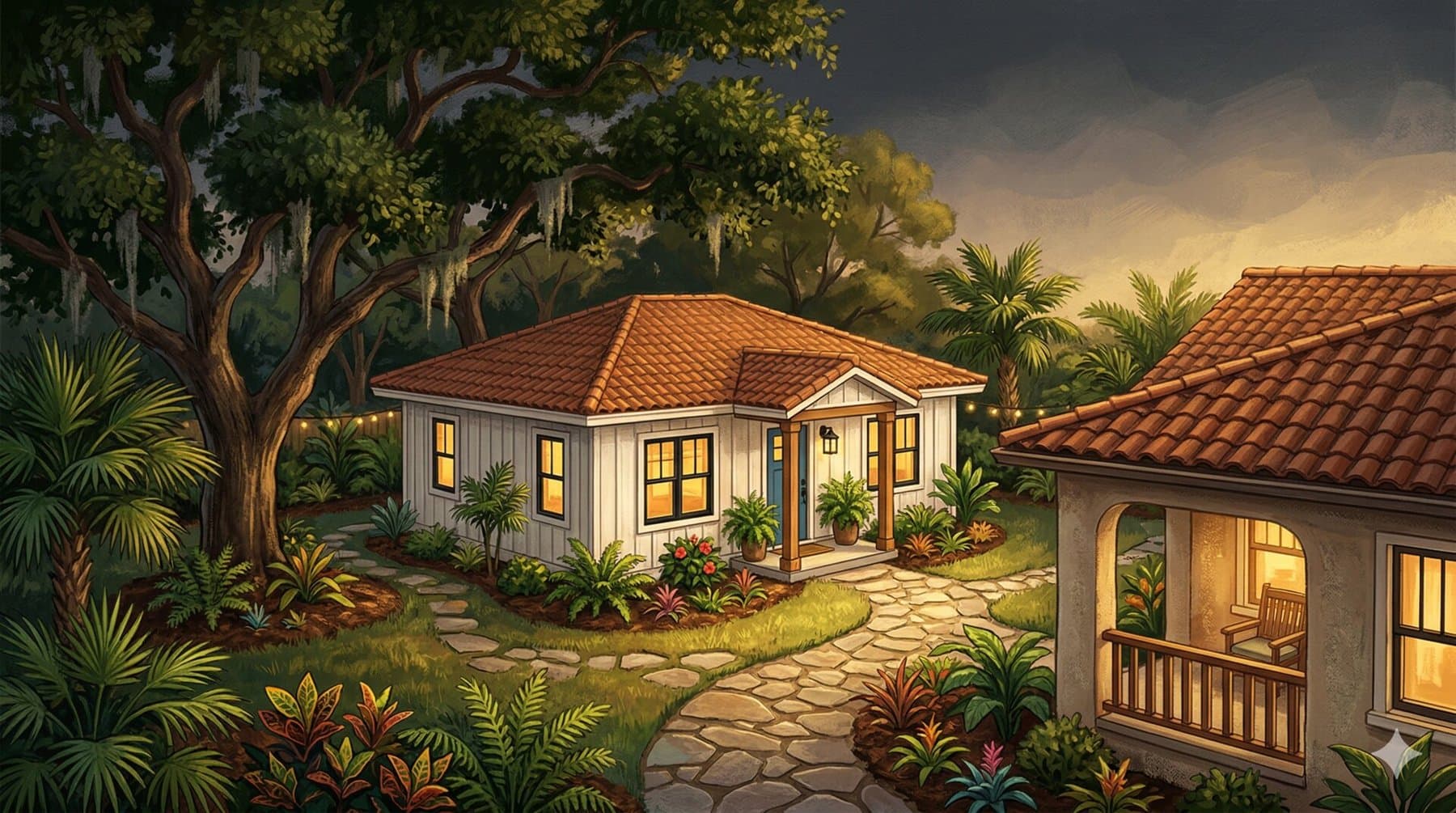
Your mother needs to downsize next spring, your Historic Kenwood lot has a detached garage from 1957 that is one wind event from falling over, and you ran the numbers on an ADU conversion last Thursday night at the kitchen counter. The spreadsheet says $185,000. The builder quote came back at $340,000. The architect wants to pull the garage down and build fresh. The city planner said something about sewer capacity you did not fully follow. That is where most ADU conversations start in Pinellas County.
Accessory Dwelling Units (ADUs) in St. Petersburg and across Pinellas have gone from a workaround for in-law housing to a mainstream build type in the last three years. The city updated its ADU zoning in 2023, Pinellas County extended its own rules in 2025, and the 2026 Florida Building Code tightened a few requirements that affect how ADUs get permitted. This guide walks you through what an ADU actually involves on a Pinellas lot in 2026, what it costs, and the questions worth asking any builder.
What Counts as an ADU in Pinellas
An Accessory Dwelling Unit is a secondary residential unit on a lot that already has a primary single-family home. It can be attached (a converted garage integrated into the main house), detached (a separate structure in the back yard), or an interior conversion (basement or upper-floor apartment, less common in Florida). ADUs have their own kitchen, bathroom, and sleeping area, and they can be rented separately from the main home.
St. Petersburg allows ADUs by right in most residential zoning districts (NT-1, NT-2, NT-3, NT-4) subject to size and setback rules. Pinellas County unincorporated zones follow a similar structure with per-district variations. Clearwater, Largo, and Dunedin each have their own ADU rules worth checking against your specific address.
Four ways an ADU typically gets built:
- Garage conversion. The existing detached garage becomes the ADU. Lowest cost, fastest permit path, but constrained by the original footprint and foundation.
- New detached ADU. New construction in the back yard. Highest flexibility, highest cost.
- Attached ADU. Added to the primary home as a separate unit with its own entrance. Common on larger lots with side-yard room.
- Second-story addition over an existing garage. The garage stays as parking, the ADU sits above. Needs structural upgrades to the garage foundation.
Our ADU mother in law suite guide walks through each approach in detail.
The 2026 Cost Range for a Pinellas ADU
Rough brackets, based on active Rev projects and comparable public records across St. Petersburg and the broader Pinellas market:
- Garage conversion, 400 to 600 sq ft: $140,000 to $220,000
- New detached ADU, 500 to 800 sq ft: $220,000 to $350,000
- New detached ADU with higher finish or specialty foundation (flood zone), 800 to 1,000 sq ft: $320,000 to $485,000
- Second-story ADU over existing garage: $280,000 to $425,000
Those are build-cost ranges. Add soft costs (architect, structural, civil for larger projects), permit fees, impact fees (Pinellas Transportation Impact Fee runs around $4,500 to $6,800 per new residential unit), and sewer connection fees if your lot needs a service upgrade.
For a cleaner cost benchmark on companion builds, see Florida Room Addition Cost and the broader Home Addition Cost Guide.
The 2026 Permit Path for a St. Petersburg ADU
Here is the sequence that actually moves:
- Zoning verification. Confirm your lot zoning district (NT-1 through NT-4 in St. Petersburg, R-R through R-6 in Pinellas County unincorporated) allows an ADU and what the size and setback rules are.
- Pre-design feasibility. A good builder walks the lot, pulls the survey, checks setbacks, verifies utility stub capacity (water, sewer, electrical), and flags any flood zone implications before you spend architect money.
- Design development, 6 to 12 weeks. Architect produces construction documents. Structural engineer if the ADU is above an existing garage or has specialty foundation requirements. Civil if the lot has stormwater implications.
- Permit submission, 2 to 6 weeks review. St. Petersburg Development Review Services or Pinellas County Building Department depending on jurisdiction.
- Permit issuance and foundation start. Slab, stem wall, or elevated foundation depending on flood zone. See our elevated house plans flood zones guide.
- Framing through dry-in, 6 to 10 weeks.
- MEP rough-in, drywall, finish, 10 to 16 weeks. The ADU gets its own electrical panel sub-feed, its own HVAC, and separate plumbing fixtures.
- Final inspection, utility connections, close-out.
Total timeline from signed design agreement to CO: 9 to 15 months for a new detached ADU. 6 to 10 months for a garage conversion.
Flood Zone ADUs
If your lot sits in AE or VE flood zone, ADU foundation rules follow the same path as any new construction in that zone:
- AE: Finished floor at or above base flood elevation plus Pinellas freeboard (1 foot). Stem wall or elevated foundation.
- VE: Finished floor at BFE plus freeboard, driven pile or elevated pile cap foundation. Slab prohibited.
The ADU does not get an exception from flood zone rules. See our AE VE X Flood Zones Pinellas guide and the flood vents R322.2.2 guide for enclosure requirements.
If the primary home is substantially damaged and you are rebuilding under FEMA 50% rules, an ADU can sometimes be rolled into the substantial improvement scope. The math on that is specific to each property. See our FEMA 50% Rule Florida guide.
What to Ask Any ADU Builder
Four things that separate a builder who can finish an ADU on time from one who disappears after demo:
- A real GC license. Jeremy Wharton holds CRC1331628 (residential) and Brent Patterson holds CGC1522463 (commercial unlimited), both verifiable on the Florida DBPR portal. Any builder you consider should be verifiable there too.
- Documented ADU permit history. Not "we did a mother-in-law suite once." Ask for permit numbers, completion dates, and photo documentation.
- In-house labor. Revolution runs 20+ W-2 carpenters on payroll. On a 9-month ADU build, you do not want a builder scrambling for subs every phase.
- A clear position on the design side. Revolution operates design-build as a hybrid: we pair clients with independent architects when the project needs full plans, and we coordinate everything under one contract. For garage conversions and smaller ADUs, we often work from stock plans or in-house drafting.
Our top 9 things to consider when hiring a home addition contractor in St. Petersburg guide applies cleanly to ADU builder interviews.
Related Reading on Rev's Home Addition Hub
Frequently Asked Questions
Can I rent out my ADU on Airbnb in St. Petersburg?
St. Petersburg allows short-term rentals in some zoning districts but prohibits them in others. ADU-specific rules vary by neighborhood. Verify with the City of St. Petersburg Codes Compliance before you plan around rental income. Long-term rentals (30 days or more) are allowed in most districts.
How much does a Pinellas ADU add to my property tax bill?
The ADU gets assessed as additional improved value on your Pinellas County property card. Rough estimate: assessed value increases 60 to 80% of the ADU build cost, and your millage rate applies to that increase. For a $250,000 ADU, expect $2,800 to $4,200 in additional annual property tax at current Pinellas millage.
Do I need a separate electrical meter for my ADU?
No, in most cases. ADUs typically run off a sub-feed from the main house panel. Separate metering is an option but requires utility coordination and adds roughly $3,500 to $6,500 to the project.
Can an ADU be built in a flood zone?
Yes, with the same foundation rules as any new construction. AE zone requires finished floor at or above BFE plus Pinellas freeboard (1 foot). VE zone requires driven pile foundation. See our AE VE X Flood Zones Pinellas guide.
How long does a garage conversion to ADU take?
6 to 10 months from signed design agreement to certificate of occupancy. The existing foundation and shell save roughly 2 months versus new construction, but MEP (plumbing, electrical, HVAC) and finish work still drive the critical path.
What is the minimum lot size for an ADU in St. Petersburg?
Varies by zoning district. NT-1 requires larger lots, NT-4 allows ADUs on smaller lots. Verify your specific zoning through the City of St. Petersburg zoning portal or ask your builder to pull the current rule set.
Can I convert my pool house into an ADU?
Yes, if it meets the zoning setbacks, has independent kitchen and bathroom plumbing, and gets permitted as a dwelling unit (not an accessory structure). Most pool houses need plumbing and electrical upgrades to meet residential code.
Does Revolution handle historic district ADUs?
Yes. Historic Kenwood, Historic Uptown, Granada Terrace, and Old Northeast all allow ADUs subject to Certificate of Appropriateness (COA) review. See our Remodeling Old Northeast St. Pete guide and the historic home restoration guide. Ready for a lot walk and feasibility review on your ADU project? Book a 48-hour project review and we will have a scope conversation, a zoning check, and a realistic cost range on your calendar within two business days.