ADU & Mother-in-Law Suite Additions in St. Petersburg: Costs, Permits, and What’s Actually Allowed

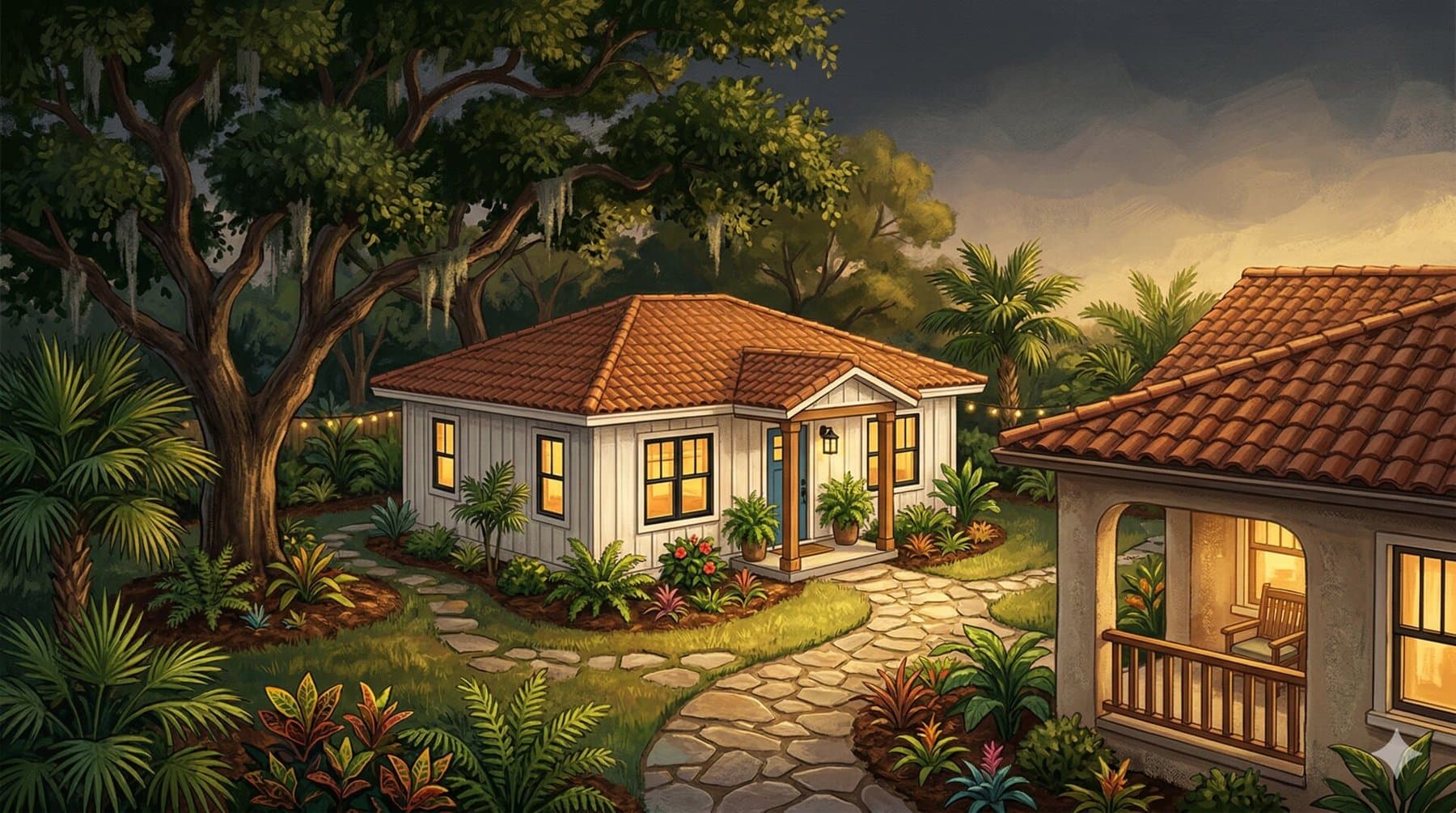
An accessory dwelling unit (ADU) or mother-in-law suite in St. Petersburg typically costs $90,000 to $325,000+depending on whether you’re converting an existing garage, attaching a new wing to your house, or building a fully detached cottage in the backyard. The cheapest path — a garage conversion — starts around $75,000. A ground-up detached ADU with its own foundation, utilities, and finishes usually lands between $200,000 and $325,000. The most expensive variable isn’t the construction. It’s whether your lot is zoned to allow one in the first place.
If you’re considering a custom home addition in St. Petersburgan ADU is one of the highest-leverage projects you can build — aging parents, adult kids, rental income, or a private guest suite all justify the investment. But St. Pete’s zoning code is specific about where ADUs are allowed, how big they can be, and who has to live on the property. Below, we walk through every piece of that puzzle.
What an ADU Actually Is (and What to Call It)
The terminology confuses almost everyone on their first project. Here’s what these terms actually mean:
- ADU (Accessory Dwelling Unit) — A self-contained second living unit on a single-family lot. Has its own bedroom, bathroom, kitchen, and entrance. Legally a separate dwelling, even though it shares a property with the main house. This is the term the city code uses.
- Mother-in-law suite — The casual name for the same thing, though some homeowners use it to describe a bedroom suite attached to the main house without a full kitchen. The legal distinction matters: without a kitchen, it’s usually an addition, not an ADU.
- Granny flat — Same as ADU. More common in California and Australia.
- Casita — Regional term (Southwest, Florida) for a small detached guest house. Usually means a detached ADU.
- Guest house — Can mean an ADU, or can mean a detached room without kitchen or full plumbing. Check your zoning paperwork — the definition is what the city says it is.
Why the difference matters: An ADU is legally a dwelling unit. It triggers its own permits, its own impact fees, and its own setback and parking requirements. A guest suite attached to your main house — bedroom, bathroom, sitting area, no kitchen — is treated as an addition. Same square footage, different rule book, often different cost.
The Four Types of ADU You Can Build in St. Pete
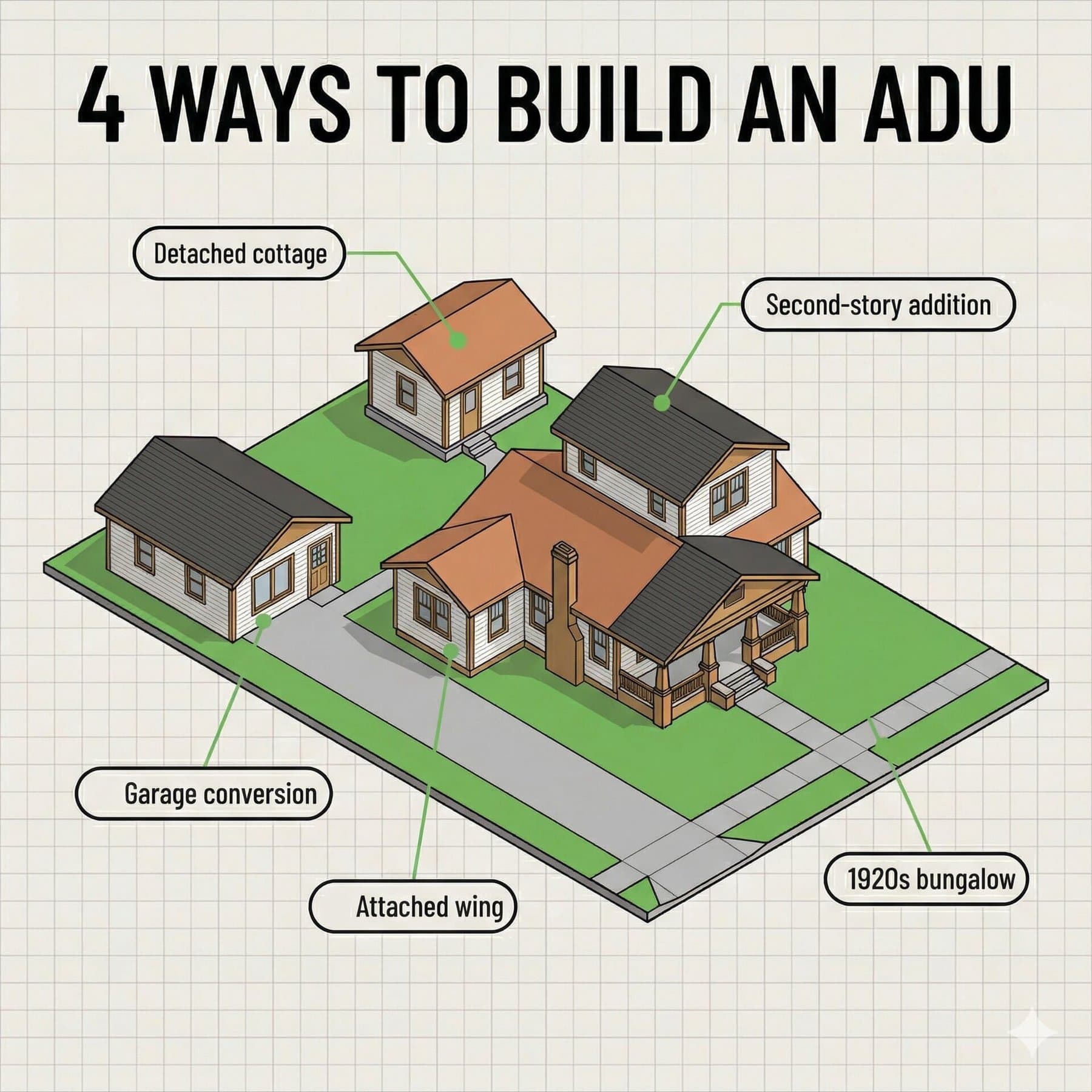
1. Detached ADU (Backyard Cottage)
A standalone structure in your backyard with its own foundation, roof, and utilities. Typically 400 to 1,000 square feet. This is the most expensive option but also the most flexible — you control the design, the privacy level, and the parking layout.
Typical cost: $200,000 to $325,000+ for 500 to 800 square feet
Best for: Long-term family living, rental income, maximum privacy, properties with generous backyards
2. Attached ADU (New Wing Addition)
A new wing built onto your existing house with its own entrance, kitchen, and bathroom. Shares a wall with the main home but functions independently. Sometimes called a “bump-out ADU” when it projects off the back or side of the house.
Typical cost: $175,000 to $275,000 for 500 to 750 square feet
Best for: Aging parents who need proximity, lots too small for a detached build, homeowners who want to preserve yard space
3. Garage Conversion ADU
Converting an existing attached or detached garage into a legal dwelling unit. The shell already exists, which cuts cost significantly. But you’re adding insulation, HVAC, plumbing, a kitchen, windows, and often a new slab or slab reinforcement.
Typical cost: $75,000 to $150,000 for 400 to 500 square feet
Best for: Budget-conscious projects, homeowners willing to trade parking for living space, lots where adding a structure isn’t allowed
Pinellas County zoning differences — garage-ADU vs. detached-ADU. A garage conversion ADU usually rides the existing structure’s setbacks. If your garage is currently attached to the main house, it inherits the main-house setback envelope (no setback variance needed). If it’s a detached garage already meeting accessory-structure setbacks (typically 5 feet from side and rear lot lines), you can usually convert it without filing for a variance. A new detached ADU built from scratch has to meet those same accessory-structure setbacks plus minimum lot size and maximum size caps — which is why some lots qualify for a garage conversion but won’t accommodate a fresh detached build. We pull the parcel’s setback survey before design to confirm which path is actually open to you.
Cost differential — garage conversion vs. ground-up detached. A garage conversion ADU typically lands $30,000 to $60,000 below an equivalently sized new-construction detached ADU. The conversion runs $75,000 to $150,000 because the slab, foundation, exterior walls, and roof framing already exist; you’re paying for insulation upgrade, HVAC (usually a mini-split), plumbing rough-in, kitchen, electrical panel coordination, and finishes. A ground-up detached ADU at $200,000 to $325,000 carries the full cost of foundation work, framing, exterior envelope, separate utility service runs, and sometimes a new driveway and walkway. The conversion path is the budget-friendly entry point if your existing garage’s footprint, ceiling height, and condition support it.
Why garage conversion ADUs are popular for snowbird rental income. A common pattern in St. Pete: a half-year resident converts the attached garage to a legal ADU, then long-term-rents it out (30+ days, since short-term rentals aren’t permitted in most single-family districts) during the months they’re back north. The lower cost basis ($75K-$150K versus $200K+ for detached) shortens the breakeven window meaningfully. The trade-off: you lose your covered parking, and Pinellas County will reassess the property at the new market value once the certificate of occupancy is issued. We talk through both sides of that trade with every snowbird client at the first design meeting.
4. Second-Story ADU (Above Garage or Main House)
Adding a second story over an existing garage or part of the main house. This is the least common option in St. Pete because most homes here are single-story on slab foundations, and adding a second story requires serious structural engineering to verify the existing walls and foundation can carry the load.
Typical cost: $225,000 to $400,000+
Best for: Homes with existing two-story garages, lots with strict footprint limits, waterfront properties where going up is cheaper than going out
St. Petersburg’s Zoning Reality: Where ADUs Are Actually Allowed
This is where most ADU projects live or die. St. Petersburg’s Land Development Regulations permit ADUs in most single-family residential zoning districts — but the specifics matter.
What’s typically required:
- Zoning district — ADUs are permitted in NS-1, NT-1, NT-2, NT-3, NT-4, and NSM single-family districts. They’re prohibited or restricted in some multifamily and commercial zones. Your property record card or the city zoning lookup tells you which district you’re in.
- Minimum lot size — Most single-family districts require a minimum lot size of 5,000 to 7,500 square feet for an ADU. Smaller lots may not qualify, especially for detached ADUs.
- Maximum ADU size — Usually capped at 750 to 900 square feet, or 40% of the main house’s heated square footage, whichever is less. Garage conversions are generally limited to the existing garage footprint.
- Setbacks — Detached ADUs must meet the same setbacks as other accessory structures: typically 5 feet from side and rear property lines, further for front. Attached ADUs follow the main house’s setback rules.
- Height limit — Accessory structures are usually capped at 15 to 25 feet depending on district.
- Parking — Most districts require one additional off-street parking space for the ADU, though St. Pete has been relaxing this requirement near transit corridors.
- Owner-occupancy — Historically, St. Pete required the property owner to live in either the main house or the ADU. That rule has loosened in recent years but still applies in some overlay districts. Confirm with zoning before you assume you can build one to rent out while living elsewhere.
- Short-term rental restrictions — You generally cannot use an ADU as an Airbnb or short-term vacation rental in St. Pete single-family districts. Long-term rental (30+ days) is usually permitted.
The reality check: Zoning rules change. Before you commit to a design, we pull your property’s zoning record, review any overlay districts, and confirm what’s actually allowed on your specific lot. What worked for your neighbor two years ago may not work for you today.
The Permit Process and Timeline
Once zoning is confirmed, the permit path for an ADU in St. Petersburg looks like this:
- Pre-application meeting (optional but recommended) — Meet with city planning staff to walk through your proposed design. Takes 1 to 2 weeks to schedule. Catches zoning issues before you pay for engineering.
- Design and engineering — Full architectural drawings, structural engineering (especially for detached or second-story builds), site plan with setbacks, utility plans, energy calculations. Typically 6 to 12 weeks.
- Permit submittal — Building permit, electrical permit, plumbing permit, mechanical (HVAC) permit. Notice of Commencement recorded with Pinellas County before work begins.
- Plan review — 10 to 30 business days per Florida statute (HB 267). Resubmittals after corrections take another 5 to 15 days.
- Inspections — Foundation, framing, electrical rough-in, plumbing rough-in, mechanical rough-in, insulation, drywall, final. Each phase must pass before the next begins.
- Certificate of Occupancy — Issued after final inspection, which legally converts the structure to a second dwelling on your lot.
Realistic timeline from first meeting to move-in: 9 to 15 months for a detached ADU. 6 to 10 months for a garage conversion. Attached ADUs land in between.
We handle the permit process start to finish — the city, the county, the inspectors. Permits are part of the job.
What ADUs Actually Cost in St. Petersburg
Here’s what we typically see across the main project types in the St. Pete market:
| ADU Type | Size Range | Typical Cost | Cost per SF |
|---|---|---|---|
| Garage conversion | 400 – 500 SF | $75,000 – $150,000 | $180 – $310 |
| Attached addition ADU | 500 – 750 SF | $175,000 – $275,000 | $290 – $420 |
| Detached ADU (new build) | 500 – 800 SF | $200,000 – $325,000+ | $360 – $500+ |
| Second-story ADU | 500 – 900 SF | $225,000 – $400,000+ | $400 – $550+ |
Where the Money Goes on a Detached ADU
For a 600-square-foot detached ADU in the $225,000 range, here’s a realistic budget breakdown:
| Component | Typical Range |
|---|---|
| Design, engineering, permits | $15,000 – $25,000 |
| Foundation and slab | $12,000 – $20,000 |
| Framing, roof, exterior envelope | $40,000 – $65,000 |
| Impact windows and exterior doors | $10,000 – $18,000 |
| Utility connections (water, sewer, electric) | $15,000 – $35,000 |
| HVAC (mini-split typical) | $6,000 – $10,000 |
| Plumbing rough and fixtures | $12,000 – $20,000 |
| Electrical rough and finish | $10,000 – $16,000 |
| Insulation, drywall, paint | $12,000 – $18,000 |
| Kitchen (cabinets, counters, appliances) | $15,000 – $30,000 |
| Bathroom finishes | $8,000 – $15,000 |
| Flooring and trim | $8,000 – $14,000 |
| Site work, driveway, landscaping | $5,000 – $15,000 |
What drives cost up: Long utility runs from the main house, flood zone elevation requirements, impact windows on every opening, high-end finishes, and any excavation needed for the foundation or utility trenching.
What drives cost down: Sharing utilities with the main house instead of separate meters, staying within 600 square feet to avoid additional code triggers, simple rectangular footprints, stock window sizes, and using the same cabinet and tile vendors as a main-house project running in parallel.
Wondering If Your Lot Can Support an ADU?
We'll pull your zoning, check flood zone status, and walk the site before quoting a single drawing.
Utility Hookups: Separate Meters or Shared?
This decision has real cost implications and it’s worth thinking through early.
Shared utilities (most common for family use):
- ADU runs off the main house’s water, sewer, and electric
- Lowest cost — typically $5,000 to $12,000 in trenching and connections
- You’re responsible for all utility bills
- Not ideal if you plan to rent the ADU long-term, because you can’t separate the tenant’s usage
- Usually allowed if the main house’s panel and water service have enough capacity
Separate meters (for rental ADUs):
- ADU has its own electric meter and sometimes its own water meter
- Cost adds $8,000 to $20,000 depending on pole location and trenching
- Requires coordination with Duke Energy and the city water department
- Clean billing separation for rental tenants
- Can also qualify your ADU for its own homestead or rental property tax treatment
Sewer vs. septic: Most St. Pete properties are on city sewer. If your property is on septic (more common in outlying neighborhoods and some parts of Shore Acres), adding an ADU may require an enlarged drain field or a second system. That’s a conversation with Pinellas County Health Department before you commit to the design. Septic-related site work can add $10,000 to $30,000 to the project.
Florida-Specific Considerations
Hurricane Code
Pinellas County sits in a 145 MPH design wind zone. Every ADU — whether detached, attached, or converted — must meet current Florida Building Code hurricane standards. That means:
- Impact-rated windows and exterior doors (or code-approved shutters)
- Engineered hurricane tie-downs on every rafter and stud connection
- Roof deck attachments that meet the enhanced fastening schedule
- Garage conversion walls must be brought up to current wall-stud and sheathing standards, not grandfathered from the original garage
For a typical ADU, hurricane compliance adds roughly 8% to 15% to construction cost compared to what the same structure would cost in a non-hurricane state. That’s already baked into the cost ranges above.
Flood Zones and FEMA’s 50% Rule
If your property sits in an AE, VE, or AH flood zone — common in Shore Acres, Tierra Verde, Bahama Shores, Venetian Isles, and much of the waterfront — FEMA’s Substantial Improvement rule comes into play.
For a new detached ADUthe lowest finished floor must be at or above Base Flood Elevation (BFE). That can mean a raised slab, piers, or full stem-wall construction — adding $15,000 to $50,000+ depending on how far you’re elevating.
For a garage conversion or attached ADUthe project cost counts toward the 50% rule. If your renovation value (including the ADU work) exceeds 50% of your home’s assessed structural value over a rolling 12-month window, the entire existing structure may need to be brought to current flood code — including elevation. On a 1950s ranch in a flood zone, that can turn a $150,000 ADU into a $400,000 project you didn’t plan for.
We’ve completed more than $10 million in flood zone construction. Before you commit to a budget, we pull your FEMA flood map, check your assessed value, and tell you exactly what the 50% rule means for your property. This is one of those conversations that has to happen early — not after demolition.
Historic Districts
If your main house is in a designated historic district (Old Northeast, Roser Park, portions of Kenwood, Granada Terrace), the historic preservation review board has to approve any new detached structure or exterior modification. That adds 4 to 12 weeks to the front end and sometimes constrains design choices — roof pitch, window style, exterior materials. We’ve done the dance with the review board. It’s not impossible, but it needs to be built into the timeline from day one.
Designing an ADU for the Right Use
The single biggest design question: what’s this ADU for, and for how long?
Aging Parents (Multigenerational Living)
If you’re building for parents who may eventually need accessibility features, design for aging in place from day one. Zero-step entries, 36-inch doorways, curbless showers, grab bar blocking behind bathroom walls, lever door handles, and a primary bedroom and bath on the ground floor. Adding these features during construction costs a fraction of retrofitting later. Our aging in place design approach works just as well for ADUs as it does for main homes.
Rental Income
If the long-term plan is rental, think about privacy (separate entrances, fencing, parking), durability (LVP flooring, quartz counters, simple fixtures), and utility separation. You also want to confirm the legal rental status for your zoning district before you build — some parts of St. Pete allow long-term rentals but not short-term, and that constraint should drive design choices like how the kitchen and living area are laid out.
Guest Suite (Occasional Use)
A guest suite gets used a few weeks a year. That changes the calculus — you can probably skip the full kitchen (if your zoning allows calling it an accessory structure rather than a dwelling unit), share laundry with the main house, and simplify HVAC with a single mini-split. Total cost can drop significantly, though you lose some of the resale value that a true ADU provides.
Rental + Future Use
Many of our clients build ADUs with a short-term plan (rental income now) and a long-term plan (eventual parent or adult-child housing). Design for the more demanding use case. A rental unit built to aging in place accessibility renovation standards serves both purposes. A bare-bones rental built without accessibility features locks you out of the second use.
Why T&M Pricing Makes Sense for ADU Projects
ADUs sit at a sweet spot for budget risk: small enough that scope changes feel dramatic, complex enough that you can’t fully know the cost until you’ve done the engineering, pulled the utility plan, and coordinated with the city.
A fixed-price ADU bid usually includes a 25% to 40% cushion to protect the contractor against surprises — utility runs that cost more than expected, flood elevation requirements that hit after design, permit corrections that require re-engineering. You pay for that risk whether or not the surprises happen.
We use Time & Materials with open-book pricing. You see every material receipt and every labor hour. Weekly budget reports compare actuals to estimates so there’s no end-of-project surprise. By the time we break ground, roughly 80% of cost is locked in because the engineering and permitting are done. The remaining variability comes from real decisions you make along the way — and you get to decide whether each one is worth it.
With 20+ W-2 carpenters on payroll, we also control the schedule. On a detached ADU, we’re not waiting on three different subcontractor crews to stop their other jobs and show up. When we start, we keep moving. That matters even more when the ADU is meant for an aging parent arriving on a specific date.
Ready to figure out what an ADU would cost on your property? Call us at (727) 888-6161. We’ll pull your zoning, check your flood zone, walk the site, and tell you what’s actually possible before you pay for a single drawing.
Frequently Asked Questions
Can I build an ADU or mother-in-law suite in St. Petersburg?
Yes, in most single-family zoning districts, but the specifics depend on your lot. St. Pete allows ADUs in NS-1, NT-1, NT-2, NT-3, NT-4, and NSM districts subject to minimum lot size, maximum ADU size, setbacks, and parking rules. Before committing to a design, confirm your property's zoning district, any overlay restrictions, and whether owner-occupancy rules apply.
How much does an ADU cost in St. Pete?
A garage conversion ADU runs $75,000 to $150,000. An attached ADU addition runs $175,000 to $275,000. A fully detached backyard ADU typically costs $200,000 to $325,000 or more depending on size, finishes, and utility complexity. Flood zone elevation, long utility runs, and historic district reviews can push detached builds well above $325,000.
Can I rent out my mother-in-law suite as an Airbnb?
Generally no, short-term vacation rentals (under 30 days) are not permitted in most St. Petersburg single-family zoning districts, which is where most ADUs are located. Long-term rentals (30+ days) are usually allowed. Before you design for rental income, confirm with city planning what's permitted in your specific district.
Do I have to live on the property to build an ADU?
Historically yes, St. Pete required owner-occupancy of either the main house or the ADU. Some of those rules have loosened in recent years, but owner-occupancy is still required in certain overlay districts. Confirm with city planning before assuming you can build an ADU on a property you don't live on.
How long does it take to build a detached ADU?
Plan for 9 to 15 months from first meeting to move-in. That breaks down roughly into 6 to 12 weeks of design and engineering, 4 to 8 weeks of permit review, and 16 to 24 weeks of construction. Garage conversions run shorter (6 to 10 months total) because the shell exists. Flood zone elevation or historic district review adds 4 to 12 weeks at the front end.
Does an ADU need its own utility meters?
Not required, but recommended for rental use. Shared utilities (main house feeds the ADU) cost less up front but make it impossible to bill a tenant separately. Separate electric and water meters add $8,000 to $20,000 but simplify landlord accounting and can qualify the ADU for its own tax treatment. For family use, shared utilities are usually the right call.
Will an ADU increase my property taxes?
Yes. The completed ADU is assessed at full market value on the next January 1 after the certificate of occupancy. This new value is added on top of your existing assessment, the Save Our Homes 3% annual cap does not shield new construction from full-value reassessment. Talk to the Pinellas County Property Appraiser's office for an estimate before you commit to budget.
Can I convert my existing garage into a legal mother-in-law suite?
Yes, in most St. Pete single-family districts, provided the garage meets setback requirements and you can add the required systems (insulation, HVAC, plumbing, electrical panel capacity, egress windows, impact-rated exterior openings). Conversions typically run $75,000 to $150,000 and take 6 to 10 months. The biggest gotcha: converting your garage eliminates your covered parking, which some districts require be replaced elsewhere on the lot.
What's the cost difference between a garage conversion ADU and a detached ADU in St. Pete?
A garage conversion ADU runs $75,000 to $150,000. A new-construction detached ADU runs $200,000 to $325,000+. That's a $30,000 to $175,000 spread, driven mostly by the fact that the conversion reuses the existing slab, foundation, walls, and roof, you're paying for insulation upgrade, mini-split HVAC, plumbing rough-in, kitchen, electrical panel coordination, and finishes, but not for a ground-up structure. In neighborhoods like Shore Acres, Snell Isle, or the Old Northeast where lot sizes vary widely, a garage conversion is often the only ADU path that makes financial sense. We pull your parcel's zoning, setback survey, and existing garage condition before design to confirm whether conversion is actually open to you.
Related Resources:
- Home Addition Services — Our full design-build approach for custom additions and ADUs
- St. Pete Service Area — City-permitting context for additions and ADUs in Pinellas
- Florida Room Addition Cost Guide — If you’re weighing a sunroom instead of a full ADU
- Whole Home Remodel Guide — When an ADU is part of a larger renovation plan
- 1970s Ranch Home Remodel — Ranch homes often have the lot size and footprint to support an ADU addition
- Aging in Place Services — Accessibility-focused design for multigenerational ADUs
Call (727) 888-6161 or request a consultation online. We’ll walk your property, pull your zoning, and tell you what’s actually possible before you spend a dollar on design.
Planning an ADU or Mother-in-Law Suite?
Call Revolution at (727) 888-6161 or request a free consultation. We'll pull your zoning, check your flood zone, and tell you what's actually possible.