Tear Down, Elevate, or Deep-Remodel? A Florida Flood-Zone Decision Framework
This guide runs the decision math. If you need a contractor who has completed all three paths in Pinellas flood zones, start with our flood-zone contractor page — open-book T&M, in-house 20+ carpenter crew, FEMA compliance in-house.

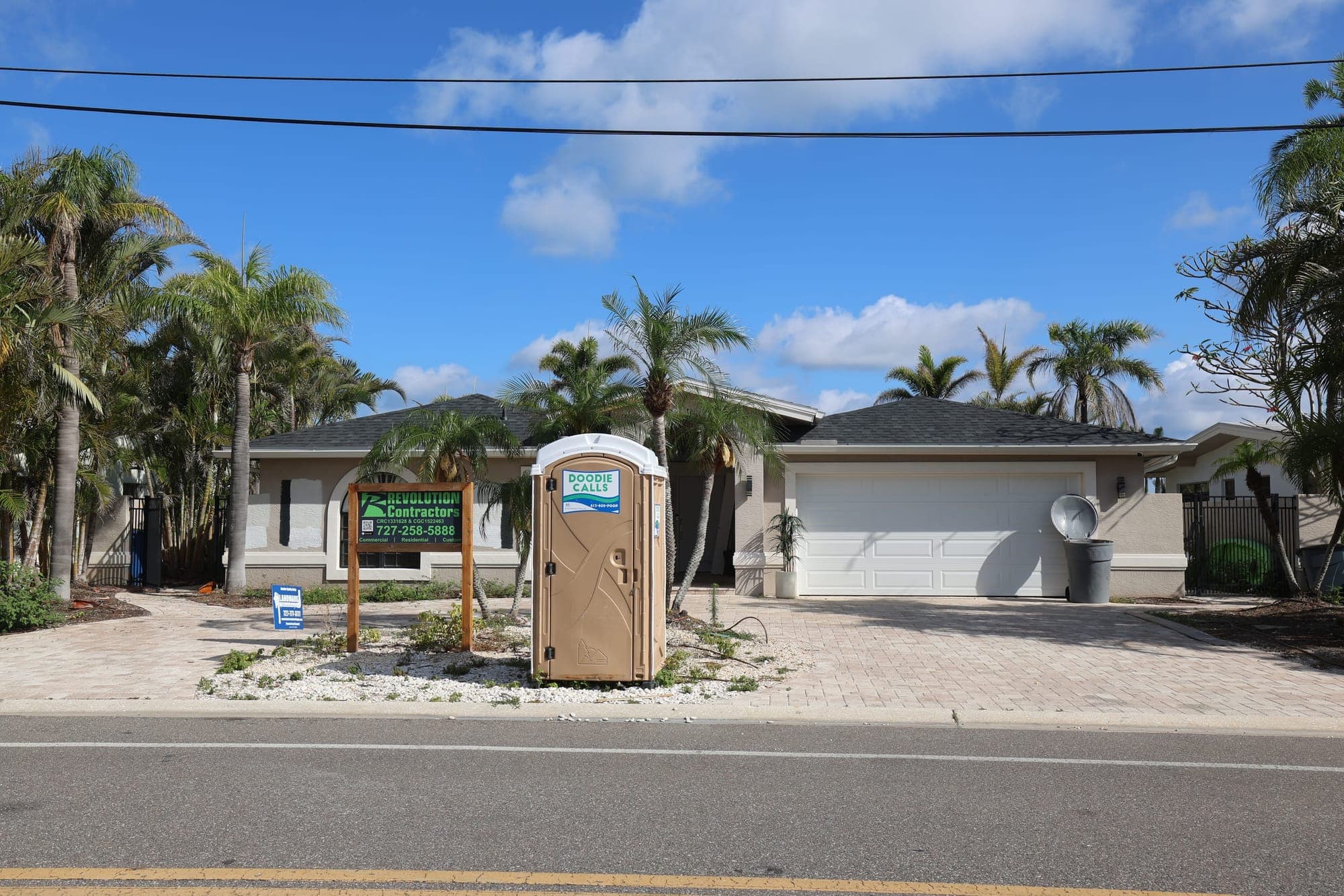
Every Pinellas homeowner with flood damage, an aging structure in an AE or VE zone, or a rising NFIP premium is facing the same three-way decision: deep-remodel in place, elevate and renovate, or tear down and rebuild. The right answer depends on damage percentage, structure value, historic character, grant eligibility, timeline tolerance, and how you actually want to use the property. This guide runs the math for each path.
The Short Version
Three paths. One right answer per property. The 50% Rule sets the gate.
- Deep Remodel In Place — damage under threshold, homeowner staying put, $150-400/sqft, 6-12 months.
- Elevate + Renovate — structure worth preserving, AE/VE zone, $250-500K total, 12-18 months.
- Tear Down + Rebuild — substantial damage over 60% or homeowner wants a different home, $400-700/sqft new build, 12-16 months.
In This Article
The Decision Most Pinellas Homeowners Face After Helene / Milton
If your property is in an AE or VE zone in Pinellas County, the 2024-2025 storm cycle probably delivered one of three outcomes: partial water damage that stays under the 50% Rule threshold, substantial damage that trips the threshold and forces full compliance, or a wake-up call about how much premium exposure you carry on a slab-elevation home. Any of those three creates the same question: what do we do next?
There are three real answers. Deep-remodel in place under the 50% Rule threshold. Elevate the home and renovate above. Tear down and rebuild new. There is also one common wrong path — do the minimum, hope the next storm misses, and defer the compliance decision to a future you. That path stops working the moment the floodplain administrator issues a Substantial Damage Determination higher than 50% of pre-flood structure value.
This guide's job is to run the cost, timeline, regulatory, and financing math for each of the three real paths so the decision stops feeling like a coin-flip and starts feeling like a spreadsheet.
Option A — Deep Remodel In Place
You rebuild what you have without touching the foundation. Storm damage repair plus voluntary renovation, all under the 50% Rule threshold, all in the existing footprint at the existing elevation. The house stays where it is.
When it fits
- Damage under the 50% Rule threshold, or the property was undamaged.
- You are willing to accept continued NFIP premium exposure without post-work elevation relief.
- The existing structure has structural integrity and layout you want to keep.
- You want the fastest path back into your home.
What it costs
Deep remodel in place runs $150-400 per square foot in Pinellas, depending on finish level and how much of the mechanical, electrical, and plumbing systems get touched. A 2,400 sqft deep remodel at $250/sqft is a $600,000 project. Line-item costing matters because everything you spend counts toward the 50% Rule threshold across any rolling 12-month permit window — labor, materials, permits, plans, architect and engineer fees, contractor overhead and profit, site prep, and demolition all count. Land value is excluded.
Timeline
6-12 months typical from permit to certificate of occupancy on a deep remodel. Partial occupancy is possible for some phases — bedrooms and secondary systems may stay functional while the kitchen or primary baths are torn out.
FEMA compliance
Rebuild in existing footprint at existing elevation is permitted under 50% Rule as long as cumulative cost stays below the threshold. No elevation. No BFE upgrade. No breakaway wall requirement. The trade is that the property never gets full compliance relief — future storms can still trigger substantial damage.
Financing
Standard renovation loan, HELOC, or cash. Because there is no elevation work, Elevate Florida grant funding is not eligible, and Increased Cost of Compliance funding under NFIP is not triggered (ICC requires a substantial-improvement or substantial-damage determination).
The risk
You are not future-proofed. The next storm cycle can trigger substantial damage on the same structure, which then forces the elevate-or-rebuild decision again with a shorter timeline and probably worse financing options. Homeowners choosing this path should build a compliance-reserve fund toward the eventual elevation work.
Option B — Elevate + Renovate
You raise the house on a new foundation and renovate above. The existing structure stays, but its relationship to the ground changes — from at-grade or slab elevation to piers, columns, or a stem-wall foundation at or above Base Flood Elevation plus local freeboard.
When it fits
- The home has historic or architectural character worth preserving.
- Structural condition of the existing frame is sound — not storm-compromised beyond repair.
- You qualify for Elevate Florida grant funding (income tier + property eligibility).
- The cost delta from rebuild justifies keeping the existing structure.
What it costs
Elevation cost alone runs $150,000-$300,000 on a standard single- story home in AE zone, higher in VE zone (pile foundation + breakaway wall requirements). Renovation on top of elevation adds $100,000-$200,000 depending on scope. Total elevate-plus-renovate budget is $250,000-$500,000 for most Pinellas projects. See our detailed house elevation cost breakdown for the line-item math.
Timeline
12-18 months typical, with 8-16 weeks of that window as pure elevation work (jacking, new foundation, utility reconnection, structural reconnections). Full displacement required throughout — no partial occupancy during elevation.
FEMA compliance
Full compliance to Base Flood Elevation plus local freeboard (typically BFE + 1 foot in St. Petersburg municipal, higher on some barrier islands). Certificate of Elevation issued at completion. After elevation, the property may qualify for a Letter of Map Amendment to remove it from the Special Flood Hazard Area on the FIRM map, which unlocks lower NFIP premiums or optional flood coverage. LOMA candidacy depends on the finished elevation relative to BFE and requires professional survey documentation.
Financing
The elevation-financing stack has three sources. Elevate Florida grant covers a percentage of eligible elevation costs based on income tier — post-Helene rounds have been at higher percentages than pre-storm program rounds. Increased Cost of Compliance under NFIP pays up to $30,000 toward compliance work when a substantial-damage or substantial-improvement determination has been issued. Homeowner contribution (private flood insurance proceeds, HELOC, or cash) fills the gap. Coordinate all three from day one — retrofitting the stack after work starts creates gaps that get denied.
The risk
Grant approval is not guaranteed. Elevate Florida rounds oversubscribed post-Helene — a strong application filed early beats a perfect application filed late. If you plan the project around grant funding that does not come through, the financing gap can force scope compromise or delayed start. Design review in historic districts adds another layer that can extend the timeline.
For homeowners exploring this path in depth, we run a free elevation feasibility assessment that covers structural evaluation, grant-eligibility screening, and preliminary cost bracketing.
Option C — Tear Down + Rebuild
Complete demolition of the existing structure followed by new construction on the same lot. Foundation, framing, mechanical, envelope, and finishes all built to current Florida Building Code and current FEMA requirements from day one.
When it fits
- Substantial damage over 60% of pre-flood structure value.
- Structural condition is compromised beyond economical repair.
- Lot value is high enough that new-construction ROI works on the rebuild.
- You want a fundamentally different layout, size, or design language than the existing home.
- The lot passes feasibility on setbacks, height limits, coastal construction lines, and historic-district review.
What it costs
$400-700 per square foot for new coastal construction in Pinellas, depending on finish level, elevation zone (VE runs higher than AE per-sqft), and design complexity. A 2,400 sqft rebuild is $960,000-$1.68M all-in. See our custom-home services for the full cost picture on new-build coastal construction.
Timeline
12-16 months typical from demolition permit to certificate of occupancy. Full displacement for the entire build — no partial occupancy at any phase.
FEMA compliance
New construction to current code and BFE + freeboard is automatic. No 50% Rule question ever comes up because there is no pre-improvement structure value to measure against — the entire building is new. Certificate of Elevation issued at completion. LOMA candidacy typically strong on new construction because the finished elevation is designed to exceed BFE by design margin.
Financing
Construction-to-permanent loan is the standard vehicle. Elevate Florida grant funding does not apply to tear-down-and-rebuild (the program is elevation-specific). Increased Cost of Compliance under NFIP can apply if a substantial-damage determination on the existing structure has been issued before demolition — but the timing has to be right and the paperwork has to be filed before demo starts. Insurance proceeds from the damage event fund the balance.
The risk
Setback and zoning rules under current code often force smaller footprints than a straight replacement of the existing home. Coastal Construction Control Line jurisdiction on some barrier- island parcels triggers Florida Department of Environmental Protection review in addition to local permitting. Historic- district contributing structures may not be tear-downable at all without a review-board decision. Feasibility work has to happen before commitment.
Side-By-Side Comparison
Same 2,400 sqft AE-zone home across all three paths. Cost, timeline, FEMA outcome, and the trade-offs that matter most.
The Decision Matrix
The right answer depends on seven factors. Score each honestly before committing to a path.
- Damage percentage of pre-flood structure value. Under 40%? Deep remodel is viable. 40-60%? Deep remodel is possible with strict scope discipline; elevation becomes attractive. Over 60%? Elevation or rebuild only — deep remodel does not deliver enough compliance for the money.
- Property value range. Under $500K structure value? Deep remodel or elevation typically outperforms rebuild on ROI. Over $1M structure value? Rebuild math often works because lot value carries the new construction cost. Middle range depends on damage percentage and lot value.
- Homeowner attachment to the existing home. Historic character, family memories, or architectural details worth preserving push toward elevate. Willingness to start over with a modern layout pushes toward rebuild.
- Insurance premium math. Deep remodel keeps the premium exposure. Elevate opens Letter of Map Amendment candidacy and NFIP relief. Rebuild delivers premium relief by design.
- Grant eligibility. Elevate Florida income tier and property eligibility open a funding source that changes the math on Option B substantially. If you qualify and win a round, elevate becomes the highest-ROI path in most scenarios.
- Timeline tolerance. Need to be back in the house in 8 months? Deep remodel only. Can tolerate 12+ months of displacement? Elevate or rebuild are both open. Factor rental cost into total project cost for the longer paths.
- Financing available. HELOC only? Deep remodel is your ceiling. Construction-to-perm loan approved? Rebuild is open. Elevate Florida grant approved? Elevation math shifts favorably.
Not sure which path is yours? Run your numbers on the Flood-Zone Decision Calculator — enter damage percentage, structure value, grant eligibility, and timeline tolerance to get a recommended path in under two minutes.
Common Wrong Paths
“Just repair the damage and don't touch FEMA compliance”
Works only if repair cost stays under the 50% Rule threshold across any rolling 12-month permit window. Homeowners who scope for “repair only” and then quietly add renovation upgrades to the same permit sequence trip the threshold, get flagged by the floodplain administrator, and end up in forced-compliance mode with worse economics than if they had planned for it. If damage is close to the line, order an independent appraisal to set the highest defensible denominator before starting repairs.
“Elevate later, not now”
Elevate Florida grants are oversubscribed post-Helene. Every round has more qualified applicants than funded slots. Waiting a year means waiting for the next round with the same competition and probably higher construction cost. Waiting five years means competing with the next storm cycle's substantial-damage wave. The right window is now, while damage documentation is fresh and program funding is active.
“Cheap tear-down with an unlicensed builder”
Tear-down and rebuild in a Florida flood zone requires a licensed residential or certified building contractor who has actual experience with FEMA compliance, ASCE 24-14 flood-resistant design standards, and coastal building code. Unlicensed builders and paper contractors do not deliver the structural detailing that passes elevation certificate inspection, and they cannot pull the elevation certificate that unlocks insurance relief. Every dollar saved on the contractor is a dollar spent on rework later.
“DIY the paperwork”
The paperwork stack across all three paths is real: Substantial Damage Determination, permit set with plans, elevation certificate, grant application, ICC claim, LOMA request, historic-district review. Homeowners who try to run this without a general contractor who knows the sequence end up with paperwork gaps that void ICC claims, delay grant approvals, or fail elevation inspection. A licensed GC handles the paperwork as part of the build.
How Revolution Handles All Three Paths
We have completed dozens of Pinellas flood-zone projects across all three paths — deep remodels under the 50% Rule threshold, full elevations with Elevate Florida and ICC funding stacks, and new-construction rebuilds on tear-down lots — since we started running flood-zone work in 2019. Our approach is the same across all three:
Open-book Time-and-Materials billing
Same billing model whether you elevate, rebuild, or deep-remodel. Weekly budget reports show every line item hitting the project. On 50% Rule projects, that means you see the cumulative-cost number in real time and can steer the scope before the threshold bites. On elevation projects, that means the grant paperwork reconciles against actual cost line items. On rebuild projects, that means the construction-to-perm loan draws reconcile against actual completion.
In-house 20+ carpenter W-2 crew
The same lead carpenter runs your project from demolition through finish. Not a rotating subcontractor pool. This matters most on elevation projects, where the structural reconnection work between existing frame and new foundation demands continuity of judgment — and on tear-down projects, where the FEMA-code detailing during framing does not get retrofitted after the fact.
FEMA compliance handled in-house
Certified Residential Contractor license (CRC1331628) covers all three paths. We handle the Substantial Damage Determination interaction with the floodplain administrator, the elevation certificate sequence with the surveyor, the ICC claim paperwork with the NFIP adjuster, and the Elevate Florida grant application with the program office. No outside consulting fees layered onto the project. The paperwork is part of the build.
Historic-value preservation on Option B
For homes with historic character worth preserving, we partner with independent architects who handle design review through the City of St. Petersburg Community Preservation Commission. Our partnership with architect John Barie produced the King House restoration in Old Southeast, which won the 2025 Preserve the Burg Residential Rehabilitation Award — see the King House case study for the design-through-construction sequence on a historic elevation project.
Named crew on site through completion
Caleb, Brent, and the rest of the lead carpenters run projects personally — not through a project manager who visits weekly. That continuity matters for the sub-contractor coordination on elevation work (structural engineer, house-moving specialist, foundation crew, plumbing and electrical reconnection) and for homeowner communication throughout the displacement period.
Weighing your options after Helene damage or a 50% Rule question?
We run a free feasibility assessment that covers all three paths — damage percentage math, elevation cost bracketing, and rebuild footprint feasibility — before you commit to a direction. No sales pitch, no upsell to elevation if deep-remodel is the right call.
Frequently Asked Questions
How do I know if my home is over 50% substantially damaged?
The floodplain administrator in your jurisdiction — City of St. Petersburg Floodplain Section, Pinellas County Building, or the applicable barrier-island municipality — issues a Substantial Damage Determination. They compare estimated repair cost against pre-flood market value of the structure only (land excluded). Cost documentation is usually a licensed contractor's line-item repair estimate. Market value comes from the property appraiser's just value or, if that under-weights the structure, a licensed residential appraisal ordered by the homeowner. If repair cost equals or exceeds 50% of pre-flood structure value, the property is substantially damaged and full FEMA compliance (elevation to Base Flood Elevation plus local freeboard) is required. Post-Helene, most Pinellas jurisdictions accepted appraisal counters. We recommend ordering an appraisal before accepting a preliminary determination that looks close to the line.
Can I combine Elevate Florida grant + ICC + private insurance for elevation?
Yes — stacking these three sources is the standard funding path for a full elevation. Elevate Florida pays a percentage of eligible elevation costs based on income tier (post-Helene rounds have been at higher percentages than pre-storm rounds). Increased Cost of Compliance under the National Flood Insurance Program pays up to $30,000 toward compliance work when a substantial damage or substantial improvement determination has been issued. Private flood or homeowners insurance covers the underlying damage repair. Homeowner contribution fills the remaining gap. The paperwork order matters — Substantial Damage Determination must be issued before ICC can be filed, and Elevate Florida application timing depends on the current grant round window. Coordinate all three from day one; retrofitting the funding stack after work starts creates gaps that get denied.
What if my home is historic — do I have to preserve it?
Historic designation shapes the decision but does not force it. Homes listed on the National Register of Historic Places or contributing structures in a locally designated historic district (Old Northeast, Roser Park, Uptown, Historic Kenwood in St. Petersburg) have specific compliance carve-outs — including a Substantial Improvement exception under 44 CFR 59.1 that allows compliance-work exemption if the alteration would compromise historic status. This does not eliminate the compliance question; it changes the review. City of St. Petersburg's Community Preservation Commission reviews Certificate of Appropriateness applications for exterior work on designated historic properties. Elevation of a historic structure typically requires design review to preserve street-facing character (masking piers with lattice or storefront skirting, preserving the primary elevation, keeping historic materials on visible faces). We coordinated the exterior review for the King House Old Southeast restoration through the CPC — that project won the 2025 Preserve the Burg Residential Rehabilitation Award. Historic status makes the design harder, not the decision easier.
How long does Elevate Florida grant approval take?
Elevate Florida application-to-approval timing varies by round. Post-Helene emergency rounds compressed timelines relative to pre-storm program windows, but demand oversubscribed available funds. Typical sequence: application submission, income verification, structure eligibility review, cost estimate review, funding notification. Under normal rounds, 4-8 months from application to funding notification is common. Under storm-recovery rounds, timing has been faster on some applications and slower on others depending on documentation completeness. Recommendation: submit the application as soon as damage assessment is complete, do not wait until repair scoping is final. You can add scope refinements later — a filed application is much more valuable than a perfect application filed six weeks later.
Do I have to move out of my home during elevation or tear-down?
Yes — both elevation and tear-down require full displacement. For elevation: the house is jacked, disconnected from utilities, and re-set on a new foundation, which takes 8-16 weeks of the total 12-18 month timeline with no living conditions on the property. For tear-down and rebuild: complete demolition means zero on-site living conditions for the full 12-16 month build timeline. For deep remodel in place under the 50% Rule threshold, partial occupancy may be possible depending on the scope — kitchen or full-bath renovations typically require alternative living arrangements for the duration of that trade, but bedrooms and secondary systems may remain functional. Pinellas has a mature short-term rental market that supports 12-16 month renovation displacement — factor 12+ months of rental cost into total project cost when evaluating tear-down or elevate vs deep-remodel-in-place.
What if I decide to tear down but the lot has restrictions?
Zoning setbacks, height limits, historic-district review, coastal construction control lines, and lot coverage restrictions all shape what a rebuild can look like. Setback rules in Pinellas coastal neighborhoods often force smaller footprints than a straight replacement — a 2,400 sqft ranch on a substandard lot may only rebuild at 2,000 sqft if current setback rules apply to new construction (as they do). VE-zone rebuilds add pile foundation and breakaway wall requirements that raise per-square-foot cost above AE-zone rebuilds. Coastal Construction Control Line jurisdiction (which applies to some barrier-island parcels seaward of the CCCL) triggers Florida Department of Environmental Protection review in addition to local permitting. We run zoning and setback verification during the feasibility phase — before homeowners commit to tear-down — so the buildable envelope is a known number, not a surprise mid-design.
How much does it cost to elevate a house in Florida vs tear it down and rebuild?
Elevation costs in Pinellas typically run $150,000-$300,000 for the elevation work itself (jacking, new foundation, utility reconnection, structural reconnections) on a standard single-story home in AE zone. Add $100,000-$200,000 for cosmetic and mechanical renovation above the elevation work, and total elevate-plus-renovate range is $250,000-$500,000 for most projects. Tear-down and rebuild costs run $400-$700 per square foot for new coastal construction, so a 2,400 sqft rebuild is typically $960,000-$1.68M. The math often favors elevation when the existing home has structural integrity worth preserving and the homeowner values character; it often favors rebuild when substantial damage exceeds 60% of pre-flood value, structural condition is compromised, or the homeowner wants a fundamentally different layout. Both paths deliver full FEMA compliance and eliminate future 50% Rule exposure.
Can I stay under the 50% Rule with a deep remodel and skip elevation entirely?
Yes — if the property qualifies. Deep remodel under the 50% Rule threshold is a legitimate path when: (1) storm damage falls under the 50% Rule threshold or the property was undamaged, (2) the flood-zone designation is AE with a livable Base Flood Elevation math, and (3) the homeowner accepts continued NFIP premium exposure without post-work elevation relief. Scope discipline is the discipline: line-item costing including labor, materials, permits, plans, architect and engineer fees, contractor overhead and profit, site prep, and demolition all count toward the threshold. Cumulative tracking over any rolling 12-month permit window is what building departments enforce. We've completed dozens of Pinellas deep remodels under the 50% Rule threshold without triggering substantial improvement — the discipline is real, the paperwork is regular, and the outcome is a fully renovated home without the elevation cost floor.
Related Reading
- The FEMA 50% Rule in Florida: What Every Homeowner Needs to Know
- House Elevation Cost in Florida: Line-Item Breakdown
- Elevated House Plans for Florida Flood Zones
- ICC (Increased Cost of Compliance) Florida Flood Insurance Guide
- Letter of Map Amendment (LOMA) Pinellas Homeowner Guide
- My Safe Florida Home Grant Guide
- Elevate Florida Program — St. Petersburg Homeowner Guide
- Flood-Zone Projects — Revolution Contractors
- Home Elevation Services
- Custom-Home Services
- Luxury Custom-Home Builder in St. Petersburg
- Flood Damage Help Near Me