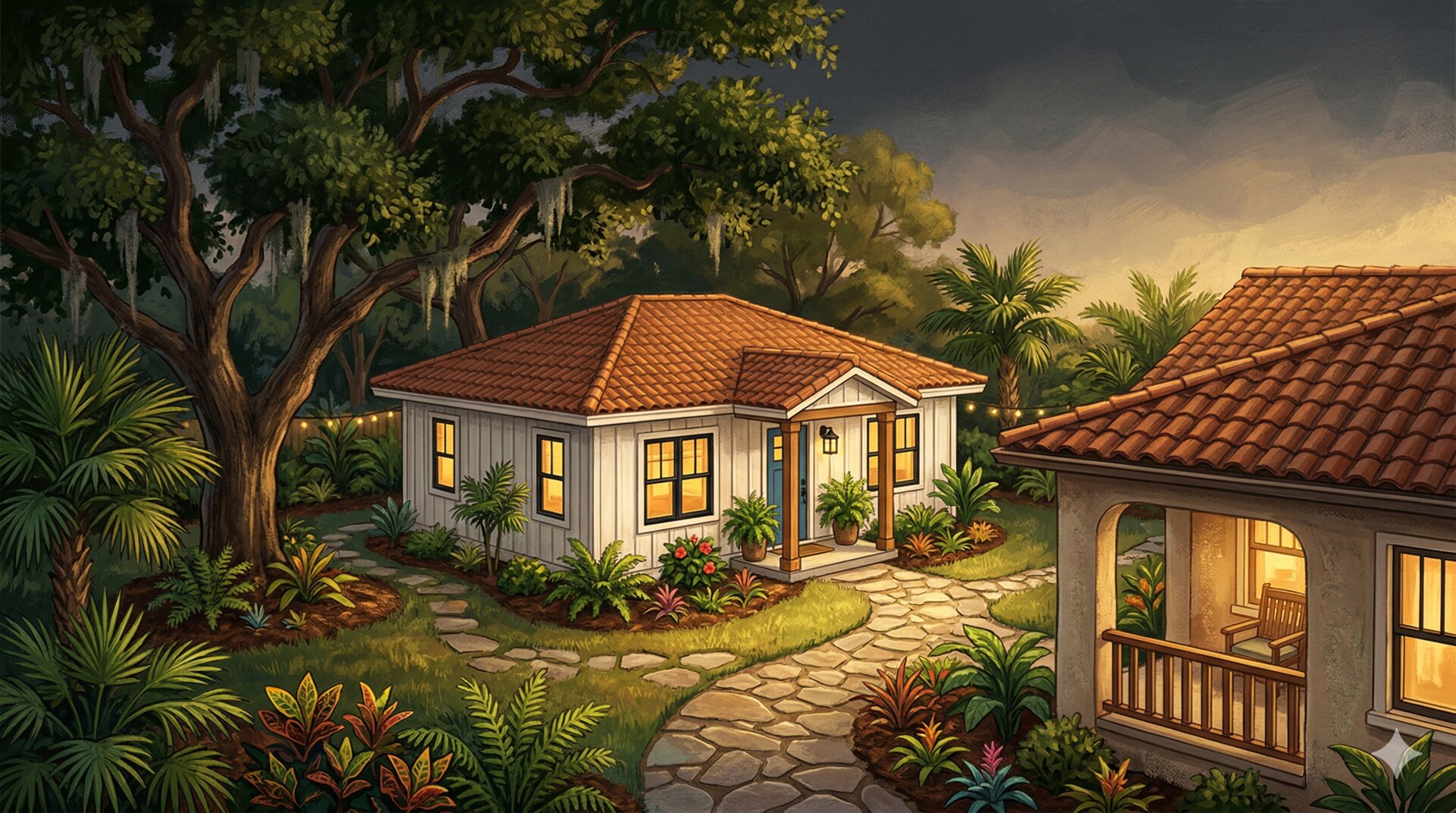
ADU Grants and Permits in Pinellas County and St. Petersburg (2026 Owner's Guide)


So you want to build an Accessory Dwelling Unit (ADU) on your Pinellas property, and someone told you there's grant money for it. Here's the straight answer before you spend a Saturday reading zoning code.
For a St. Petersburg homeowner in 2026, there is no direct cash grant that writes you a check to build an ADU. The one true ADU cash grant in Pinellas County is Largo's $8,000 reimbursement, and it only covers properties inside the West Bay Drive Community Redevelopment District in Largo. If you own in St. Pete, you can't use it. The highest-value incentive you can actually reach is the Multigenerational Tax Exemption through the Pinellas County Property Appraiser, which cuts your property tax after an ADU is built for an elderly parent or grandparent. There are also federal tax angles for solar panels on the ADU, and narrow federal credits if the ADU is tied to a qualifying small business.
That's the honest shape of the incentive map. The rest of this guide walks through zoning, size caps, permit path, costs, and the tax programs you can actually use. We're Revolution Contractors (Jeremy Wharton CRC1331628 and Brent Patterson CGC1522463, with 20+ W-2 carpenters on payroll). We build ADUs. We don't file grant paperwork or tax exemption applications. You handle those with your accountant and the granting agency. We handle the dirt, framing, inspections, and Certificate of Occupancy.
Can you even build an ADU on your Pinellas property in 2026?
The first question isn't about money. It's about whether your lot is legal for an ADU at all.
In Pinellas County, the rules split by jurisdiction. If your property sits in unincorporated Pinellas (meaning you pay property tax to the county but not to a specific city), you're governed by the county's ADU ordinance that took effect July 30, 2024. If you're inside St. Petersburg city limits, you're governed by the St. Pete zoning code. Largo, Clearwater, and the other Pinellas cities each run their own rules.
In unincorporated Pinellas, ADUs are allowed in residential zones up to 1,000 square feet of living area. If your parcel sits inside a Coastal Storm Area (the county's elevated-risk flood category), that cap drops to 750 square feet. The county waives development review fees for ADUs, which is meaningful cash savings even though it isn't a grant. Staff-level review handles ADUs up to 20% over the size cap, and anything larger requires a variance.
In St. Petersburg, ADUs are allowed in specific neighborhood zoning districts. The ones chief research confirmed are NS-1 (Neighborhood Suburban) and the NT-1, NT-2, and NT-3 Neighborhood Traditional variants. Several secondary sources also list NTM-1, NSM, and CRT (Corridor Residential Traditional) as eligible, but the lists diverge, and the city's code gets amended often enough that you should not trust a two-year-old blog on this question. Check your parcel at stpete.org/gis or call St. Petersburg Planning and Development Services before you start designing.
If you're in a historic district (Old Northeast, Granada Terrace, Roser Park, Historic Kenwood, Driftwood, and others), your ADU also goes through Historic Preservation Commission review on top of standard building permits. That adds months and an extra fee, but it isn't a dealbreaker. We've worked on review-board projects in Old Northeast and the HPC path is navigable with the right design partner.
What state law actually governs ADU construction in Florida right now?
You may have heard that Florida recently mandated ADUs statewide. That isn't quite right.
The only live state law on the books is Florida Statute 163.31771, originally enacted in 2004 and last amended in 2020. It's permissive, not mandatory. It says a local government "may adopt an ordinance" allowing ADUs in single-family-zoned areas. It does not force them to. If a local government does adopt an ADU ordinance under this statute, the owner has to sign an affidavit saying the ADU will be rented at an affordable rate to low or moderate income households, defined as rent plus utilities not exceeding 30% of median adjusted gross annual income. The approved units count toward the city's affordable housing obligations in its state-mandated comprehensive plan.
There was a real push in the 2026 legislative session to go further. Senate Bill 48 (filed by Senator Gaetz) and House Bill 313 (filed by Representative Nix) would have required Florida cities to permit at least one ADU per single-family lot. SB 48 passed the Senate 38 to 0 on February 4, 2026. Then it died in House messages on March 13, 2026, when the two chambers couldn't agree on short-term rental authority language. HB 313 died the same day in the Intergovernmental Affairs Subcommittee.
A different bill, CS/CS/HB 1389, did pass and took effect July 1, 2026. It expanded affordable housing preemption and legalized tiny homes and townhouses in more places. But the ADU section was stripped out of the final House amendment before passage. Net effect: Florida did not mandate ADUs in 2026. Statute 163.31771 still controls, and it leaves the question to your local government.
Expect another mandate attempt in the 2027 session. If you see a blog that says "Florida now requires ADUs on every lot," check the date and the source. As of November 2026, that framing is wrong.
What grants actually pay cash for ADU construction in Pinellas County?
Here's the honest inventory, program by program.
Largo CRA ADU Grant (up to $8,000, Largo-only)
Largo's Community Redevelopment Agency runs a reimbursement program that pays up to $8,000 per property to offset impact fees and permit fees on an ADU build. It pays after the Certificate of Occupancy is issued, so you fund the construction yourself and the CRA cuts the check once the unit is finished and signed off.
Two restrictions make this a narrow program. First, you have to live in the home where the ADU is going. Rental property owners don't qualify. Second, and this is the one that disqualifies most Pinellas readers, the property has to sit inside the West Bay Drive Community Redevelopment District in Largo. If your parcel is anywhere in St. Petersburg, Clearwater, Pinellas Park, or unincorporated Pinellas, you can't use this grant. We flag it here because it's the only real cash ADU grant in the county, and some readers do own in WBD-CRD Largo. If that's you, visit largo.com/planning/accessory_dwelling_units.php and talk to Largo Community Redevelopment before you start work. The program requires pre-approval.
Multigenerational Tax Exemption (county-wide, highest-value for most readers)
This is the one most St. Petersburg readers can actually reach, and for the right family situation it compounds into real money.
The Multigenerational Tax Exemption (Florida's "Granny Flat" exemption framework, administered by the Pinellas County Property Appraiser) reduces your property tax after you build an ADU for a parent or grandparent. The exemption is the lesser of two figures: the increase in your assessed value from the ADU construction, OR 20% of your total post-improvement assessed property value. Whichever number is smaller is what gets exempted from the taxable base.
Industry estimates place the typical annual savings around $1,900 for a representative Pinellas home, but your actual savings depend on your assessed value and the millage rate of your taxing authority.
Eligibility rules are strict:
- At least one parent or grandparent age 62 or older has to live in the ADU as their primary residence.
- That parent or grandparent cannot claim a homestead exemption on any other property.
- The improvement has to be completed after July 30, 2024 and before January 1 of the exemption year you're applying for.
- If ownership of the property changes, a new application is required.
- If the qualifying resident moves out or no longer meets the criteria, you have to notify PCPAO.
- Willful false statements get the exemption revoked and expose you to a tax lien.
The application is filed with the Pinellas County Property Appraiser, not with a city office. Contact: (727) 464-3207. This exemption applies inside St. Petersburg city limits because PCPAO is county-wide. Over a 10-year occupancy at an estimated $1,900 per year, that's roughly $19,000 off your cumulative property tax bill, before any millage rate changes. For a family building an ADU to house an aging parent, this is the single most impactful incentive available.
St. Petersburg Local Ad Valorem Tax Exemption (NOT your ADU path)
You may run into this one in a Google search. It's a real program, but it isn't for you if you're building one ADU on your single-family lot.
The St. Pete Local Ad Valorem Tax Exemption, authorized under the Florida Live Local Act (SB 102, 2023) and St. Pete Ordinance 561-H, offers municipal property tax exemptions to new affordable rental developments. The floor is 50 residential units minimum, with at least 20% of those units rented to households at or below 60% Area Median Income. One ADU on one lot doesn't meet the threshold. We're mentioning the program only so you don't waste an afternoon chasing a path that doesn't apply.
Pinellas County Independent Living Program (up to $20,000, but excludes St. Pete)
If you're building an accessibility-focused ADU, the Pinellas Independent Living Program covers up to $20,000 in accessibility improvements: wheelchair ramps, grab bars, roll-in showers, tub-to-shower conversions, door widening, ADA-compliant toilets, railings. Income limits in 2026 were $58,450 for an individual and $83,450 for a family of four.
The geographic restriction knocks most of this guide's readers out. The program is available only in unincorporated Pinellas County. It explicitly excludes St. Petersburg, Clearwater, Largo, and Belleair Shore. And it closed to new applications on May 4, 2026, with a waitlist available at (727) 464-8210.
If you own in unincorporated Pinellas, qualify by income, have a documented permanent physical impairment, and the program reopens, this can offset up to $20,000 of your accessibility-related fit-out cost. Four layered conditions make it a narrow lane, but worth tracking if those boxes check.
Pinellas County Home Repair Loan Program (forgivable up to $75,000, NOT for ADUs)
This one comes up because readers often conflate "home improvement grants" with "ADU grants." They're different animals.
The Pinellas Home Repair Loan Program offers up to $75,000, fully forgivable if you stay in the home as your primary residence. The money covers roof replacement, windows and exterior doors, HVAC systems, and electrical upgrades needed to bring an existing home up to code. It does NOT fund new ADU construction. It's for repairing code-deficient conditions on the primary dwelling.
Same geographic restriction as the Independent Living Program: unincorporated Pinellas only, excludes St. Petersburg. Also closed to new applications as of May 4, 2026. If you own in unincorporated Pinellas and your primary home has code issues, this is a real tool. If you're trying to fund an ADU, it isn't.
CDBG, HOME, and SHIP (community-level, not homeowner-direct)
Pinellas County's 2026 to 2027 Notice of Funding Availability allocated $2,339,516 in federal Community Development Block Grant (CDBG) funds, $1,924,297 in HOME funds, $5,080,000 in State Housing Initiatives Partnership (SHIP) funds, plus smaller allocations for Emergency Solutions Grants, Housing Trust Fund, and Neighborhood Stabilization.
The Pinellas 2026-2027 Action Plan specifically identifies affordable ADUs as a priority area. That matters because it signals the county is open to funding nonprofit-built affordable ADUs through this pipeline.
But this isn't a homeowner check path. CDBG, HOME, and SHIP flow through the county to housing nonprofits and developers. You don't apply as an individual building an ADU on your own lot. Also, CDBG and SHIP eligibility excludes St. Petersburg, Clearwater, and Largo, because those cities run their own federal entitlement programs separately. If you're interested in a nonprofit-built affordable ADU path, contact Pinellas Community Development at (727) 464-8210.
Florida Hometown Heroes (purchase assistance, not construction)
The Florida Hometown Heroes Housing Program offers up to $35,000 in down payment and closing cost assistance through a 0% interest deferred second mortgage, formula-driven at 5% of the first mortgage amount ($10,000 minimum, $35,000 maximum). The 2026 to 2027 funding cycle opened July 13, 2026 with a $50 million pool, and over $20 million remained available as of October 20, 2026.
The catch for ADU-interested readers: this is a purchase program, not a construction program. If you're buying a Pinellas home that already has an ADU on the lot, Hometown Heroes may help with your down payment. If you already own the property and want to add an ADU, this program doesn't apply to you.
IRS Section 44 Disabled Access Credit (small-business orientation)
Internal Revenue Code Section 44 gives small businesses a federal tax credit equal to 50% of eligible access expenditures between $250 and $10,250 per year, for a maximum annual credit of $5,000. "Small business" means gross receipts of $1 million or less OR 30 or fewer full-time employees in the prior year.
For an ADU to qualify, the construction has to be tied to a qualifying small business. A home office for a disabled operator. A licensed in-home care arrangement. Possibly a short-term rental business, though St. Pete's 30-day minimum rental rule in residential zones effectively blocks the Airbnb angle. A pure family-use ADU housing an elderly parent is unlikely to qualify.
Talk to a CPA before counting on this credit. The eligibility calculus is specific enough that general construction advice isn't the right venue to make the call.
IRS Section 190 Barrier Removal Deduction (same small-business caveat)
Internal Revenue Code Section 190 allows up to $15,000 in deductions for architectural barrier removal expenses. Same small-business orientation as Section 44. The two can sometimes stack on the same project: the credit covers the first $10,250 of qualified expenditures, and the deduction can apply above that threshold. Both require eligible small-business status, so this isn't a direct homeowner tool.
Federal solar tax credit and Florida renewable property tax exemption
This one actually stacks cleanly for ADUs.
The federal residential solar tax credit returns 30% of installed cost on a rooftop solar system, in place through tax year 2032. If you install a $20,000 rooftop solar system on your ADU, you get a $6,000 federal tax credit the following year.
Florida also exempts the added property value from renewable energy equipment from your assessed taxable value under Florida Statute 196.182. That means the $20,000 of solar doesn't bump your property tax up in future years. You get the federal credit on the install AND permanent protection from a tax-assessment increase on the added value.
This is a real, grab-able incentive. If you're building an ADU anyway, adding solar at construction time is cheaper per watt than retrofitting later, and the tax treatment is favorable in a way most construction add-ons aren't.
Private financing and nonprofit paths
A few options don't fit neatly in the grant bucket but are worth naming. Construction-to-permanent loans through local credit unions and banks ran 6.75% to 7.5% interest in 2026. RenoFi, a specialty lender, lets you borrow up to 125% of current home value based on after-renovation value, which helps owners with constrained equity. Habitat for Humanity of Pinellas and West Pasco and the Florida Housing Coalition occasionally support specific ADU projects through partnership arrangements, not open public applications. Pinellas County Housing Authority: no ADU-specific grant program identified in research.
What size ADU can you build in St. Petersburg? (And where?)
Size rules in St. Pete come in two caps, and the smaller of the two controls your build.
The absolute maximum is 800 square feet of ADU living area. The relative maximum is 67% of your primary dwelling's livable floor area. The ADU can be no larger than whichever of those two numbers is smaller.
Worked example: you own a 1,000 square foot primary home in NT-2. Sixty-seven percent of 1,000 is 670 square feet. That's smaller than the 800 square foot absolute cap, so your ADU can be up to 670 square feet. If your primary home is 1,500 square feet, 67% is 1,005 square feet, but the 800 square foot absolute cap kicks in, so you're capped at 800. The minimum ADU size is 375 square feet.
Setback and height rules vary by zoning district. In NS-1, side setbacks are 7 feet and rear setbacks are 15 feet, with a minimum lot size of 7,500 square feet for ADU eligibility. Height caps are typically around 30 feet in NS-1 but vary.
Parking usually adds one off-street space for the ADU. However, parcels near PSTA high-frequency transit lines may qualify for a parking exemption, which can be the difference between a buildable ADU and an impossible one on a small lot.
If your parcel sits inside a Coastal Storm Area, the size cap tightens. Pinellas County's rule for unincorporated parcels drops the max to 750 square feet in CSA. St. Petersburg has its own flood-zone-related requirements, which include elevating the finished floor to or above the Base Flood Elevation (BFE) set by the Federal Emergency Management Agency (FEMA) through the Florida Building Code (FBC). If your ADU is in a Special Flood Hazard Area, the elevation requirement adds cost and changes design. We cover the flood-zone construction specifics on our Flood Zone St. Petersburg page.
How much does it cost to build an ADU in Pinellas County?
Cost is where most readers want a straight number. Here's the honest range, with the caveats you need.
Construction cost for a new ADU in Pinellas in 2026 runs roughly $129,000 for a basic prefab or modular detached unit on the lower end, up to $370,000 for a two-story, two-to-three-bedroom, site-built traditional detached ADU on the higher end. The variables that move the number: square footage, prefab versus site-built, number of bedrooms, flood-zone elevation requirements, whether you're doing a garage conversion (cheaper) versus ground-up detached (more expensive), and finish level.
That range is construction only. Add permits and fees on top:
- Design (Florida-licensed architect or designer): roughly $3,000 to $8,000
- St. Petersburg building permit: based on construction valuation; the city uses a published fee schedule tied to project value
- Pinellas County impact fees: roughly $2,000 to $7,000 or more depending on service area
- Historic Preservation Commission review: additional fee if your lot is in a historic district
- Optional private-provider expedited plan review: $1,500 to $5,000 if you want faster city turnaround
Total permit-and-fee load typically falls between $5,500 and $20,000 before construction starts. Add that to your construction cost to get your all-in number.
Timeline runs 6 to 10 months from permit submittal to Certificate of Occupancy in a standard zoning district. In a historic district requiring HPC review, timelines stretch to 9 to 14 months or longer. Private-provider plan review can compress the city-side wait but does not shortcut the HPC path.
A garage conversion is almost always the cheapest ADU path, because the shell exists and you're changing interior use rather than adding a new foundation and envelope. A detached, site-built ADU is almost always the most expensive, because you're effectively building a tiny house from scratch, with its own electrical, plumbing, HVAC, and foundation work.
If you're housing an elderly parent, lean toward a design that includes aging-in-place features from day one: zero-step entry, 36-inch doors, curb-less shower, lever handles, ground-floor bedroom. The marginal cost of specifying these at construction is low. The marginal cost of retrofitting later is high.
What's the permit process for an ADU in St. Pete?
The permit path is where most ADU projects actually get stuck. Here's how it runs when it goes smoothly.
Step 1: GIS and zoning check. Before you spend a dollar on design, pull your parcel at stpete.org/gis and confirm your zoning district permits ADUs. If you're in a historic district, note the overlay. If you're in a Coastal Storm Area or Special Flood Hazard Area, note that too.
Step 2: Pre-application meeting with Planning and Development Services. St. Pete Planning will walk you through parcel-specific constraints before you commit to a design. This is free and worth the 30 minutes.
Step 3: Design with a Florida-licensed architect or designer. We coordinate design through independent architects we trust rather than keeping designers on staff. That keeps you in the driver's seat on design decisions while we focus on the build. Expect 6 to 12 weeks for a complete permit set depending on complexity.
Step 4: Historic Preservation Commission review (if applicable). If your lot is in a historic district, HPC review comes before building permit submittal. The commission evaluates design compatibility with the district's architectural character. Approval is grantable but requires compliant design.
Step 5: Building permit submittal. Permits go through the St. Pete Development Services portal. Review time varies with workload. Private-provider expedited review is available at added cost for faster turnaround.
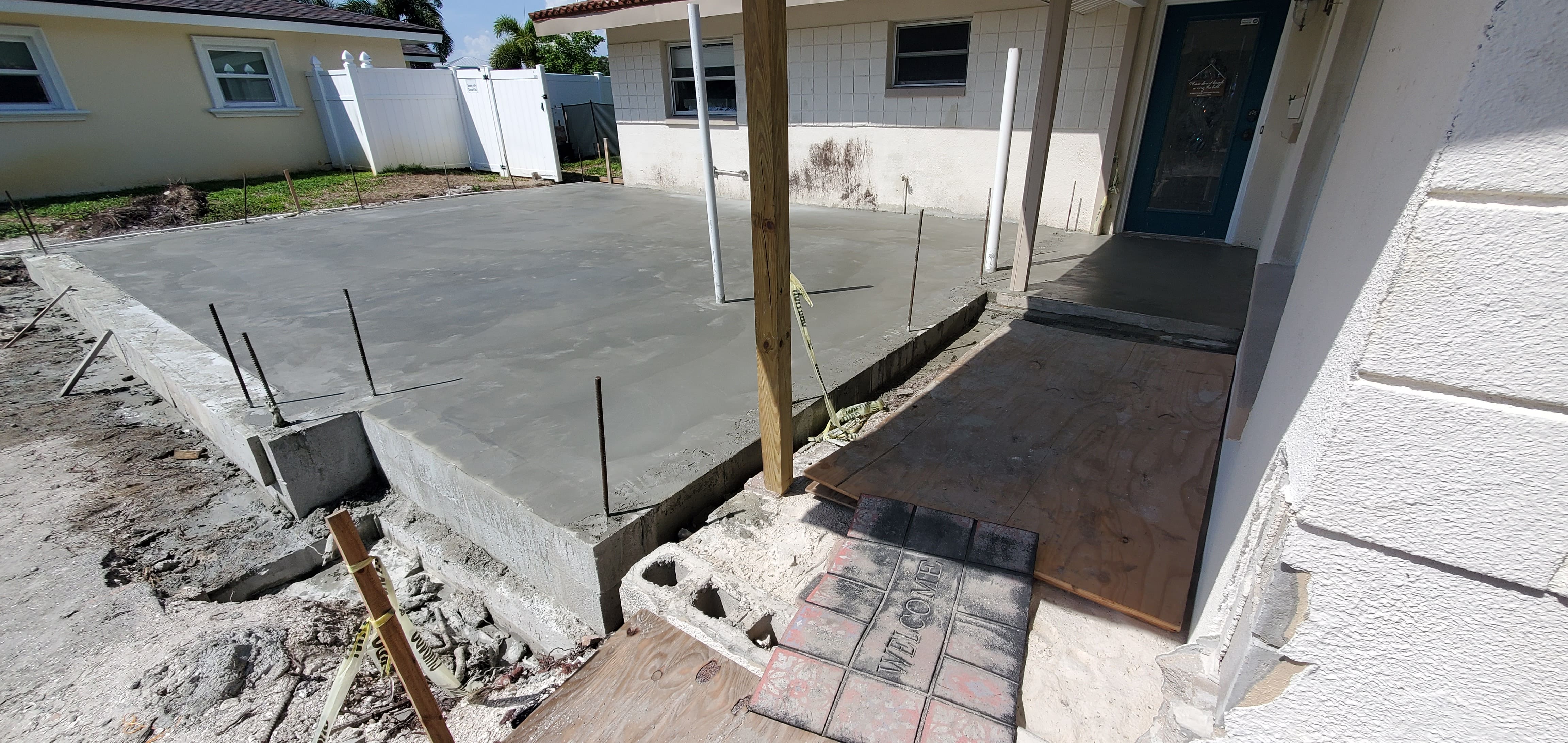
Step 6: Permit issuance and site preparation. Once permits are in hand, we mobilize. Site clearing, foundation layout, utility locates.
Step 7: Construction. Foundation, framing, rough mechanical electrical plumbing (MEP), inspections, insulation, drywall, finishes. For a detached ADU this typically runs 4 to 7 months. A garage conversion runs faster.
Step 8: Final inspections and Certificate of Occupancy. Final building, electrical, plumbing, mechanical, and zoning inspections. Once all pass, the city issues the CO.
Step 9: Post-CO tax filings (owner responsibility). If you're pursuing the Multigenerational Tax Exemption, you file with PCPAO after the CO is issued. If you added solar, your federal tax credit gets claimed the following tax year on Form 5695. If you're in Largo WBD-CRD, you submit your CRA reimbursement request after CO.
We handle Steps 2 through 8 as your general contractor. You handle Step 9 (the tax and grant filings) with your accountant and the granting agency. We do not file exemption applications, CRA reimbursement requests, or variance hearings on your behalf. That lane belongs to you.
Are there tax breaks for accessibility-focused ADUs?
If you're building the ADU for a parent, grandparent, or family member with mobility or accessibility needs, there are tax angles worth knowing. Most of them stack with the Multigenerational Tax Exemption rather than replacing it.
For families housing an aging parent, the Multigenerational Tax Exemption is the primary lever, as discussed above. Beyond that:
- Medical expense deduction (IRS Schedule A): If you itemize, costs of medically necessary home improvements (ramps, grab bars, widened doorways, roll-in showers) may qualify as deductible medical expenses to the extent they exceed 7.5% of your adjusted gross income. Talk to your CPA on the specifics.
- IRS Section 44 Disabled Access Credit: Only applicable if the ADU is tied to a qualifying small business (not a pure family-use scenario).
- IRS Section 190 Barrier Removal Deduction: Same small-business caveat.
- State and local accessibility grants: The Pinellas Independent Living Program covers up to $20,000 in accessibility work, but only in unincorporated Pinellas (excludes St. Pete), and it's closed as of May 4, 2026 pending waitlist openings.
For a St. Petersburg homeowner building an ADU for an aging family member with accessibility needs, the realistic incentive map is: Multigenerational Tax Exemption as the primary ongoing benefit, federal medical expense deduction if you itemize, federal solar tax credit if you add solar, and the state renewable energy property tax exemption on that solar. Everything else has geographic, small-business, or program-closure constraints.
Can CDBG, HOME, or SHIP funds pay for my ADU?
The short answer for a St. Petersburg homeowner is no, not directly. The longer answer is worth understanding, because there's a path through the nonprofit side.
Federal CDBG and HOME funds, along with state SHIP funds, flow through Pinellas County to housing developers and nonprofit organizations. These programs fund affordable housing projects, not individual homeowner ADUs. The 2026-2027 Pinellas allocation ($2.3 million CDBG, $1.9 million HOME, $5.1 million SHIP per the NOFA figures) is substantial, and Pinellas's 2026-2027 Action Plan specifically identifies affordable ADUs as a priority investment area.
What that means practically: if a Pinellas housing nonprofit decides to build affordable rental ADUs on donated or acquired lots, those projects can be CDBG-funded. If you're a homeowner thinking "can I get some of that CDBG money to build an ADU on my lot?", the answer is no. You apply to the county for CDBG funds as an organization, not as an individual homeowner.
Also, CDBG and SHIP eligibility excludes St. Petersburg, Clearwater, and Largo because those cities administer their own federal entitlement grants separately. If you're a nonprofit or developer based in those cities, you apply to the city, not the county.
If you have a serious interest in participating in a nonprofit-built affordable ADU program, the contact point is Pinellas Community Development at (727) 464-8210.
FAQ: ADU questions Pinellas homeowners actually ask
Can I short-term rent my ADU on Airbnb?
Not in the City of St. Petersburg. St. Pete requires a 30-day minimum rental period in residential zones, which effectively bans Airbnb and VRBO short-stay use. Build your ADU's financial model around long-term tenants. Typical 1-bedroom rent in St. Pete ran between $1,400 and $1,900 per month in 2025 to 2026 market data.
What if my parent doesn't move in right away? Can I still get the Multigenerational Exemption?
The exemption requires the qualifying parent or grandparent (age 62 or older) to reside in the ADU as their primary residence. If no qualifying resident is there, you don't get the exemption for that year. If they move in later, you apply once the criteria are met. If they move out, you have to notify PCPAO.
Can I convert my garage into an ADU under these rules?
Usually yes, assuming your lot is in an eligible zoning district and the converted unit meets the 375 square foot minimum. Garage conversions are typically the cheapest ADU path because the shell exists. You're adding or upgrading plumbing, electrical, HVAC, insulation, interior partitions, and often a kitchenette, but you're not building new foundation and envelope. Parking replacement may be required if the garage currently counts toward your required off-street spaces.
Can I build a two-story detached ADU above a new garage?
In most eligible St. Pete districts, yes, subject to the 800 square foot cap or 67% primary dwelling ratio (whichever is smaller), height limits in your zoning district, setback compliance, and HPC approval if in a historic district. This is a common configuration because it concentrates the ADU footprint over space you'd use for a garage anyway.
Will the ADU add significant value to my property?
Industry data from Pinellas and comparable Florida markets suggests ADUs typically add value in the range of 20% to 35% of construction cost in resale terms, plus ongoing rental income if leased. The multigenerational use case (housing a family member) doesn't optimize for resale value directly, but it does keep an aging parent out of assisted living (which averages $5,000 to $7,000 per month in the Tampa Bay area).
How long does ADU permitting really take?
Realistically, 6 to 10 months from design completion to Certificate of Occupancy in a standard zoning district. 9 to 14 months or more in a historic district with HPC review. Design time (6 to 12 weeks) is on top of that if you don't have a complete permit set when you start.
What if the zoning says my parcel isn't eligible?
You can apply for a zoning variance, but variances are discretionary and the city doesn't grant them freely. A better path for most parcels is to check whether a different accessory use (like a multigenerational single-family configuration with a second kitchen under one address and one meter) might meet your family's needs without triggering ADU rules. Pinellas County explicitly allows the multigenerational single-family option in unincorporated areas; St. Pete's handling varies.
Does Revolution Contractors handle the grant application and tax exemption filings?
No. We're the general contractor. We build the ADU, coordinate the independent architect on design, run the permit submittals, manage subs, carry the inspections, and deliver the Certificate of Occupancy. Grant applications (Largo CRA if applicable) and tax exemption filings (PCPAO Multigenerational, federal solar credit, IRS Section 44 or 190 if applicable) are owner responsibilities. You handle those with your accountant and the granting agency directly. We stay on the construction side.
What's the ballpark cost for a 600 square foot detached ADU in Shore Acres?
Shore Acres sits largely in Special Flood Hazard Areas, so flood-zone elevation requirements apply. For a 600 square foot detached ADU on an elevated pile or stem-wall foundation meeting current Base Flood Elevation, expect construction cost in the $220,000 to $310,000 range, plus $5,500 to $20,000 in permits and fees. Costs run higher in Shore Acres than in non-flood-zone St. Pete neighborhoods specifically because of the elevation and wind-load requirements.
Can I phase the project? Build the shell now, finish the interior later?
Usually a false economy. Permit and impact fees are paid up front based on the full project scope. Phasing the interior costs you a second mobilization and keeps your project in permit-active status longer. Unless you have a cash flow reason to phase, it's cheaper to build complete.
Next steps: how Revolution builds ADUs in Pinellas County
Here's the condensed version of how to actually move forward if you're seriously considering an ADU.
- Pull your parcel at stpete.org/gis. Confirm zoning district, historic district overlay, flood zone, Coastal Storm Area designation.
- If the parcel is in unincorporated Pinellas, confirm you're not in Coastal Storm Area (which tightens the ADU size cap to 750 square feet).
- Verify your intended ADU use against the Multigenerational Tax Exemption rules if housing a parent or grandparent, or against market-rate long-term rental economics if renting. (Short-term rental is off the table in St. Pete.)
- Book a pre-application meeting with St. Petersburg Planning and Development Services. Free, and it saves you from designing something the city will reject.
- Get a design. We coordinate independent architects we trust rather than carrying designers in-house. Your design dollars go further that way, and the architect works to your program, not ours.
- Submit permits, build, close out the CO. This is where Rev does the heavy lifting. Permits, framing, mechanical electrical plumbing, inspections, finishes, final sign-off.
- File your tax exemption or grant application post-CO. If you're pursuing the Multigenerational Tax Exemption, file with PCPAO once the CO is issued and your qualifying family member is in residence. If you added solar, claim the federal credit on your next tax return. If (and only if) you're in Largo WBD-CRD, submit your CRA reimbursement request.
We build ADUs across St. Petersburg, in unincorporated Pinellas County, and in the surrounding Pinellas cities. Garage conversions, detached cottages, in-law suites above garages, and ground-up accessory buildings. We've navigated historic district review in Old Northeast and surrounding neighborhoods, and we've built to FBC elevation standards in Shore Acres and the other coastal flood zones.
If you're ready to talk through your lot, your family situation, and what's actually buildable within your budget, reach out. Jeremy Wharton (CRC1331628) and Brent Patterson (CGC1522463) run the company with over 20 years combined experience in St. Petersburg construction, backed by 20+ W-2 carpenters on payroll (not a paper contractor subbing out framing to whoever's cheapest that week).
Visit our Home Additions page if you're adding attached square footage instead of a detached unit. See Open Up Your Plan if you'd rather reconfigure the primary home instead of adding an ADU. If flood zone construction is on your roadmap, our Flood Zone St. Petersburg page covers the elevation and permit specifics.
Pick up the phone and tell us what you're thinking. We'll tell you what's buildable.
Regulations and program status current as of November 2026. Florida ADU policy, Pinellas County programs, and St. Petersburg zoning code change year to year. Verify current rules with Planning and Development Services, the Pinellas County Property Appraiser, and the granting agency before relying on any specific program figure in this guide.