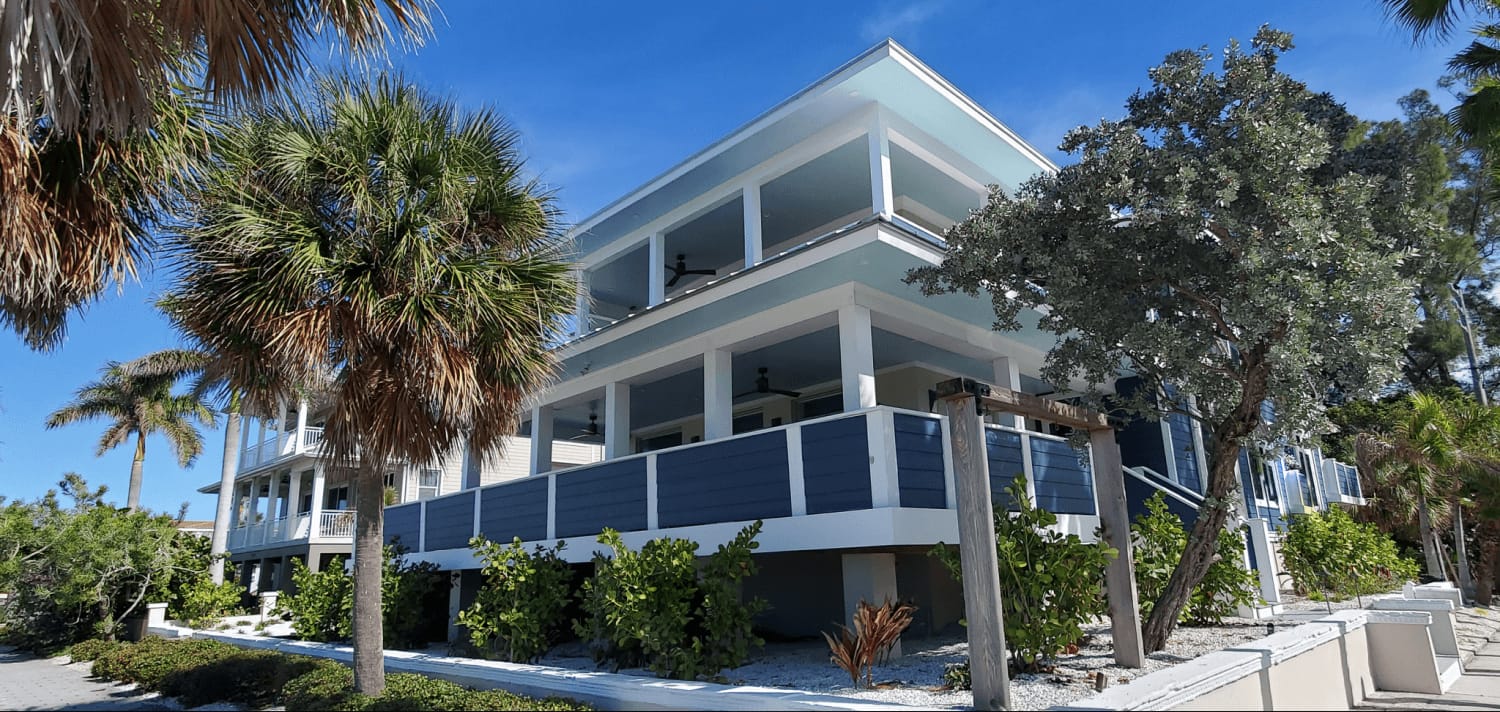
Home Addition Contractor in St. Petersburg
Second-story additions, master suites, ADUs, in-law suites, and garage conversions across St. Petersburg and Pinellas County — coordinated by Revolution Contractors under one contract. 20+ W-2 carpenters, open-book Time & Materials, FEMA 50% Rule and permit stack handled in-house. Florida CRC1331628 + CGC1522463.
CGC1522463
Planning a home addition in St. Petersburg?
A home addition is new-construction conditioned space bolted onto an existing house — second-story additions, master suite additions, single-room additions, ADUs, and garage conversions to conditioned space. Most projects run $200-$400 per square foot in St. Pete and 8-14 months concept to move-in. Coastal flood-zone lots and historic districts add cost and time. At $200-$400/sqft, adding on usually beats buying comparable homes at $700/sqft in the same neighborhood.
Revolution Contractors coordinates the full addition as general contractor — structural engineering, permit stack (building, electrical, plumbing, mechanical, roofing, windows), foundation tie-in, framing, and finish — with a single dedicated superintendent from pre-construction through final inspection. Call (727) 888-6161 for a site walk.
Cost Breakdown by Project Type
Four project types drive most St. Pete addition work. Each carries a different cost band based on wet-vs-dry room content, first-vs-second floor structural pathway, and flood-zone regulatory overlay.
Match the scope to your constraints, then follow the sub-hub links below for the full detail on each project type.
| Project type | First-floor dry | First-floor wet | Second-story premium | Flood-zone premium |
|---|---|---|---|---|
| Room addition | $200-$250/sqft | $250-$300/sqft | +30-50% | +20-30% |
| Master suite | $250-$300/sqft | $280-$350/sqft | +30-50% | +20-30% |
| Second-story | n/a | n/a | $300-$400+/sqft base | +20-30% |
| ADU / garage conversion | $60-$150/sqft (conversion) $200-$400/sqft (new) | +$40-$60/sqft | (2nd-story ADU unusual) | +20-30% |
Cost bands sourced from Revolution’s 2026 St. Petersburg home addition cost guide. Actual project cost depends on site conditions, finish level, and flood-zone or historic-district overlays.
20+ carpenters on Revolution’s payroll
Framing crew and trim crew are separate, both W-2 employees on Revolution’s payroll — not a paper-contractor model. Structural tie-in, ZIP sheathing, and Simpson Strong-Tie hurricane-strap work all handled in-house by carpenters who’ve been on Rev’s crew for years. Named crew across the company includes Caleb, Jeremy, Thad, and Brent leading field operations.
T&M with weekly budget reports
Time & Materials contract, actual labor and material cost plus a flat markup, weekly line-item reports comparing actuals to estimates. Every invoice, every hour, every material receipt visible to the homeowner. By construction start, 90-95% of costs are confirmed. When work goes faster than estimated, you save money — not us.
Coastal & permit stack in-house
$10-20M in flood-zone work across three hurricanes. We run the FEMA 50% substantial-improvement calculation before design starts on every AE, VE, or Coastal A parcel. St. Petersburg Building Department permits (building, electrical, plumbing, mechanical, roofing, windows) pulled with Florida Product Approval (NOA) numbers pre-attached so plan review doesn’t stall on wind-load documentation. FBC 2026 code compliance handled in-house. Try our free FEMA 50% Rule Calculator to estimate whether your addition triggers substantial-improvement compliance.
Structural Tie-In and Material Specifics
Every home addition ties into existing structure. That tie-in is where poor coordination shows up years later as roof leaks, sagging floors, or thermal bridging. Revolution runs foundation tie-in via epoxy-set rebar dowels into the existing footer per Florida Building Code Section 1810. Second-story additions get Simpson Strong-Tie hold-downs at every corner and ZIP System sheathing (integrated air/moisture barrier plus structural shear panel in one) for weather-tight enclosure before roofing.
Windows and doors go PGT WinGuard impact-rated across the entire addition, sized per Florida Product Approval (NOA) numbers pre-attached to plan-review submittals. Roofing continues the existing roof material where possible or transitions to GAF Timberline HDZ for architectural asphalt at the price-per-square-foot most St. Pete homeowners are already carrying. Insulation to R-30 minimum in the ceiling, R-13 minimum in the walls per FBC energy code.
On flood-zone parcels, everything below Base Flood Elevation gets flood-damage-resistant materials per FEMA Technical Bulletin 2 — concrete, closed-cell foam, treated lumber, marine-grade fasteners. Utilities elevate above BFE. New to Base Flood Elevation vs Design Flood Elevation? Our BFE vs DFE Explainer walks through the freeboard math. The full flood-zone material stack is covered in our Coastal & Flood Zone Projects service page.
Types of home additions we build
Four project types drive most St. Pete addition work — each with its own structural pathway, permit stack, and cost band. Match the scope to the constraint, then follow the sub-hub link for the full detail. Not sure which addition scope fits? Take our Find My Service quiz — 3 questions routes you to the right Revolution service page.
Second Story Addition
$300-$400+/sqft
Structural-engineering-first — foundation underpinning, shear-wall reinforcement, roof rebuild. Common on tight urban lots and Snell Isle waterfront lots where preserving flood-compliant ground floor matters.
Second story details →Master Suite Addition
$150K-$280K, 350-500 sqft
Primary bedroom + walk-in closet + en-suite bath. Slab or stem-wall tie-in, HVAC zone extension, plumbing rough-in. The most common addition scope in Old Northeast and Historic Uptown bungalow retrofits.
Master suite details →Room Addition
$80-$300/sqft, 3-6 months
Single-room scope — bedroom, home office, sunroom, Florida room, or screened-lanai conversion to conditioned space. Foundation extension, framing, MEP rough-in. Non-structural pathway, faster timeline.
Room addition details →ADU, In-Law, Garage Conversion
$60K-$300K depending on scope
Accessory dwelling units — attached in-law suites, detached secondary dwellings, or garage conversions to permitted conditioned living space. St. Pete’s ADU rules have been updated recently; feasibility depends on zoning, setbacks, and lot coverage. First-floor primary suite work and in-law suite additions for aging parents fall under the same scope.
St. Pete addition detail →Ready to walk your property?
We’ll review setbacks, flood zone, historic overlay, and structural tie-in options before you commit to a design direction. No sales pitch — just an honest read on what’s possible.
St. Pete addition work we’ve done
Revolution has tied second-story additions into slab-on-grade ranches in Crescent Lake, master suite additions into CBS masonry bungalows in Old Northeast, and detached ADUs into lots in Snell Isle’s AE flood zone. Every waterfront project runs the FEMA 50% calculation before design starts. Every historic-district project gets Certificate of Appropriateness coordination through the Community Planning & Preservation Commission before the building permit review starts.
For a related waterfront restoration case study on the same engineering-first approach, see the King House project in Old Southeast.
Home Addition FAQ
How much does a home addition cost in St. Petersburg?
First-floor additions in St. Pete typically run $200-$300 per square foot; second-story additions run $300-$400+ per square foot because the existing foundation and load-bearing walls have to be reinforced for the new load. Flood-zone lots (AE / VE zones) add another 20-30% for elevation and flood-damage-resistant materials below Base Flood Elevation. Wet-room scope (kitchen or bath in the addition) is the single biggest multiplier — a 2,000 sq ft garage-plus-two-offices addition without wet rooms lands around $200,000; the same footprint with a kitchen and bath lands closer to $500,000. For the full line-item breakdown, see our home addition cost guide. Call (727) 888-6161 for a Pinellas-specific range on your property.
How long does a home addition take in Pinellas County?
A straightforward first-floor inland addition in St. Petersburg runs 8-14 months from concept to move-in: 3-6 months of architect and structural engineering, 2-5 months of St. Petersburg Building Department permit review, and roughly 6 months of construction. Coastal AE / VE flood-zone parcels or historic-district (Old Northeast, Historic Uptown, Kenwood) properties add 4-6 months for FEMA compliance review or Certificate of Appropriateness review before the building permit can start.
Will an addition trigger the FEMA 50% rule on my flood-zone lot?
If your property is in an AE or VE flood zone on the Pinellas County FIRM map and the cost of the addition plus any other improvements in the same 12-month window exceeds 50% of the structure’s pre-improvement market value, FEMA’s substantial-improvement rule requires the entire structure elevated to current flood code. Revolution runs the 50% calculation before design starts on every property in an AE, VE, or Coastal A zone. Second-story additions and detached ADUs are common on waterfront lots specifically because they preserve existing flood-compliant living space without triggering whole-structure elevation.
Can I add an ADU, in-law suite, or garage conversion to my St. Pete property?
Often yes — depends on the parcel’s zoning district, lot size, setbacks, parking, lot coverage, and impervious-surface ratios. St. Petersburg’s ADU rules have been updated in recent years and many residential lots now allow accessory dwelling units, both attached in-law suites off the main house and detached secondary dwellings. Garage conversions to conditioned living space follow a change-of-use path under the Florida Building Code and are usually cheaper per square foot than a new ADU because the foundation and roof already exist. Revolution pulls the zoning and any deed restrictions before design starts. Read our types-of-additions sub-hubs (second-story, master suite, room addition) or call for a lot-specific feasibility walk.
How does Revolution’s Time & Materials pricing handle the unknowns behind existing walls?
Additions are the scope where unknowns hit hardest — you don’t know what’s behind the existing wall you’re tying into until you open it. Revolution’s open-book Time & Materials contract publishes weekly cost reports comparing actuals to estimates line by line — every invoice, every hour on the jobsite, every material receipt visible to the homeowner. When we open a wall and find something, we photograph it, price the remediation transparently in that week’s report, and only proceed on the option you pick. By construction start, 90-95% of costs are confirmed. When work goes faster, you save money — not us.
What makes a home addition cost $400/sqft vs $200/sqft in St. Pete?
Six cost drivers explain most of the delta between a $200/sqft and a $400/sqft addition. Wet-room scope (kitchen or bath) adds $100-$150/sqft over dry-room work because of plumbing rough-in, waterproofing, tile, and fixtures. Second-story pathway adds 30-50% over first-floor because the existing foundation and load-bearing walls have to be reinforced. AE or VE flood-zone parcels add 20-30% for flood-damage-resistant materials below Base Flood Elevation and utility elevation. HVAC zone extension, electrical panel upgrade, foundation tie-in method (slab vs. stem-wall vs. underpinning), and historic-district Certificate of Appropriateness compliance in Old Northeast or Historic Uptown round out the drivers. Stack two or three of these and you land at $400/sqft; strip them out and you land at $200/sqft.
Do I need a structural engineer for a first-floor addition?
Yes if a load-bearing wall is opened between the existing house and the addition, or if the roof line changes to accommodate the new footprint. Often not required for a small non-structural bump-out that ties in through an existing exterior wall opening without altering the load path. Foundation tie-in has to meet Florida Building Code Section 1810 regardless — epoxy-set rebar dowels into the existing footer is the standard Revolution detail. On any addition where the answer isn’t obvious, we bring the structural engineer in during pre-construction so plan review doesn’t stall for a redesign.
What are the FBC 2026 code changes that affect home additions in Pinellas County?
Pinellas County is in a 150 mph wind zone under Florida Building Code 2026, which drives most of the material specification. Every impact window and door needs a Florida Product Approval (NOA) number pre-attached to plan-review submittals — PGT WinGuard is the standard Revolution spec. Every strap and connector on the load path has to be Simpson Strong-Tie (or equivalent) hurricane-rated. ZIP System sheathing (integrated air/moisture barrier plus structural shear panel) is the current standard for weather-tight enclosure. Energy code drives insulation minimums (R-30 ceiling, R-13 wall). On flood-zone parcels, everything below Base Flood Elevation follows FEMA Technical Bulletin 2 for flood-damage-resistant materials.
How does a second-story addition affect my property taxes in Pinellas County?
The Pinellas County Property Appraiser reassesses the structure value after the certificate of occupancy is issued. A second-story addition that adds 800-1,200 sqft typically drives ad valorem tax up in the range of a few thousand dollars annually depending on assessed value per square foot in your neighborhood and any Save Our Homes cap that applies. Save Our Homes protects the underlying homestead value from spikes, but the new addition square footage assesses at current market rate. Your existing homestead exemption stays intact; only the improvement portion picks up the new assessment. Pull a specific estimate from the Pinellas Property Appraiser’s parcel record before finalizing scope if the property-tax impact is a deciding factor.
Deeper reads on cost, timeline, and permits
Cost, timeline, and cost-driver detail: Home Addition Cost Guide — 2026 St. Petersburg. Full line-item breakdown, wet vs. dry room math, flood-zone premium, second-story cost delta, and the FEMA 50% rule against real St. Pete project numbers.
- What to Expect During a Home Addition — phase-by-phase timeline, staying in your home during the build, and the design-through-move-in sequence.
- ADU and Mother-in-Law Suite Guide — zoning, detached vs. attached, garage-conversion economics, and the St. Pete ADU ordinance decision framework.
- Remodel, Add On, or Build New? — the decision framework when the addition math starts approaching the cost of new construction.
- Flood Zone Projects — elevation, breakaway walls, and Coastal A / VE / AE zone specifics when the addition triggers full-structure compliance.
Get a Free Estimate
Tell us the property address, addition type you’re considering (second-story, master suite, room addition, ADU, or garage conversion), and any flood-zone or historic-district context. We’ll walk the site and give you a Pinellas-specific range on an open-book Time & Materials basis.