How Much Does It Cost to Build a Custom Home in St. Petersburg, FL?

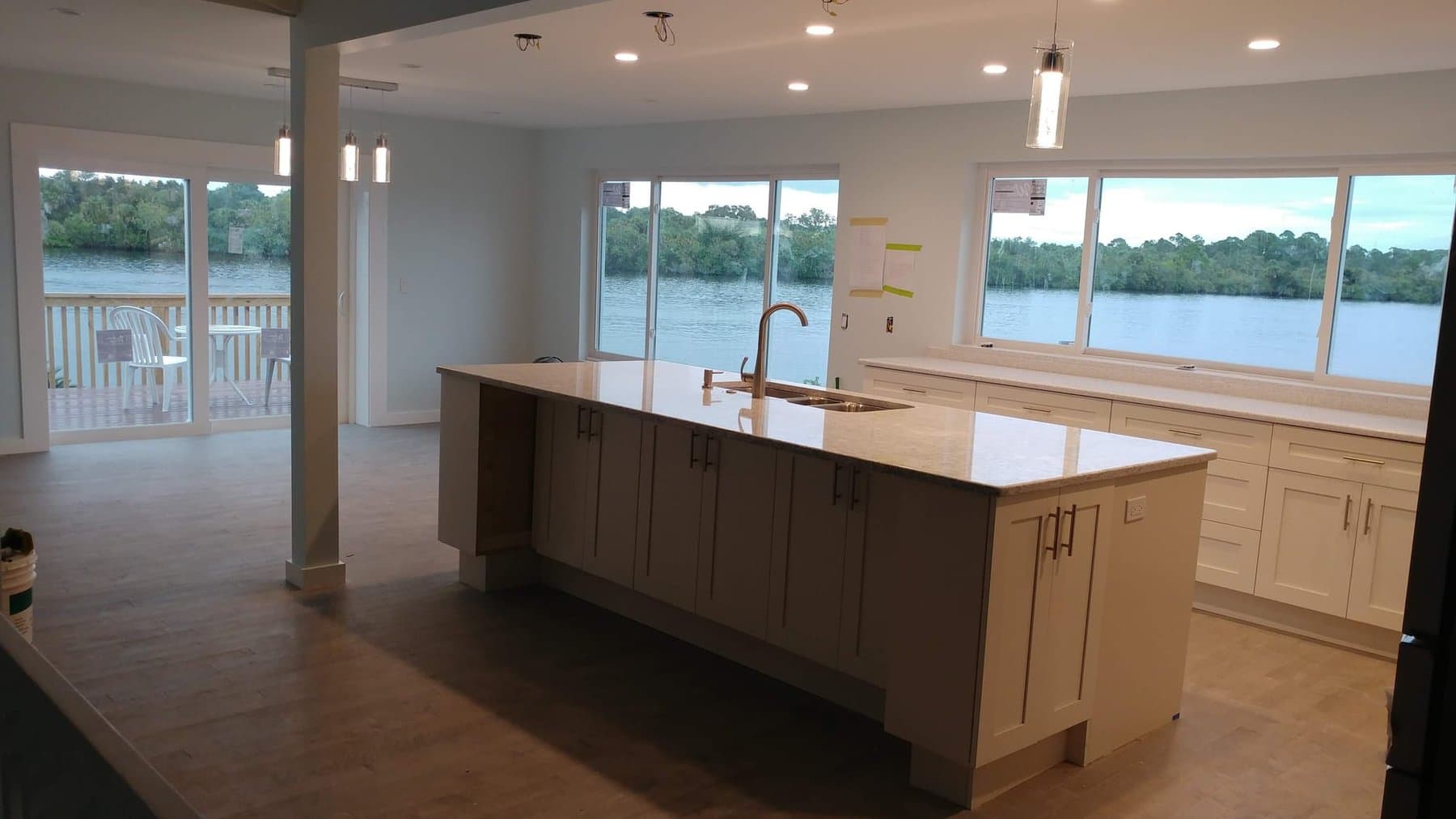
A custom home in St. Petersburg, Florida is a new-construction single-family dwelling designed to a homeowner-specific program (lot, layout, finishes, mechanicals) rather than a builder's stock plan — permitted under the Florida Building Code with coastal-Pinellas surcharges for FEMA elevation above Base Flood Elevation, 150 mph wind-zone hardened envelope, and Florida Product Approval (NOA) sourcing.
Updated April 2026. Building a custom home in St. Petersburg runs $1.2M–$2M+ all-in for a 3,000 sq ft home at current 2026 pricing, and that's before you add a pool. Base construction alone runs $350–$500/sq ft for a true custom home (with luxury waterfront crossing $700/sq ft), and most of our April 2026 jobsite projects land in the $400–$500 range inside a flood zone.
Both figures run meaningfully higher than the national averages on Angi or HomeLight because coastal Pinellas County sits in a 150 mph wind zone with layered code surcharges inland builders never face: FEMA elevation above the base flood elevation, FL Product Approval (NOA) sourcing on every window and door, hurricane strapping with Simpson Strong-Tie connectors, impact-rated glazing, soil that won't behave without a geotechnical report, and a Pinellas building department permit process with five mid-construction inspections (foundation, rough framing, rough-in MEP, insulation, and final) that can surprise even experienced developers.
At Revolution Contractors, we see this reaction constantly: if you're comparing that number to what you saw on a national home cost calculator and feeling confused, that's the right reaction. Here's what's actually in that number — and what's not.
In This Article
- What “Custom Home Cost” Actually Includes
- Cost Per Square Foot by Finish Level
- What Florida's Coastal Location Adds to the Bill
- The Hidden Costs Most Custom Home Budgets Miss
- Build vs. Buy vs. Renovate — The Real Math
- How Design-Build Changes the Cost Equation
- How Long Does It Take to Build a Custom Home?
- Frequently Asked Questions
What “Custom Home Cost” Actually Includes
Most cost guides lead with the base construction figure and call it a day. That's the number per square foot your builder charges to put walls, a roof, and finishes on your floor plan. It does not include land, design fees, permits, site prep, landscaping, pool, or the carrying costs you'll pay while the house gets built.
Here's what a realistic all-in budget looks like for a 3,000 sq ft custom home in St. Pete:
| Line Item (2026 Pricing) | Low | High |
|---|---|---|
| Land (infill/teardown lot) | $175,000 | $500,000+ |
| Design / Engineering | $60,000 | $120,000+ |
| Permits + Impact Fees | $17,000 | $28,000 |
| Site Development | $35,000 | $65,000 |
| Base Construction | $900,000 | $1,500,000 |
| Landscaping / Pool | $80,000 | $200,000+ |
| Contingency (10–15%) | $90,000 | $150,000 |
| Total All-In | $1.2M | $2M+ |
A concrete anchor from our custom home building services in St. Petersburg: we're building a custom home right now — all custom finishes, custom cabinetry, floating staircases (installed by specialty crews we coordinate), glass railings, high-end everything — and that project is coming in at $1.6–$1.7M. A 3,000 sq ft home at $400–$500/sq ft in a flood zone plus realistic land and soft costs puts your all-in budget in the $1.5M–$1.8M range. That's the number to plan around if you want a home in Snell Isle or along the water in South St. Pete.
“An important question that should be asked is the difference between custom homes and either semi-custom or builder-grade homes — there's a big difference. A builder-grade home might be built for $250 to $350 per square foot, whereas a full custom home — a one-of-one — is going to be $400+ up to $1,000/sqft for real luxurious waterfront homes. For a normal custom home that we are building right now, we're seeing them in the $400 to $500 per square foot range.”
Cost Per Square Foot by Finish Level
There's an important distinction between a builder-grade home and a true custom home. A builder-grade or semi-custom house — where you're picking from a few packages of finishes — can be built for $250–$350/sq ft. A full custom home — a one-of-one where you control every surface — is a different number. Here's how the tiers break down:
Builder-Grade / Semi-Custom ($250–$350/sq ft)
Solid construction with finish packages you choose from a menu. Good for first-time builders or investment properties. Below $300/sq ft is realistic for a straightforward build on non-flood-zone land. But this isn't what most people mean when they say “custom home.”
Custom (Non-Flood Zone) ($300–$400/sq ft)
Full custom finishes, your floor plan, your selections on every surface. If your lot doesn't require flood zone elevation work, this is your range. A 3,000 sq ft home at this tier runs $900K–$1.2M in base construction before land and soft costs.
Custom (Flood Zone) ($400–$500/sq ft)
This is where most of our current projects land. The coastal premium — pilings, elevated foundation, flood-compliant mechanical systems — adds at least 20% over a comparable inland build. For a line-by-line look at elevation costs, see our house elevation cost guide. A 2,000 sq ft flood zone custom home is going to be just shy of a million dollars or cross over it with nicer finishes. A 3,000 sq ft home runs $1.2M–$1.5M in base construction.
Ultra-Custom / Waterfront ($500–$1,000+/sq ft)
Barrier island builds on Tierra Verde, Snell Isle waterfront, or Pass-a-Grille with architect-level detail, custom millwork throughout, high-end finishes across every surface. The structural work alone — pilings, elevated mechanical systems, flood vents — is a different category. We haven't had a standard custom home cross $500/sq ft yet, but real luxury waterfront builds can reach $1,000/sq ft.
What Florida's Coastal Location Adds to the Bill
Here's where St. Pete gets expensive compared to inland Florida or what the national averages assume. Coastal Pinellas County has cost drivers that don't exist in Orlando or Tampa proper.
Flood Zone Foundation Work
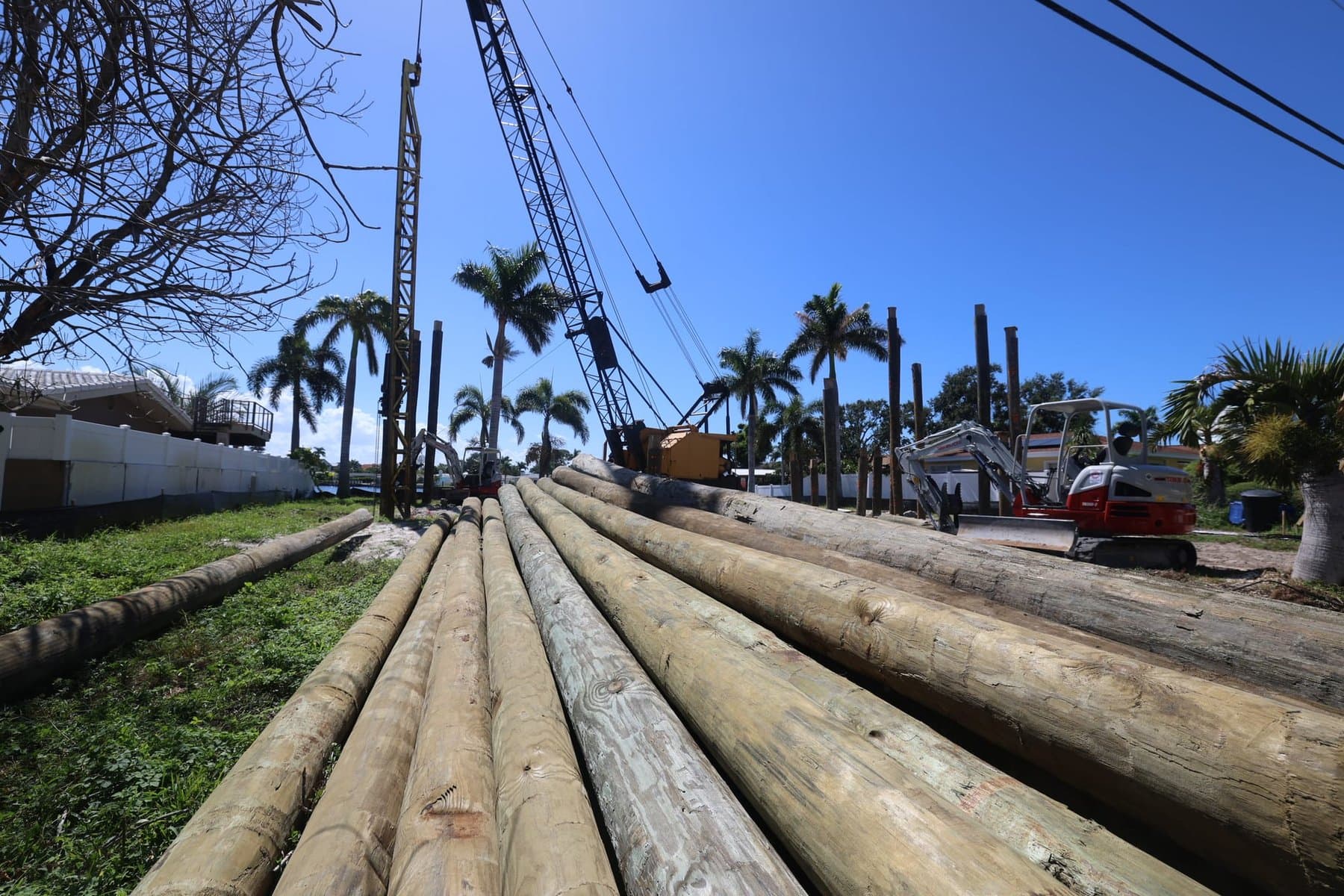
Most of St. Pete's desirable waterfront and near-water properties sit in AE or VE flood zones — federal designations that dictate how your home must be built. In an AE zone, your lowest occupied floor must be built at or above the Base Flood Elevation (BFE), the FEMA-calculated flood height for that specific location, plus one foot of freeboard (additional height Pinellas County requires on top of BFE). In a VE zone — which includes barrier island properties — you're required to build on pilings or piers.
About half the new builds we're doing in waterfront areas sit on soil dense enough for a standard stem wall foundation with spread footings. The other half need driven piles, which adds $50,000–$100,000 for a standard house between 2,000 and 4,000 sq ft. Combined with elevated mechanical systems, engineered flood vents in every stem wall compartment, breakaway walls on VE-zone enclosures, additional CMU masonry, and a post-construction elevation certificate stamped by a Florida surveyor, a house that might be $300–$400/sq ft inland on a slab on grade moves into the $400–$500/sq ft range — at least a 20% bump for the foundation, framing, and structural upgrades. Lenders also require builder's risk insurance and flood insurance during construction, layered on top of the construction loan interest carry.
Pinellas Soil Conditions
Here's something most builders won't tell you upfront: Pinellas County has a soil problem. The county's Fellowship Sandy Loam soil contains montmorillonitic clay, which shrinks and swells with moisture changes. In waterfront and near-water areas, you're often also dealing with sand, silt, and organic soils. Before your structural engineer can design your foundation, you'll need a geotechnical soil report — typically $3,000–$8,000 — and the results will shape your foundation design. This isn't optional for a custom build near water.
Hurricane-Rated Materials
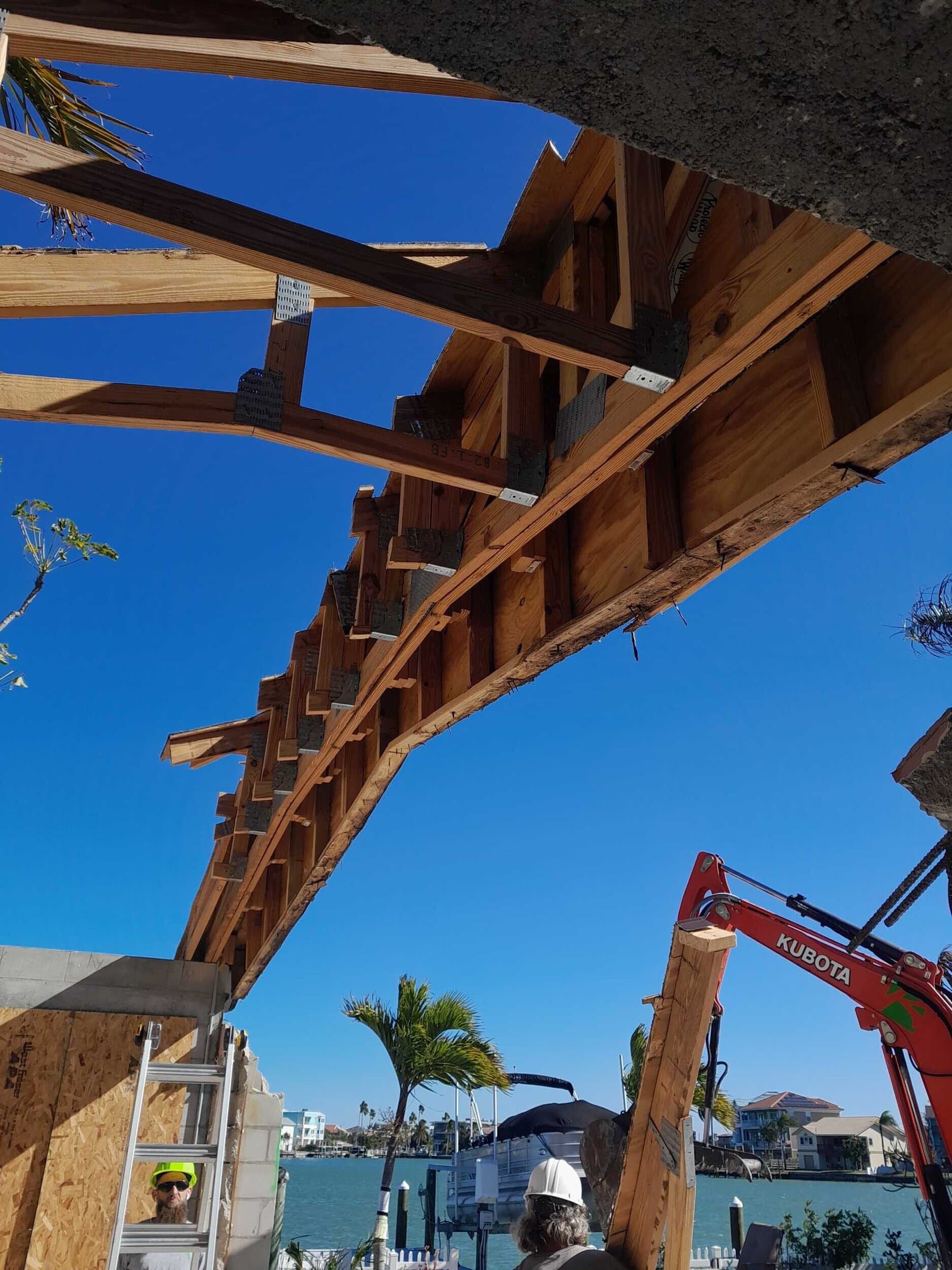
Florida's building code mandates 150 mph wind-rated construction throughout coastal Pinellas, and every exterior component must carry a Florida Product Approval (NOA) number the building department verifies at permit and rough framing inspection. On our current builds that means PGT WinGuard impact glass throughout (or equivalent CGI/ES Windows lines), Therma-Tru impact-rated entry doors, GAF Timberline HDZ architectural shingles on a ZIP System roof deck with peel-and-stick underlayment, Hardie board lap siding with LP SmartSide trim on gables and soffits, and Simpson Strong-Tie hurricane clips, straps, and hold-downs tying every truss to the top plate and every stud pack to the foundation.
Impact windows alone run $1,200–$2,500 per opening installed. A whole-home PGT WinGuard package for a 3,500 sq ft house: $27,000–$60,000+. Inside the walls, tile wet areas get a Schluter Kerdi waterproofing assembly rather than cement board, which is the difference between a bathroom that holds up and one that's a warranty call in year three.
The upside: a new home built to current code in coastal Pinellas will carry significantly lower flood insurance premiums than an older home at grade. For a home on Snell Isle or near Boca Ciega Bay, that gap can be $5,000–$8,000/year. Over 20 years, the new construction case gets financially stronger.
The Hidden Costs Most Custom Home Budgets Miss
These are the line items that don't show up in the builder's base quote — and where people who planned on a $1.5M budget find themselves at $1.8M.
Demolition and Lot Prep
Pinellas County is fully built out. There are no raw lots left in the neighborhoods where you want to build. Every buildable lot in St. Pete is either an infill lot — a gap where a house was torn down — or a teardown you buy specifically to demo. That means demolition is nearly a universal cost for our custom home clients here.
Tearing down an existing house: $10,000–$25,000. If the home was built before 1980 — which is common in St. Pete's older stock — asbestos testing is required, and abatement can add another $2,000–$15,000. Plan for it.
Permits and Impact Fees
In Pinellas County, permits and impact fees aren't just the building permit. You're looking at Pinellas County school impact fees ($4,500–$7,500), parks and recreation fees ($1,200–$2,000), water and sewer connection ($3,000–$6,000), transportation impact fees, and building permit fees ($3,500–$6,500) priced against construction value. Total: $17,000–$28,000. Note that if you're building in the City of St. Petersburg — not unincorporated Pinellas County — you'll be dealing with the City of St. Pete Building Department, which runs its own permit intake, plan review, and inspection queue separate from the county. Expect 6–12 weeks from plan submittal to permit issuance, plus HOA architectural review on top of that in gated neighborhoods and a Certificate of Appropriateness from the Old Northeast review board for any build inside a local historic district.
Construction Interest
If you're financing the build with a construction loan — which most custom home buyers do — you're paying interest-only draws during construction, then refinancing into an end loan at dry-in or certificate of occupancy. At current rates, a 14-month build on a $1.5M construction loan runs $60,000–$90,000 in interest carry before you ever move in, plus another $3,500–$6,000 in builder's risk insurance for the same window. None of that appears in your builder's contract. Waterfront lots add a seawall inspection (and potentially a $40,000–$150,000 seawall replacement if the existing wall is failing), which lenders will flag during appraisal.
Temporary Housing
If you're selling your current home to fund the build, you need somewhere to live during the 14–24 months of construction. Extended-stay hotels and short-term rentals in Pinellas run $100–$200/night. Three to six months of temporary housing adds $9,000–$36,000 to your real cost of building. Out-of-state relocators often underestimate this one.
Landscaping and Pool
Almost every builder's base quote excludes landscaping and pool. They're not wrong to — those are separate contracts. But budgeting landscaping at $15,000–$80,000+ and a pool at $60,000–$120,000+ (higher on barrier islands with permit and setback requirements) gets you to a finished-home number that's meaningfully different from the construction contract.
Not Sure Where Your Budget Lands?
We'll walk you through the build-vs-renovate math for your specific lot and flood zone before you commit to either direction.
Build vs. Buy vs. Renovate — The Real Math in St. Pete
A lot of people arrive at the “custom build” conversation after pricing out the alternatives. Here's how the math actually works in this market.
Buying Existing
St. Pete's median home price is around $449,000–$505,000, but that's not the segment you're shopping in. Premium neighborhoods — Snell Isle, Old Northeast, waterfront South St. Pete — run $800,000–$3M+ for existing homes. And those homes come with deferred maintenance, older systems, and often a flood zone problem that you inherit rather than solve.
Major Renovation (Buy + Gut)
This is where the FEMA 50% Rule becomes critical. In AE and VE flood zones, if your renovation exceeds 50% of the assessed structure value of the existing home, the entire structure must be brought to current flood zone code. That means elevation. That can mean pilings. A renovation that crossed the 50% threshold on a $400,000 assessed structure just became a $100,000–$200,000 more expensive project than you planned — and you're still working with an old house.
We've had clients whose lift-and-renovation path reached $800,000–$1 million — at which point it made logical sense to tear down and rebuild a new home at $1.2–$1.5M for the larger square footage they actually wanted. Most of the mitigation projects we've looked at have gotten exorbitant enough to push people into rebuilding. For clients who want more space without starting from scratch, building an addition instead of a full custom home sometimes lands better with the numbers and the timeline.
Custom Build
All-in cost of $1.2M–$2M+ is a real number. But so is an insurance premium that's $5,000–$8,000/year lower than the existing structure next door, a home built exactly to your floor plan and finish preferences, and no deferred maintenance surprises on day one.
For buyers with a $1.5M+ budget in coastal St. Pete, the gap between buying existing, renovating, and building new is often closer than it appears. Run the 10-year total-cost calculation before you decide renovation is the conservative choice. Not sure which path makes sense? Read our remodel, add on, or build new comparison.
How Design-Build Changes the Cost Equation
Here's a stat worth knowing: research on traditional project delivery shows cost overruns of 15–30% are common. A $1.5M project becomes $1.7M–$1.95M by the end.
The traditional path — hire an architect to design, then put the plans out to bid — has a structural cost problem. The architect designs without knowing what the GC will bid. The GC bids based on plans, not budget constraints. When bids come back high, you're back to redesign at additional design fee cost.
Design-build compresses that. Design and budget develop simultaneously, which means your architect isn't designing a kitchen that the budget can't support. The data shows design-build projects run about 3% over budget on average — versus 15–30% on traditional delivery.
We operate on a Time & Materials (T&M) model, which takes that one step further. Instead of a fixed-price contract with a contingency cushion built into the builder's number, you pay for actual costs — labor and materials — with our markup applied. You get weekly budget reports and see every invoice. There's no padding built into the quote to cover the builder's risk; instead, you have real-time visibility into where your money is going. For clients who are used to managing investments and businesses, this model makes sense immediately.
In-house labor is the other piece. We have 20+ W-2 carpenters on payroll and a dedicated superintendent running each custom home build — they work for us, not for whoever's paying most that week. On a custom home project, that means schedule control from the day the foundation forms come out of the ground through final punch list. We're not waiting on subs to finish another job before your rough framing crew shows up, and our superintendent is on-site every day the building department inspects (foundation, rough framing, rough-in MEP, insulation, final) rather than calling it in from a trailer across town.
How Long Does It Take to Build a Custom Home in St. Pete?
It often takes two years to go from concept to move-in. No matter how decisive and motivated you are, a custom new home takes longer than you think. Here's what's inside that window:
Design: 3–6 months with an architect, depending on how decisive you are about the plan. If you already have a full set of blueprints, this compresses. If you're starting from a concept, expect the full range.
Permitting: 3–6 months for a new home. Pinellas County permit review runs 10–30 days once submitted; City of St. Pete runs its own permitting authority on a separate timeline. Design-build compresses the design-to-permit phase by running design and estimating simultaneously instead of sequentially.
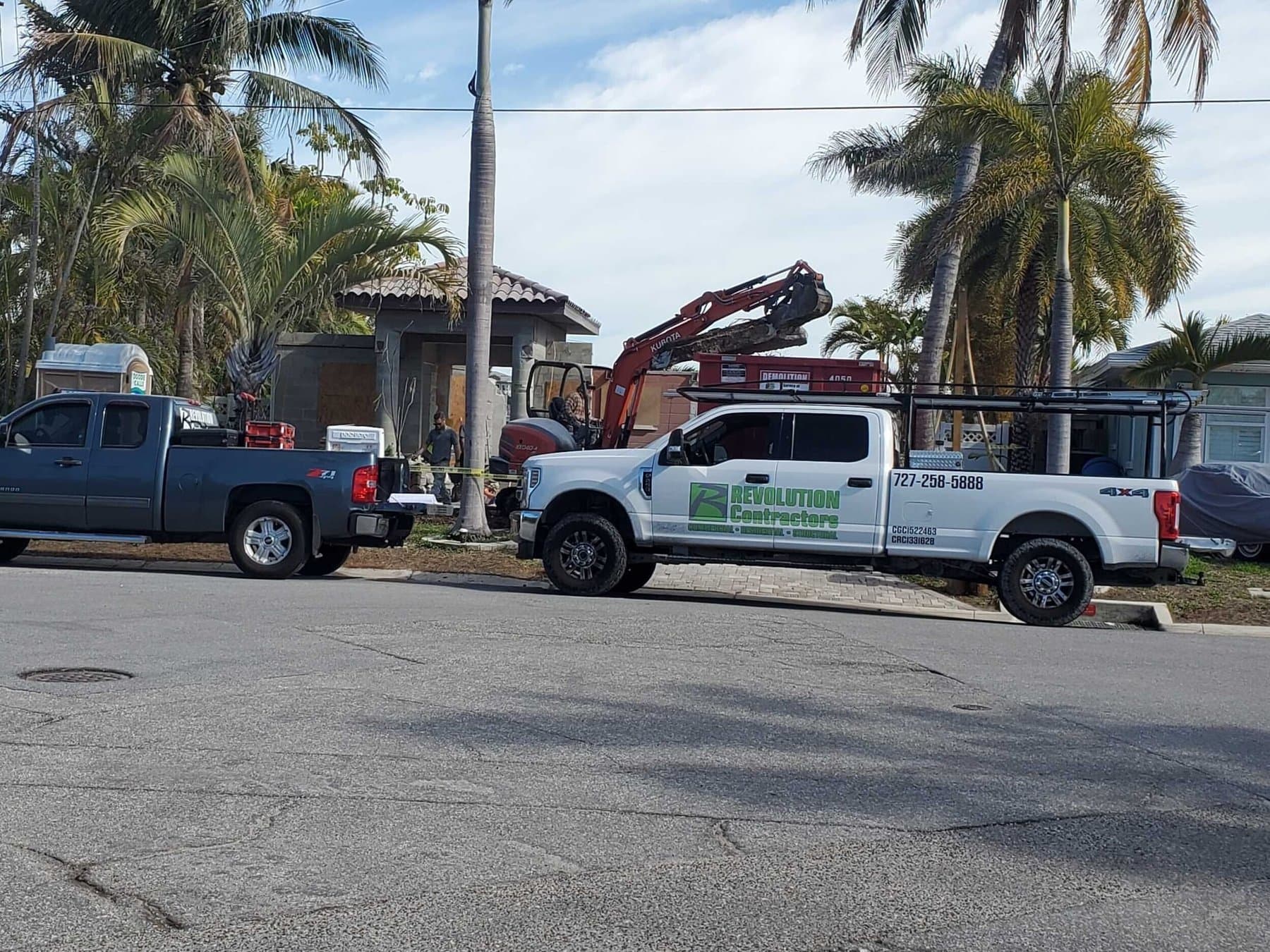
Construction: 10–14 months for most custom homes, broken into recognizable phases we report weekly: site clear and foundation 4–6 weeks, rough framing and trusses 6–8 weeks, dry-in (roof deck, windows, doors) 8–12 weeks from foundation pour, rough-in MEP and insulation 4–6 weeks, drywall through finish 16–20 weeks, then punch list and CO. If you're in a flood zone requiring driven pilings, extensive underpinning, and high-end custom cabinetry, it can stretch longer. Hurricane season (June–November) slows exterior work and creates material delivery delays on impact glass and GAF shingles.
Realistic total: 16–24 months from the first design meeting to move-in day. If you need to find a lot first, add 1–3 months up front — Pinellas is fully built out, so you're watching for teardown or infill lots. Good ones move fast.
The timeline implication for out-of-state relocators: if you're planning to be in your St. Pete home in 18 months, you need to be calling builders now.
Code-driven cost drivers you'll see on the budget: HERS rating pathway and 2026 energy code. See our deep dive on the Florida HERS rating energy code compliance for custom homes, which breaks down the two pathways, where upgrades pay back, and what code regulates on a new build.
Frequently Asked Questions
How much does it cost to build a custom home in St. Petersburg?
Custom homes in St. Pete generally run $350–$600 per square foot for the build itself, not counting land. A 3,000 sq ft custom home lands $1.05M–$1.8M. Waterfront builds in Snell Isle, Shore Acres, or Tierra Verde push $500–$750/sq ft because of FEMA elevation, foundation work, and impact-rated openings. We run Time & Materials with weekly budget reports — you see real costs, not a padded fixed bid.
How much does land cost in St. Pete for a custom home?
Buildable lots in core St. Pete neighborhoods run $250K–$500K for non-waterfront and $600K–$2M+ for waterfront. Old Northeast and Snell Isle teardowns frequently exceed $700K for the lot alone. Coastal lots in Shore Acres or Venetian Isles vary wildly by elevation and seawall condition — both factors that drive build cost too. Always evaluate the lot's flood zone before you close.
What's the difference between a custom home and a semi-custom home?
A true custom home is designed for your lot and your family from a blank sheet — architect, structural engineer, every decision yours. A semi-custom is a stock plan with finish-level choices. In St. Pete, custom is the right call for any waterfront lot, any historic district, and any irregular lot, because stock plans don't account for FEMA elevation, setback quirks, or review-board requirements. We work as a hybrid — we coordinate design and construction under one contract, but pair you with an independent architect or designer rather than carrying designers in-house. That keeps your design IP yours and gives you a single point of accountability through Revolution as the GC.
How long does it take to build a custom home in St. Pete?
Plan on 14–22 months from contract to move-in for a 3,000–5,000 sq ft custom build. Pre-construction (design, engineering, permitting) is 4–8 months. The build itself runs 10–14 months. Coastal builds take longer because of FEMA documentation and elevation inspections. We give you a real schedule at pre-construction and update it weekly — not the optimistic version most builders pitch.
What does a custom home cost per square foot in St. Petersburg in 2026?
These are ranges from active 2026 St. Pete projects, not fixed-price quotes — every custom home is priced from the actual lot, BFE, soil report, and selection set. Builder-grade or semi-custom runs $250–$350/sq ft. True custom on a non-flood-zone lot runs $350–$425/sq ft. Custom inside an AE or VE flood zone — which is most of the waterfront and near-water neighborhoods — runs $425–$525/sq ft because of stem wall or piling foundations, elevated mechanical systems, PGT WinGuard impact glass, and Simpson Strong-Tie hurricane connectors on every connection. Ultra-custom waterfront builds on Snell Isle or Tierra Verde with architect-level millwork can reach $700–$1,000/sq ft. Those are base construction numbers — add 25–35% on top for land, design, permits, impact fees, contingency, and construction loan interest carry to get to a realistic all-in budget.
How much do FEMA elevation requirements add to a custom home cost in a Pinellas flood zone?
Building to current FEMA requirements in an AE or VE zone typically adds $75,000–$200,000+ versus an equivalent inland slab-on-grade house. The line items: a geotechnical soil report ($3,000–$8,000), driven piles if soil bearing capacity is inadequate ($50,000–$100,000), stem wall foundation with engineered flood vents or breakaway walls in VE zones ($25,000–$60,000 over a standard footing), elevated HVAC and electrical panels above base flood elevation plus one foot of Pinellas County freeboard ($8,000–$15,000), a post-construction elevation certificate ($700–$1,500), and builder's risk plus flood insurance during construction ($5,000–$10,000). The payoff: a home built to current code carries $5,000–$8,000/year lower flood insurance than the pre-FIRM house next door, which recovers the elevation premium over 15–20 years.
Why is Time & Materials better than fixed-price for custom homes?
On a fixed-price custom build, the contractor pads every line item to cover their risk on unknowns — bad soil, hidden water, code changes during permitting. You pay for that padding whether the risks materialize or not. With T&M, you pay for what we actually use, plus a transparent markup. Open book. Weekly budget reports. On a $1.5M build that usually saves 10–20% versus a fixed bid with the same scope.
What 2026 cost pressures are actually moving the number on a St. Pete custom home right now?
Three real pressures are hitting builds priced this year: (1) impact-rated openings — PGT WinGuard and comparable products are up meaningfully from 2024 quotes, and specification lead times have stretched on larger multi-slide door units; (2) permit + impact fee schedules — Pinellas County + City of St. Petersburg fee tables have been re-published for the current cycle, and impact fees on a 3,000 SF new-construction custom home now routinely land in five figures; (3) construction-loan interest carry — with rates where they are through mid-2026, the interest cost during a 10–14 month build is a real budget line, not a rounding error. Bake all three into pre-construction, not into a change-order surprise at month six.
Ready to Talk Numbers?
Custom home budgets in St. Pete are specific to your lot, your flood zone, and your finish preferences. The ranges here are accurate starting points — but your actual number depends on a geotechnical report, your BFE, your lot size, and what you want inside the house.
We've built in every flood zone in Pinellas. We know what FEMA wants, what the City of St. Pete's building department expects, and what a realistic construction timeline looks like in this market. If you want a straight conversation about whether your budget fits your vision, let's take a look together.
Contact Revolution Contractors — or learn more about our custom home building process and coastal construction expertise.
Related reading: Custom Home Build Timeline | The Custom Home Building Process | Home Building Checklist for Florida | Remodel, Add On, or Build New? | Luxury Home Remodeling in St. Pete | Home Addition Cost Guide