The Setup — What Downtown High-Rise Remodels Look Like from the Contractor's Side
Downtown high-rise condo remodels are not house remodels with elevator access. They are a completely different logistics problem.
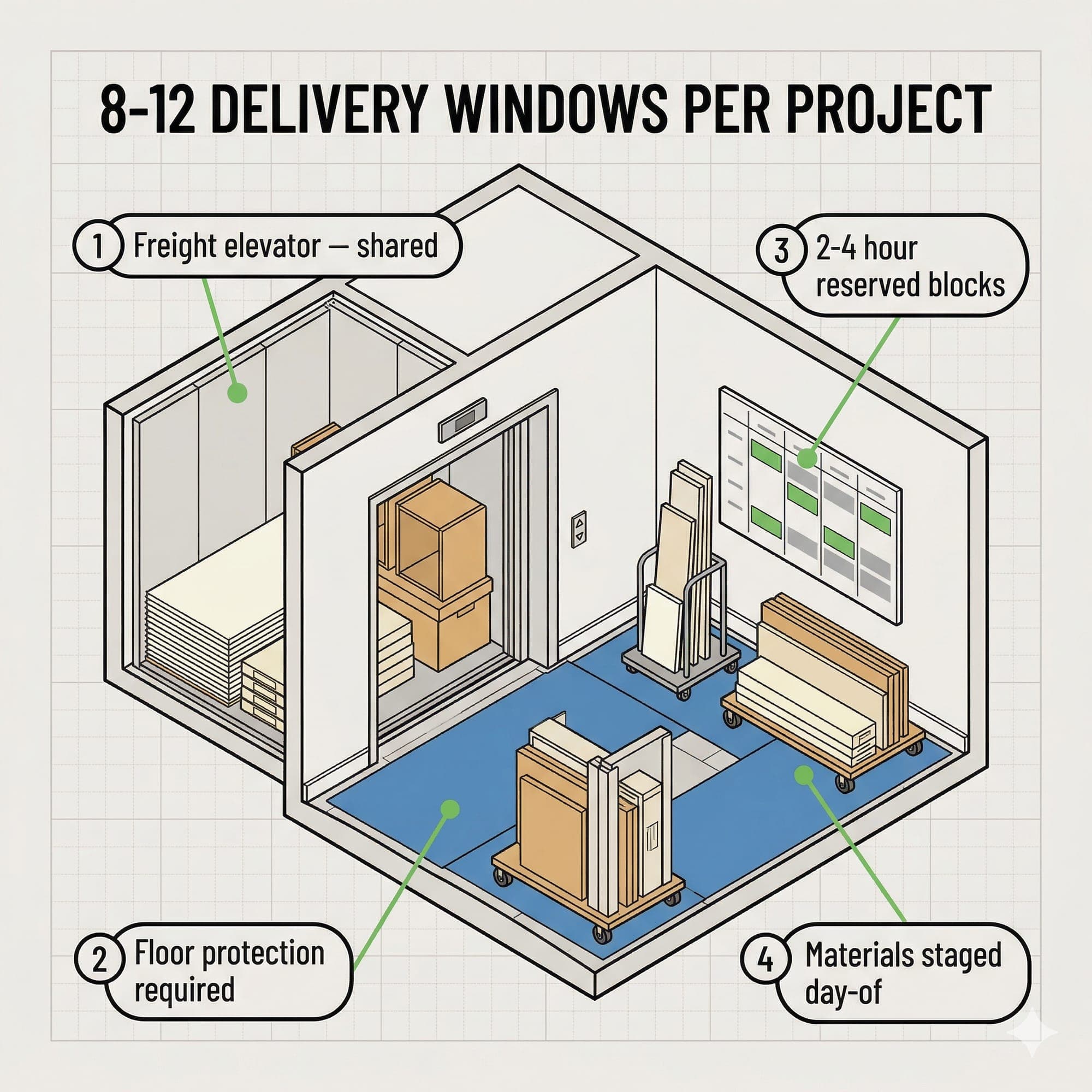
In a house, tools and materials come off a truck and walk in through the front door. In a downtown St. Petersburg tower, everything is elevator-gated. Every board of trim, every drywall sheet, every tool bag, every subcontractor visit, every bag of construction debris on its way out. All of it moves through a single service elevator that the building shares between contractors, delivery crews, dog walkers, movers, and residents doing their own weekend errands.
HOAs schedule contractor access to that elevator. Most downtown St. Pete condo associations allow contractor use only during specific hours — typically 9am to 3pm on weekdays. That is a six-hour window, and inside that window the elevator is not exclusively yours. You wait your turn behind residents and other trades. When the window closes, your crew stops moving material regardless of whether they are done for the day. The workday is compressed before it even starts.
Common-area protection is a daily discipline. Every path from the loading dock or service elevator to the unit door has to be laid with heavy floor protection. Corners get guards. Walls get film in the high-traffic sections. Elevator interiors get wall padding on the days you are moving material. All of that goes down at the start of the day and comes up at the end — you cannot leave a hallway looking like a construction zone when residents are walking through it in the evening.
Neighbor relations are the other half of the job. Every unit in a downtown tower shares walls, ceilings, and floors with another unit. When you jackhammer a floor to run new plumbing, three neighbors hear it. When you cut into a ceiling to add cans, the unit above knows. In higher-end downtown buildings, that means written notice on doors before the loudest work, tight windows for jackhammering, and enough direct human contact with the residents on either side that they know your project manager's name and phone number.
Under Florida law, buildings over four stories require the general contractor to hold a commercial unlimited GC license — a different license class from the residential GC license that covers single-family work. Rev holds CGC1522463 (commercial unlimited, held through Revolution Contractors Commercial LLC, Current through 8/31/2028 per DBPR), which is what allows us to work on downtown high-rises legally. A residential-only contractor cannot take these jobs. If the building's HOA or the city's permit office catches a residential GC on a high-rise project, the project stops.
The Service Elevator Problem
Every downtown remodel runs into some version of this. On one project, it happened at the worst possible scale.
Here is Jeremy Wharton, Revolution's owner, describing it in his own words from a 2026-01-21 interview:
Twenty-eight flights.
The building's service elevator — the one Revolution's carpenters were supposed to use to bring tools, materials, and debris up and down — was shared with residents walking dogs. Some days it worked. Some days it didn't. On the days it didn't, the crew had two choices: sit on the loading dock and burn billable hours doing nothing, or grab their tools and go up the stairs.
They chose the stairs. Twenty-eight flights up in the morning with tool bags. Twenty-eight flights down at the end of the day. And whatever material and debris runs happened in between — on stairs, on their backs, because the elevator was down.
That is not a story a contractor tells in a proposal meeting. It sounds bad. It sounds like something that would push a project sideways. What it actually did — because of the way Revolution bills — was pass through to the owner as a factual line item on a weekly report, with the reason explained in plain English: elevator down, crew took the stairs, this many hours logged.
Why Time and Materials Made This Project Viable
Most contractors quote condo remodels fixed-price. It is what clients expect. It feels safer.
Fixed-price does not survive elevator uncertainty. It does not survive building-system failures that no contractor controls. It does not survive HOA-scheduled work windows that compress the day. It does not survive shared-service-elevator queuing behind dog owners on the seventh floor.
Every one of those unknowns has a cost. A fixed-price contractor either pads the initial quote to cover the worst case — driving the price higher than the job actually deserves — or quotes tight and absorbs the loss when reality lands. Neither serves the owner. In the first case, the owner overpays for a scenario that may or may not happen. In the second case, either the contractor eats the loss (which no contractor stays in business doing) or cuts corners downstream to make it up (which the owner pays for in a different way — thinner materials, sub-crew instead of in-house labor, faster finish work than the scope deserves).
Time and Materials open-book billing serves the owner by removing the guess. Every hour a Revolution carpenter spent on this project was logged against a specific task — framing, plumbing rough-in, cabinetry install, stair-hauling because the elevator was down. Every hour showed up on the weekly budget report. Materials came through at cost, with markup disclosed line by line. Subcontractor invoices came through the same way. When the elevator broke down and the crew took to the stairs, the owner saw those hours on the report the following Friday, with the reason attached: elevator out, crew took the stairs, this many hours, this cost.
That is not fun to explain in a proposal meeting. Owners want certainty. But certainty in high-rise construction is a story contractors tell themselves. Reality is a shared service elevator that malfunctions after COVID. T&M meets reality. Fixed-price pretends it does not exist.
Our condo remodel service page walks through how the T&M model works from an owner's side — what the weekly report looks like, what happens when the scope changes, and how change orders are handled.
What We Do Differently on Downtown Condo Projects
Five things separate a downtown high-rise remodel that goes well from one that goes sideways. On this project, all five were built into the daily plan from day one.
HOA elevator-window scheduling
Every morning, the superintendent verified elevator availability with building management before the crew arrived. Material deliveries were scheduled around the HOA's allowed windows — never dropped off cold. Trash removal was staged for end-of-day (or end-of-window, whichever came first). Loading-dock reservations were coordinated with the building's front-desk staff a day ahead. When the elevator went down mid-day, the plan pivoted to work that did not require material movement — finish carpentry, punch-list, in-unit tasks — so the crew stayed productive instead of idle.
In-house W-2 carpenters, not a paper-contractor sub-lookup
Revolution has 20+ carpenters on W-2 payroll — real employees, not day-labor and not subcontracted crews that shuffle between contractors week to week. That structural difference is what let the crew hike 28 flights of stairs with tools when the elevator was down. You do not ask a subcontracted labor pool to do that. Subs bill by the job or the day and they leave when the elevator quits working. In-house W-2 crews stay on the clock and figure it out. Every hour they figured it out was captured in the T&M report.
Neighbor-relations discipline
Written notice on the doors of neighbors sharing walls, ceilings, or floors before the loudest work. Short windows for jackhammering — never open-ended demolition. Dust barriers at every unit boundary. Hallway protection from the elevator to the unit door, replaced daily. Elevator interior protection when the crew was moving material. The named PM on this project made a point of introducing himself to the neighbors on either side of the unit in the first week, so if a complaint came up they had a name and a phone number to reach directly instead of routing everything through the HOA board.
Chapter 718 (Florida Condominium Act) awareness
Downtown condo work runs under Chapter 718 of the Florida Statutes, which governs how condominiums are managed and how construction liens attach in a condominium setting. HOA applications, permit copies, insurance certificates, and lien-waiver paperwork all need to be handled correctly or the project will not clear its final inspection. On this project, all of the HOA-required documentation was submitted before work started — a week or two of front-end paperwork that some contractors try to shortcut and later regret.
Named lead carpenter on every project
A specific named superintendent led this project — the same person from kickoff through final walkthrough. The owner had one point of contact for the entire build, not a rotating cast of project managers. That continuity matters more on downtown high-rise projects than almost any other kind of work, because so much of the daily job is coordination with building management, neighbors, and HOA staff — relationships that only work when one Rev person owns them for the full project.
What Downtown Dwellers Should Ask Their Contractor Before Signing
If you are remodeling a downtown St. Pete condo, these are the six questions that separate a contractor who knows this work from one who is guessing at it. Ask them all before you sign.
How do you handle unpredictable elevator delays on a downtown condo remodel?
We build the elevator schedule into the daily plan and then bill actual hours through open-book Time & Materials. When the elevator works, the crew moves fast and hours reflect that. When it breaks down, we adapt — sometimes that means carrying tools up the stairs, sometimes it means staging deliveries around the outage — and every hour is captured line-by-line on the weekly budget report so the owner sees exactly where the time went.
Do you pad your bid for HOA common-area complications, or bill actual?
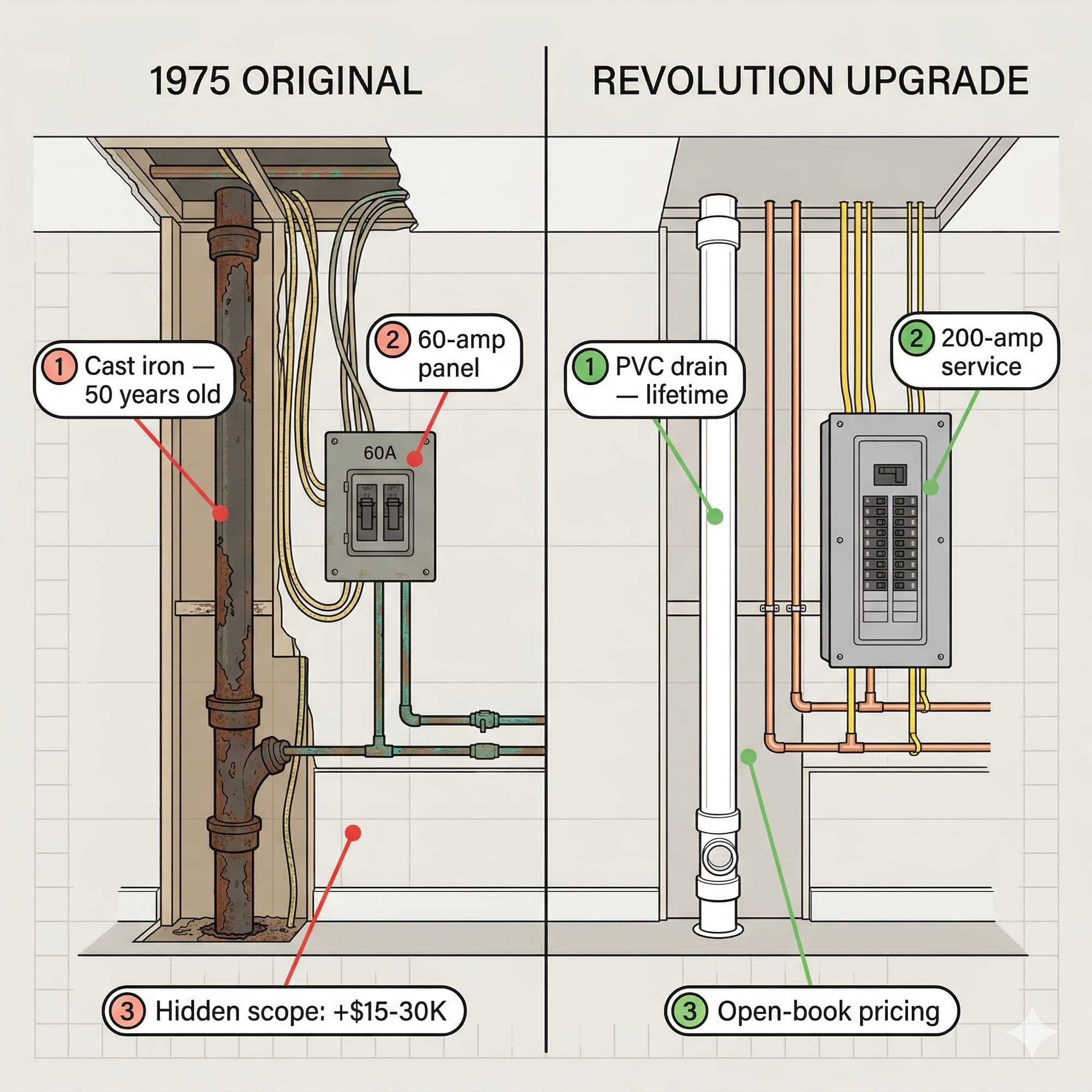
We bill actual. Our contracts are Time & Materials with open-book pricing, so the owner sees a weekly report showing labor hours by trade, materials at cost with markup disclosed, and every change order. On a downtown condo remodel with unpredictable elevator access and HOA-scheduled work windows, that transparency matters more than in a single-family remodel — because there are more variables outside anyone's control.
How many downtown St. Pete high-rise remodels have you done?
Revolution has worked on multiple downtown St. Petersburg high-rise condo projects going back to 2016 — kitchens, baths, whole-unit remodels, and repair work in buildings across the downtown core. Our team knows the HOA rhythms, the parking constraints, the loading dock schedules, and the neighbor-relations discipline these buildings require.
What happens if my neighbor complains about noise or dust?
We work to prevent complaints before they happen. Dust barriers at every unit boundary. Hallway floor protection. Elevator interior protection when we're using it. Written notice on neighboring doors before any jackhammering, and short windows for the loudest work. When a neighbor complains anyway — and sometimes one will — we respond directly, adjust if the complaint is reasonable, and document the exchange for the owner and the HOA.
How do you protect the hallway carpet and common-area flooring?
Ram board or heavy corrugated protection along the walked path from the service elevator to the unit door, taped at seams. Corner guards on turns. Wall protection where tools might swing. Daily sweep of the protected path. When we finish the project, the common area is returned in the condition we found it — that's a written condition of every downtown condo contract we sign, and it's how we stay welcome in the building.
Do you need a special license for downtown high-rise condo work?
Yes. Florida requires a commercial unlimited general contractor license for buildings over four stories. Revolution holds CGC1522463 (commercial unlimited, held by Brent Patterson through Revolution Contractors Commercial LLC, Current through 8/31/2028 per DBPR). Any contractor working on a downtown high-rise without that license is doing so improperly — and if a permit application surfaces that issue, the project stops.
Remodeling a downtown St. Pete condo?
Revolution has been running high-rise condo remodels in downtown St. Petersburg since 2016. Florida-licensed (CRC1331628 residential, CGC1522463 commercial unlimited for buildings over four stories), around 20 W-2 carpenters on payroll, open-book Time & Materials billing with weekly budget reports. We know the HOA rhythms, the loading-dock schedules, and the elevator windows in the downtown core.
Related Reading
- Downtown Condos in St. Petersburg → — neighborhood service page with elevator, HOA, and Chapter 718 detail
- Condo Remodel Service → — full service page: scope, pricing model, timeline expectations
- King House: Old Southeast Historic Restoration → — Rev's flagship 2025 Preserve the ‘Burg award-winning case study
- All Case Studies →
Anonymous by request — client name, building name, unit number, floor number, and project photos are withheld to protect owner privacy in a shared high-rise environment. Rev-side narrative and licensing details are verifiable through Florida DBPR and Revolution's public licensing records.