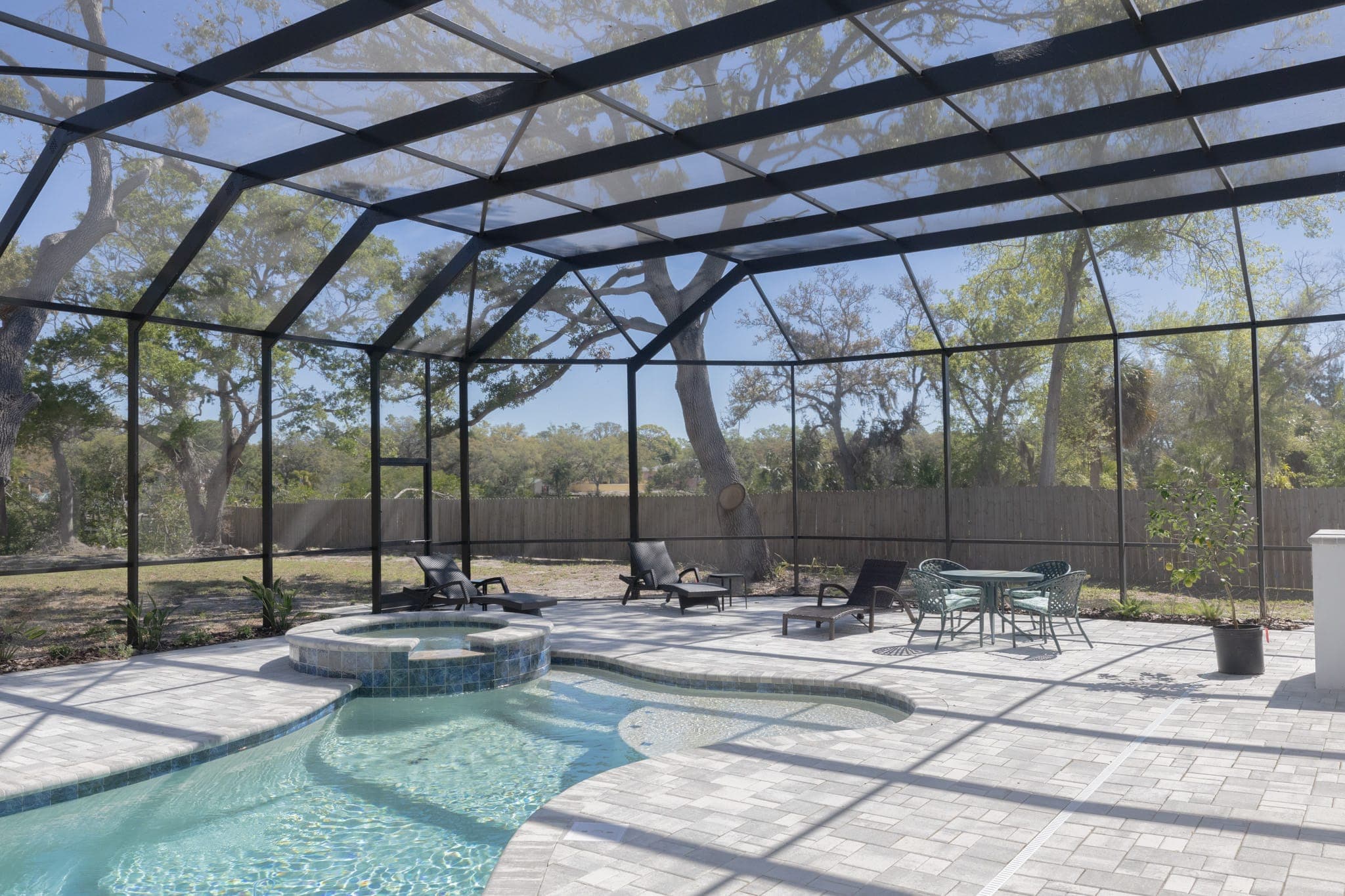
The deck around an oblong curved pool is a different problem than the deck behind a rectangular house. Curves run in multiple directions. Board orientation matters because the eye picks up every short joint that doesn’t line up with the pool’s geometry. And on a waterfront property where the deck transitions down to a private dock, the framing changes elevation, structure, and load along the way.
This Dolphin Drive project was that kind of problem. The owner came to Revolution wanting two things at once: a material upgrade from old wooden deck boards to premium composite, and a layout change so the new boards would run in a direction that actually made sense for the way the deck and the pool live together. The original board layout fought the geometry. The new one would honor it.
What the Job Actually Required
The deck wasn’t a tear-out-and-flip. Three pieces of substrate work had to happen before any composite board went down.
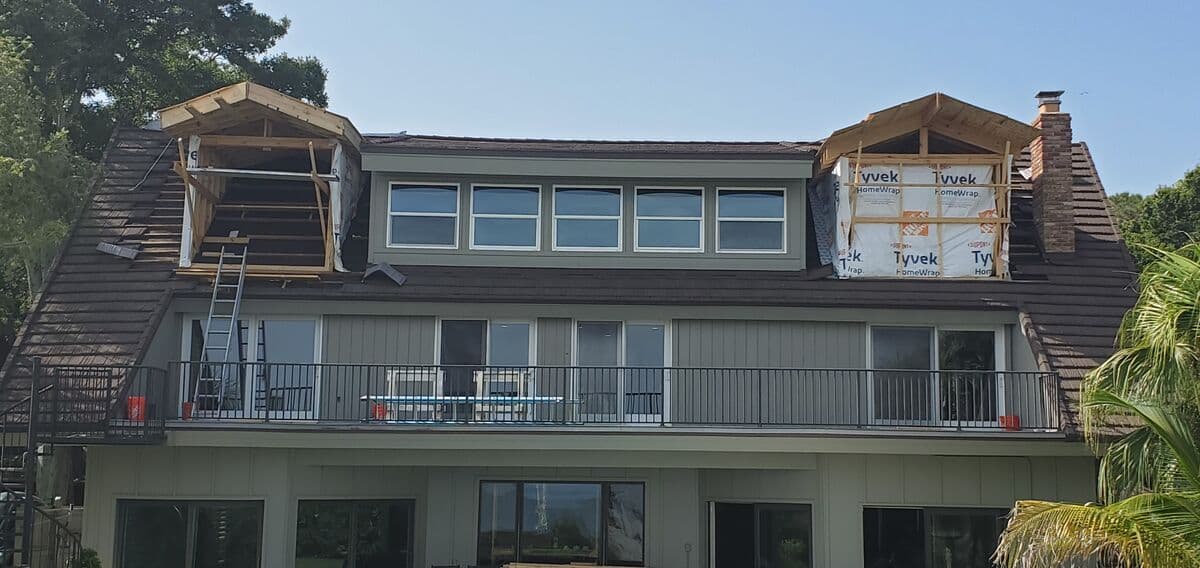
Reframing for the new direction. Composite deck boards don’t bend around a curved pool, and they don’t tolerate the wrong joist spacing. When the client wanted the boards to run in a new orientation — perpendicular to the pathway in some sections, matching the multi-level deck’s lines in others — the framing underneath had to change to support the new layout. Our crew installed pickup framing where the original frame couldn’t accommodate the new direction.
Sistering and structural repairs. Some of the existing framing needed reinforcement before any new boards went down. Joists got sistered and structural repairs went in wherever the original frame had aged or the new layout demanded more support. Putting expensive composite over questionable framing is a way to throw $55,000 at the ground; we didn’t do that.
Extending the framing down to the dock. The deck didn’t end at the pool. It stepped down through grade changes to the client’s private dock, which meant the framing had to follow the elevations correctly and the pickup framing had to integrate with the existing dock structure without introducing movement or a soft transition at the step.
Why the Board Layout Decisions Matter
Premium composite is a different material economy than pressure-treated wood. The boards are expensive enough that waste matters, and the lengths are restrictive enough that planning saves real money.
Our crew used full 16-foot boards in the long uninterrupted runs where the geometry supported a single piece. In the shorter sections — around the pool’s curves and where the deck stepped down to the dock — the cuts came off the shorter 12-foot or 8-foot stock so we weren’t wasting half a 16-footer for a 5-foot run.
This is the kind of math that only matters if you actually do it. Skip the layout planning step and you order more material than you need, your seams land in places that look wrong, and the boards meeting the curves don’t line up with the pool’s eye line. On a $55,000 material-first scope, that’s the difference between a deck that reads intentional and one that reads like it was assembled in a hurry.
What the Client Got
A pool deck where the board direction actually matches the pool’s curves. A multi-level system that flows visually from the pool deck down to the dock. Composite that is going to outlast the wood it replaced by a generation, with no annual sealing, no rotting, and no splinters underfoot.
Three weeks in the field. $55,000. A waterfront outdoor system that’s ready for the next 20 years of Pinellas sun, salt, and pool-side traffic without asking the owner for another rebuild cycle.
Considering a Pool Deck or Dock Rebuild on Your Own Waterfront Property?
Revolution handles waterfront pool decks, dock framing, and composite rebuilds across St. Petersburg and Tampa Bay. Florida-licensed (CRC1331628 + CGC1522463), founded 2016, open-book Time & Materials with weekly budget updates. We don’t take the cheap path on framing under expensive materials.
Related Reading
See more projects on our case studies index. Revolution Contractors is Florida-licensed (CRC1331628 + CGC1522463) and runs every project as open-book Time & Materials.