Kitchen Electrical Code in Florida: NEC Article 210, FBC-R E3901, and GFCI/AFCI Requirements

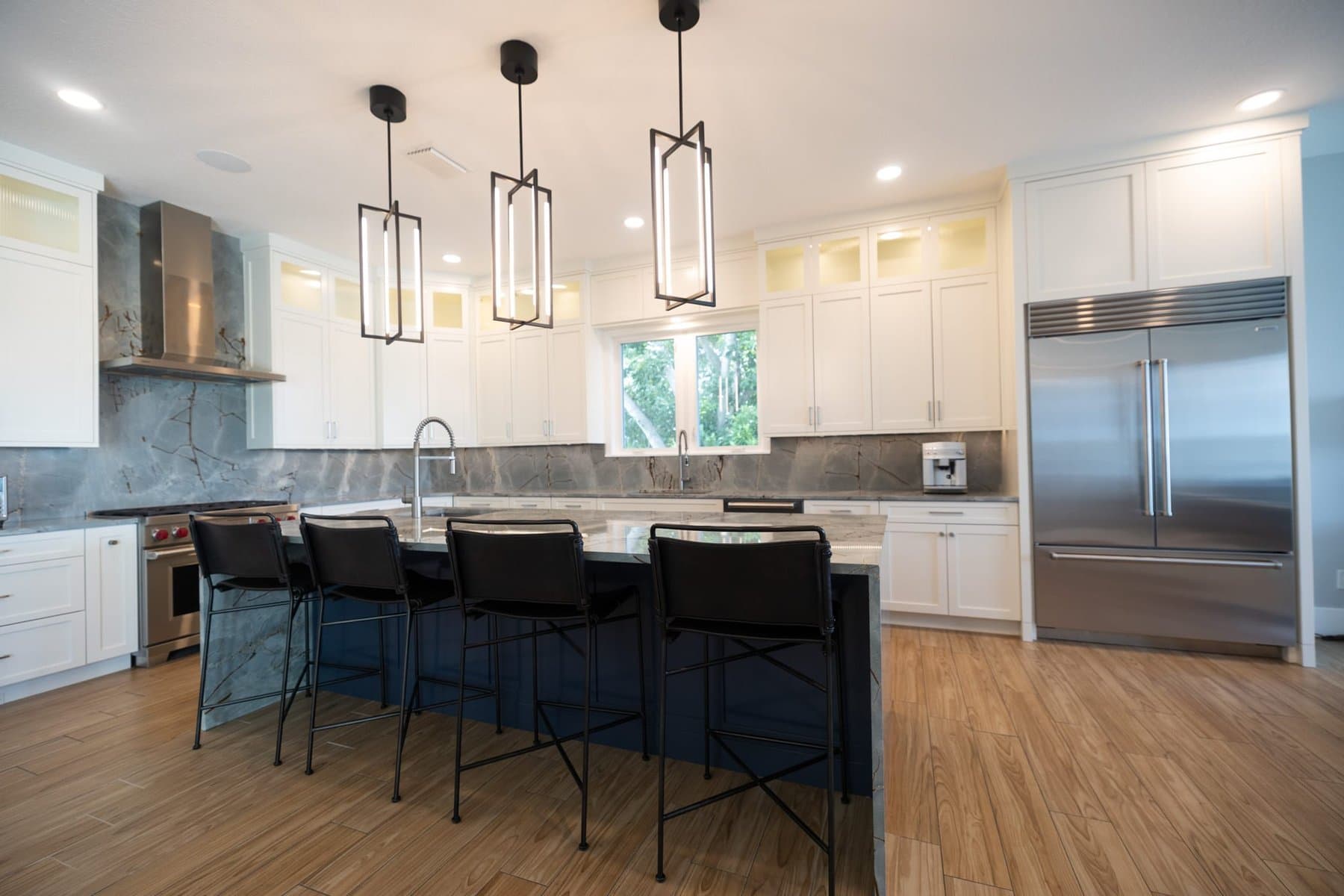
Kitchen electrical is the single most-regulated system in a residential remodel. Every countertop receptacle, every under-cabinet light, every dishwasher, every disposal, and every island outlet has its own code section, and most of the rules that were "nice to have" in a 1990s kitchen are now hard failures at a Pinellas rough-in inspection.
This guide walks the specific code sections that govern kitchen electrical work in a Florida residential remodel, receptacle spacing, GFCI and AFCI protection, small-appliance branch circuits, island receptacle rules, dishwasher and disposal circuits, and range/oven branch circuits, cited by chapter, article, and section number so a contractor, inspector, or homeowner can pull the same regulation and see the same answer.
Core answer: A code-compliant kitchen in Florida requires (1) at least two 20-amp small-appliance branch circuits serving countertop receptacles per NEC Article 210.11(C)(1) and FBC-R Section E3703.2, (2) receptacles spaced so no point along the countertop wall is more than 24 inches from a receptacle per NEC Article 210.52(C)(1) and FBC-R Section E3901.4.1, (3) GFCI protection on all 125-volt, 15- and 20-amp receptacles serving countertop and within 6 feet of any sink per NEC Article 210.8(A)(6) and (A)(7), (4) AFCI protection on all 15- and 20-amp branch circuits supplying receptacles and lighting in kitchens per NEC Article 210.12(A) and FBC-R Section E3902.16, (5) a dedicated 20-amp circuit for the dishwasher per NEC Article 422.16(B)(2), and (6) island receptacles installed per the 2023 NEC 210.52(C)(2) rewrite. The Florida Building Code, Residential (FBC-R) adopts these NEC rules in Chapters 34 through 43.
Table of contents
- What code actually governs kitchen electrical in Florida
- NEC Article 210.11(C): the two small-appliance branch circuits
- NEC 210.52(C) and FBC-R E3901: countertop receptacle spacing
- NEC 210.52(C)(2): the island receptacle rule (2023 rewrite)
- NEC 210.8(A) and E3902: GFCI protection in kitchens
- NEC 210.12(A) and E3902.16: AFCI protection in kitchens
- NEC Article 422: dishwasher, disposal, range, and oven circuits
- What Pinellas inspectors actually check at rough-in and final
- Cost impact and permit path in St. Petersburg
- Frequently asked questions
What code actually governs kitchen electrical in Florida {#what-code-governs}
Three overlapping documents govern kitchen electrical work in a Florida single-family remodel. Skip one and the whole job fails.
National Electrical Code (NEC / NFPA 70), the underlying source. The NEC is a model electrical code published by the National Fire Protection Association. Every three years a new edition drops (2017, 2020, 2023, 2026 draft). The NEC is not law by itself, it becomes law only when a state or municipality adopts it. Article 100 (Definitions), Article 210 (Branch Circuits), Article 422 (Appliances), and Article 250 (Grounding and Bonding) are the four articles that touch nearly every kitchen electrical decision.
Florida Building Code, Residential (FBC-R), 8th Edition (2023), Chapters 34 through 43, the adopted electrical code for one- and two-family dwellings. FBC-R Chapters 34 through 43 are Florida's residential electrical provisions, derived from the NEC with Florida-specific amendments and organized in the "E-numbered" section scheme (Section E3901 for receptacle outlets, Section E3902 for GFCI and AFCI protection, Section E3703 for branch circuits). FBC-R Section E3401.1 states the scope: this electrical volume applies to one- and two-family dwellings and townhouses not more than three stories above grade plane.
Florida Building Code 9th Edition, takes effect December 31, 2026 per Florida Statute 553.73(7)(e). The 9th Edition draft aligns FBC-R electrical provisions with the 2023 NEC, which brought material changes to island receptacle rules (NEC 210.52(C)(2)), GFCI expansions (NEC 210.8(A)), and AFCI applicability (NEC 210.12).
Local jurisdictional amendments, Pinellas County and City of St. Petersburg. Pinellas County and the City of St. Petersburg Building Departments both operate under the FBC but publish permit-and-inspection procedural amendments. Neither jurisdiction routinely amends the NEC substance for residential kitchen work; the code text is what the state adopted.
Bottom line: in a St. Pete kitchen remodel today, the operative rule set is FBC-R Chapters 34-43 (which mirror the 2020 NEC with select 2023 pull-ins), and the state ceiling under the 9th Edition on December 31, 2026 pulls the entire kitchen-electrical rule set to full 2023 NEC alignment.
NEC Article 210.11(C): the two small-appliance branch circuits {#small-appliance-circuits}
The oldest and most-violated kitchen electrical rule is the small-appliance branch circuit rule.
NEC 210.11(C)(1), Small-Appliance Branch Circuits Required
Two or more 20-ampere small-appliance branch circuits are required to serve all wall, floor, and countertop receptacles in the kitchen, pantry, breakfast room, dining room, or similar area of a dwelling unit per NEC Article 210.11(C)(1). These circuits shall have no other outlets, meaning no lighting, no ceiling fan, no bathroom receptacles, no exhaust hood shared onto a small-appliance branch circuit.
FBC-R Section E3703.2 mirrors this: "Two or more 20-ampere small-appliance branch circuits shall be provided for all receptacle outlets specified by Section E3901.4."
Two circuits is the code minimum. The practical build in a modern St. Pete kitchen remodel is often three or four small-appliance circuits, because a 20-amp circuit at 120 volts delivers 2,400 watts continuous, one high-draw appliance (a 1,500-watt toaster oven plus a 1,200-watt microwave) will trip a shared circuit if both run simultaneously.
NEC 210.11(C)(1) Exception, Kitchen-only appliances
An exception under NEC 210.11(C)(1) permits a receptacle installed solely for the electrical supply to and support of an electric clock or gas-range ignition to be excluded from the small-appliance branch circuit requirement. That's the narrow carve-out, everything else on a countertop or kitchen wall lands on one of the two dedicated 20-amp circuits.
NEC 210.52(B)(1), Small-appliance circuit coverage
NEC 210.52(B)(1) reinforces the mechanical rule: "In the kitchen, pantry, breakfast room, dining room, or similar area of a dwelling unit, the two or more 20-ampere small-appliance branch circuits required by 210.11(C)(1) shall serve all wall and floor receptacle outlets." A remodel that adds a new pantry with a wall receptacle has to extend a small-appliance circuit into the pantry, it cannot piggyback on a lighting circuit.
NEC 210.52(B)(2), No other outlets
NEC 210.52(B)(2) states: "The two or more small-appliance branch circuits shall have no other outlets." Under-cabinet lighting is not permitted on a small-appliance branch circuit. Range hoods are not permitted on a small-appliance branch circuit. Refrigerator receptacles may be served by a small-appliance branch circuit per NEC 210.52(B)(1) Exception 2, OR they may be on their own dedicated 15- or 20-amp circuit, this is the one flexibility point in the rule.
NEC 210.52(C) and FBC-R E3901: countertop receptacle spacing {#receptacle-spacing}
Countertop receptacle spacing is the second most-cited kitchen electrical rule. It is also one of the most-changed rules in recent NEC cycles.
NEC 210.52(C)(1) and FBC-R E3901.4.1, Wall countertop spaces
A receptacle outlet shall be installed at each wall countertop and work surface that is 12 inches (300 mm) or wider, and receptacles shall be installed so that no point along the wall line is more than 24 inches (600 mm) measured horizontally from a receptacle outlet in that space per NEC 210.52(C)(1) and FBC-R Section E3901.4.1.
The 24-inch rule is measured along the wall line at the countertop. A countertop stretch 4 feet wide requires at least one receptacle. A 6-foot stretch requires at least one (still within 24 inches from any point, assuming a centered outlet). A 10-foot stretch requires at least two.
NEC 210.52(C)(3), Receptacle height on wall countertops
Receptacles on wall countertops shall be located not more than 20 inches (500 mm) above the countertop surface per NEC 210.52(C)(3). The receptacle cannot be mounted at ceiling height or hidden 30 inches up a backsplash, it has to be reachable from the countertop.
NEC 210.52(C)(4), Rangetop and sink separation
NEC 210.52(C)(4) requires that a receptacle outlet on the wall behind a rangetop or sink be installed so that it is not located directly behind the sink or rangetop unless separated by a full-height backsplash or a countertop that extends at least 12 inches on either side. This is the rule that keeps a receptacle from sitting directly in the splash zone of a range.
FBC-R Section E3901.4.1, Adopted Florida language
FBC-R Section E3901.4.1 reproduces the NEC 210.52(C)(1) rule verbatim: "In kitchens, pantries, breakfast rooms, dining rooms, and similar areas of dwelling units, receptacle outlets for counter and work surfaces that are 12 inches or wider shall be installed in accordance with Sections E3901.4.1.1 through E3901.4.1.4." The four sub-sections cover wall spaces (E3901.4.1.1), island and peninsular spaces (E3901.4.1.2 and E3901.4.1.3), and receptacle outlet location relative to countertop (E3901.4.1.4).
NEC 210.52(C)(2): the island receptacle rule (2023 rewrite) {#island-rule}
The kitchen island receptacle rule was fully rewritten in the 2023 NEC and is the most-changed kitchen electrical rule of the last decade.
2020 NEC 210.52(C)(2), What used to apply
Under the 2020 NEC (still the operative rule in most current Florida jurisdictions until the 9th Edition takes effect December 31, 2026), an island countertop with a long dimension of 24 inches or greater and a short dimension of 12 inches or greater required at least one receptacle outlet at each island countertop space. The receptacle could be installed above the countertop, in the face of the cabinet base, or in a pop-up floor-mounted receptacle.
2023 NEC 210.52(C)(2), What the 9th Edition adopts
The 2023 NEC, which the FBC 9th Edition draft incorporates, removes the requirement for a receptacle at every island but adds a conditional trigger: "Receptacle outlets shall not be required for island and peninsular countertops or work surfaces. Where a receptacle outlet is installed for an island or peninsular countertop, the requirements of 210.52(C)(3) shall apply."
That's a significant shift in permitting practice. Before December 31, 2026, an island requires a receptacle. After December 31, 2026 in Florida (when the 9th Edition takes effect), an island does not require a receptacle, but any island receptacle that IS installed still has to meet the height, spacing, and GFCI rules of NEC 210.52(C)(3) and 210.8(A)(6).
Practical remodel implication: for kitchen remodel permits filed in Pinellas County between now and December 31, 2026, plan for the 2020 NEC island receptacle rule. For permits filed after that date, the island receptacle is designer's choice, most designers still specify one for functional reasons even though the code no longer requires it.
The banned "under-island" receptacle
NEC 210.52(C)(2) as amended in the 2023 cycle also explicitly prohibits receptacles installed in a face-up position in a work surface or countertop unless the receptacle is listed for that use. Face-up-in-countertop installs were common in the 2010s; they're now a permit failure unless the receptacle carries a specific UL listing for that position.
NEC 210.8(A) and E3902: GFCI protection in kitchens {#gfci}
Ground-fault circuit-interrupter protection is the single most-inspected kitchen electrical feature.
NEC 210.8(A), Where GFCI is required (2020 NEC baseline)
Under FBC-R Section E3902 (which adopts NEC 210.8(A)), GFCI protection is required for all 125-volt, 15- and 20-ampere receptacles installed in the following locations:
- NEC 210.8(A)(6), Kitchens, where the receptacles are installed to serve the countertop surfaces
- NEC 210.8(A)(7), Sinks, where receptacles are located within 6 feet (1.8 m) of the top inside edge of the bowl of the sink (this rule covers laundry, wet-bar, and utility sinks in addition to kitchen sinks)
- NEC 210.8(A)(8), Boathouses (relevant on the Snell Isle and Coffee Pot waterfront)
- NEC 210.8(A)(9), Bathtubs or shower stalls, where receptacles are within 6 feet of the outside edge
2023 NEC 210.8(A), Expanded scope
The 2023 NEC expands GFCI protection to include all receptacles in a dwelling-unit kitchen, not just countertop-serving receptacles. Once the FBC 9th Edition takes effect December 31, 2026, a refrigerator receptacle behind the fridge will also require GFCI protection.
FBC-R Section E3902, Florida GFCI adoption
FBC-R Section E3902.1 through E3902.11 mirrors NEC 210.8(A). Section E3902.6 specifically covers kitchen GFCI (the countertop rule). Section E3902.7 covers within-6-feet-of-sink. Section E3902.15 covers the location of GFCI devices (either a GFCI receptacle at the point of use OR a GFCI breaker at the panel; either satisfies).
Practical Rev field spec: in every kitchen remodel Rev's electricians wire GFCI protection at the panel using GFCI/AFCI dual-function breakers rather than GFCI receptacles at every countertop location. This gives a single reset point for the homeowner and is easier to inspect. Per NEC 210.8, either method is code-compliant.
The disposal and dishwasher GFCI question
Under 2020 NEC and current FBC-R, garbage disposals and dishwashers on their own dedicated circuits are not required to have GFCI protection because those receptacles do not "serve countertop surfaces." Under 2023 NEC, this changes, kitchen dishwasher and disposal receptacles will require GFCI once FBC-R 9th Edition takes effect. Rev already specs GFCI/AFCI dual-function breakers on dishwasher and disposal circuits as future-proofing on every current kitchen remodel.
NEC 210.12(A) and E3902.16: AFCI protection in kitchens {#afci}
Arc-fault circuit-interrupter protection is separate from GFCI and covers a different failure mode (parallel and series arcing in a damaged conductor).
NEC 210.12(A), Where AFCI is required
Per NEC Article 210.12(A) and FBC-R Section E3902.16, arc-fault circuit-interrupter protection is required for all 120-volt, single-phase, 15- and 20-ampere branch circuits supplying outlets or devices installed in dwelling-unit kitchens, family rooms, dining rooms, living rooms, parlors, libraries, dens, bedrooms, sunrooms, recreation rooms, closets, hallways, laundry areas, and similar rooms or areas.
Kitchens were added to the AFCI list in the 2014 NEC and have been in every cycle since. Under current FBC-R, both small-appliance branch circuits, the dishwasher circuit, the disposal circuit, the range circuit (if 120-volt, which is rare, most ranges are 240-volt), and the kitchen lighting circuit all require AFCI protection.
NEC 210.12(A), Approved protection methods
Five methods are approved under NEC 210.12(A):
- AFCI branch-circuit breaker at the panel, protecting the entire branch circuit
- Dual-function AFCI/GFCI branch-circuit breaker at the panel (Rev's default in kitchens, one device, both protections)
- Outlet-branch-circuit-type AFCI installed at the first outlet on the branch circuit (limited use; requires specific wiring method upstream)
- Combination AFCI protection using a listed combination-type AFCI receptacle
- Supplemental arc protection breaker installed at a listed panel
FBC-R Section E3902.16, Adopted Florida language
FBC-R Section E3902.16 reproduces the NEC list of rooms verbatim, then Section E3902.17 covers the five approved methods.
Practical Rev spec: dual-function AFCI/GFCI breakers on both small-appliance circuits + the dishwasher circuit + the disposal circuit + the range-hood circuit. Range circuit typically stays on a standard 40- or 50-amp 240-volt breaker with no AFCI/GFCI because 240-volt appliance branch circuits are outside the 210.12(A) scope in most current FBC-R interpretations.
NEC Article 422: dishwasher, disposal, range, and oven circuits {#appliance-circuits}
Every major kitchen appliance has its own branch-circuit rule under NEC Article 422 (Appliances).
Dishwasher, NEC 422.16(B)(2)
Per NEC Article 422.16(B)(2), a built-in dishwasher shall be permitted to be cord-and-plug connected with a flexible cord identified as suitable for the purpose, having a length not less than 3 feet and not longer than 6.5 feet. The receptacle shall be located to avoid physical damage. Most Pinellas inspectors also expect a dedicated 20-ampere branch circuit for the dishwasher, even though NEC 422.16 does not explicitly mandate "dedicated" language, the practical enforcement pattern in St. Pete is dedicated-circuit-or-fail.
Garbage disposal, NEC 422.16(B)(1)
Per NEC Article 422.16(B)(1), a built-in garbage disposal shall be permitted to be cord-and-plug connected with a flexible cord not less than 18 inches and not longer than 36 inches. Disposal is typically wired on a dedicated 15- or 20-amp circuit switched at the sink base cabinet.
Range and cooktop, NEC 210.19(A)(3) and 220.55
Per NEC 210.19(A)(3), a range branch circuit shall have an ampacity of not less than the rating of the branch circuit and not less than the maximum load to be served. Most electric ranges in Florida single-family remodels land on a 40- or 50-ampere 240-volt circuit wired with 8 AWG or 6 AWG copper (or larger aluminum equivalents per NEC 310.15). Range receptacle is typically a NEMA 14-50R.
Per NEC 220.55, kitchen ranges rated more than 8.75 kW may use the demand factors of Table 220.55 for feeder and service load calculations. This is the load-calc rule that lets an electrician size the service panel without treating a 12-kW range as 12 kW of continuous load.
Cooktop and wall oven separately, NEC 210.19(A)(3) Exception
If the cooktop and wall oven are separate units (rather than a single range), NEC 210.19(A)(3) Exception permits them to be supplied by a single branch circuit provided each unit has a tap conductor of proper ampacity. Most Pinellas electricians install separate 30- or 40-amp branch circuits for each unit for future-proofing.
Range hood, NEC 422.16(B)(4)
Per NEC 422.16(B)(4), a range hood or over-the-range microwave shall be permitted to be cord-and-plug connected with a flexible cord identified as suitable for the purpose. The receptacle shall be a single receptacle located in the cabinet above the range or otherwise accessible. Range hoods land on a general lighting circuit or a dedicated 15-amp circuit, they are NOT permitted on the two small-appliance branch circuits per NEC 210.52(B)(2).
Refrigerator receptacle, NEC 210.52(B)(1) Exception 2
Per NEC 210.52(B)(1) Exception 2, the receptacle outlet for refrigeration equipment shall be permitted to be supplied from an individual branch circuit rated 15 amperes or greater. This is the "dedicated fridge circuit" carve-out that most modern kitchens use. GFCI is required under 2023 NEC per 210.8(A).
What Pinellas inspectors actually check at rough-in and final {#inspection}
Kitchen electrical work in Pinellas County and the City of St. Petersburg gets inspected twice: at rough-in (before drywall) and at final (before certificate of occupancy or final permit close-out).
Rough-in inspection
At kitchen electrical rough-in, the inspector visually verifies:
- All boxes are set at correct heights (receptacles at 15-20 inches AFF for wall receptacles, backsplash receptacles at 44-46 inches AFF, per NEC 210.52(C)(3))
- Small-appliance branch circuits are wired as two or more dedicated 20-amp home runs (no other loads on those conductors)
- Grounding conductors are pigtailed to every box per NEC 250.148
- Conductor ampacity matches breaker sizing (14 AWG on 15 A, 12 AWG on 20 A, 8 AWG on 40 A, 6 AWG on 50 A per NEC Chapter 3 tables)
- Range hood, dishwasher, and disposal home runs are pulled to the panel on their own circuits
Final inspection
At final, the inspector verifies:
- GFCI protection is functional at every countertop, within-6-feet-of-sink, and (under 2023 NEC) every kitchen receptacle, trip test the reset button on each device or breaker
- AFCI protection is functional on every 120-volt 15/20-amp kitchen branch circuit, trip test the panel breakers
- All devices are grounded (no open-ground failures on a plug tester)
- Panel schedule accurately labels every kitchen circuit
- No exposed splices, no reverse-polarity outlets, no shared neutrals where prohibited
The most common failure
The single most-common failure at St. Pete kitchen final inspection is an under-cabinet light fixture or range hood that has been tapped onto a small-appliance branch circuit, a NEC 210.52(B)(2) violation. That failure requires re-pulling the offending device onto a general lighting circuit before the permit closes.
Cost impact and permit path in St. Petersburg {#cost-permit}
A code-compliant kitchen electrical rough-in and finish install is more expensive than a "swap-and-hope" refresh, because the code requires two dedicated small-appliance circuits, GFCI/AFCI dual-function breakers, AFCI protection on lighting, dedicated dishwasher and disposal circuits, and a properly sized range circuit.
| Scope | Typical St. Pete cost | Code-triggering feature | Permit required |
|---|---|---|---|
| Countertop and appliance swap, no wiring changes | Included in general remodel labor | Nothing new triggered | No |
| Add one new receptacle on existing small-appliance circuit | $150 to $300 per receptacle | 210.52(C) spacing verified | Yes (electrical permit) |
| Full kitchen electrical rough-in (2 SA + dishwasher + disposal + range + hood + lighting + AFCI/GFCI) | $2,500 to $4,500 labor + $600 to $1,200 materials | Full 210.11(C), 210.52(C), 210.8(A), 210.12(A), 422 compliance | Yes (electrical permit sub to general remodel permit) |
| Service panel upgrade (100 A to 200 A) triggered by kitchen load calc | $2,800 to $4,500 including permit and PoCo coordination | NEC 220.55 range demand load pushes service above 100 A | Yes (electrical permit + Duke Energy meter-set coordination) |
| Sub-panel install in kitchen area for future EV or induction range | $1,400 to $2,400 | NEC 408 sub-panel rules; NEC 250 bonding | Yes |
Permit path in St. Petersburg
Kitchen electrical work in the City of St. Petersburg requires an electrical sub-permit filed under the general remodel permit. Turnaround runs 3 to 5 weeks as of Q3 2026. Rough-in inspection is called after all conductors are pulled but before drywall. Final inspection is called after all devices are trimmed, GFCI/AFCI verified, and range/dishwasher/disposal live.
Per FBC-R Section E3401.4 (Permit Required), any addition, alteration, or replacement of an electrical system requires a permit, EXCEPT for exempt work under FBC-R Section E3401.5.1 (like replacement of a receptacle with an equivalent receptacle where the branch circuit rating and grounding remain unchanged). Anything beyond a like-for-like device swap in a kitchen triggers a permit.
Rev's approach on kitchen electrical: Rev's in-house W-2 crew does not include a licensed master electrician, Rev holds general contractor license CRC1331628 and coordinates a licensed electrical sub for every kitchen scope. That electrical sub is responsible for the permit, the rough-in, the final inspection, and any load-calc that gates a service upgrade. Rev provides the schedule, the coordination, the site management, and the punch-out. Family-owned in St. Pete since 2016, Rev has run this pattern on kitchen remodels across Old Northeast, Kenwood, Snell Isle, and Historic Roser Park.
Frequently asked questions {#faq}
What is the code for kitchen receptacle spacing in Florida?
Per NEC Article 210.52(C)(1) and FBC-R Section E3901.4.1, receptacles must be installed so that no point along the wall line of the countertop is more than 24 inches horizontally from a receptacle outlet. Any wall countertop 12 inches or wider requires at least one receptacle. Receptacles must be installed not more than 20 inches above the countertop surface per NEC 210.52(C)(3).
How many small-appliance circuits does a kitchen need in Florida?
At least two 20-ampere small-appliance branch circuits are required per NEC Article 210.11(C)(1) and FBC-R Section E3703.2. These circuits serve all wall, floor, and countertop receptacles in the kitchen, pantry, breakfast room, and dining room. They shall have no other outlets, no lighting, no range hood, no exhaust fan can share these circuits under NEC 210.52(B)(2). Most modern St. Pete kitchen remodels install three or four small-appliance circuits for headroom on high-draw countertop appliances.
Do kitchen receptacles require both GFCI and AFCI protection?
Yes, under current FBC-R and 2020 NEC (the operative rule set in Florida through December 31, 2026), all 125-volt, 15- and 20-amp receptacles serving kitchen countertops require GFCI protection per NEC 210.8(A)(6), and all 15- and 20-amp branch circuits supplying outlets in the kitchen require AFCI protection per NEC 210.12(A). The two protections are separate and additive. Most Rev kitchen jobs use dual-function AFCI/GFCI breakers at the panel to satisfy both rules with a single device.
Does a kitchen island need a receptacle in Florida?
Under the current FBC-R (which mirrors 2020 NEC), yes, a kitchen island with a long dimension of 24 inches or greater and a short dimension of 12 inches or greater requires at least one receptacle outlet per NEC 210.52(C)(2). Under the 2023 NEC (which the FBC 9th Edition adopts starting December 31, 2026), island receptacles will no longer be code-required, but any island receptacle installed must still meet spacing and GFCI rules. Face-up receptacles installed directly in the countertop face are prohibited unless specifically listed for that use.
Do I need a permit to add a kitchen receptacle in St. Petersburg?
Yes. Under FBC-R Section E3401.4, adding a new electrical outlet requires an electrical permit. The only exempt work is a like-for-like device replacement where the branch circuit rating, wiring method, and grounding remain unchanged per FBC-R Section E3401.5.1. In the City of St. Petersburg, electrical permits for kitchen work typically run 3 to 5 weeks in turnaround as of Q3 2026 and require rough-in and final inspections.
What is the code for a dishwasher circuit in Florida?
Per NEC Article 422.16(B)(2), a built-in dishwasher may be cord-and-plug connected with a listed flexible cord 3 to 6.5 feet in length. Pinellas inspection practice expects a dedicated 20-ampere branch circuit for the dishwasher. Under 2023 NEC (effective in Florida December 31, 2026), the dishwasher receptacle will also require GFCI protection. Rev already specs dual-function AFCI/GFCI breakers on dishwasher circuits in every current kitchen remodel as future-proofing.
What changes in kitchen electrical code when the Florida Building Code 9th Edition takes effect?
Three material changes: (1) GFCI protection extends to all kitchen receptacles, not just countertop-serving receptacles, per 2023 NEC 210.8(A)(6) as adopted; (2) the island receptacle mandate under 2020 NEC 210.52(C)(2) is removed, island outlets become designer's choice but must still meet spacing and GFCI rules if installed; (3) AFCI protection scope tightens on residential outlet-branch-circuit devices. The 9th Edition takes effect December 31, 2026 per Florida Statute 553.73(7)(e). Permits filed before that date are read against 8th Edition rules; permits filed after are read against 9th Edition rules. See Rev's Florida Building Code 9th Edition explainer for a broader change list.
About Revolution Contractors
Revolution Contractors is a licensed St. Petersburg general contractor (CRC1331628), family-owned in St. Pete since 2016. Kitchen remodels are one of Rev's core service lines, Rev coordinates the licensed electrical subcontractor, the licensed plumbing subcontractor, and the in-house W-2 carpenters, framers, and finish trades under a Time and Materials open-book contract with weekly budget reports. Every kitchen remodel Rev runs in St. Pete pulls an electrical sub-permit under the general remodel permit, gets rough-in and final inspections, and closes with a certificate of completion.
Kitchen electrical is one of the two areas (plumbing being the other, per Jeremy's owner interviews) that most-often drives kitchen remodel budget overruns, because the wall behind the tile has 40 to 80 years of prior electrical work that has to be re-pulled to current code, and because a 100-amp panel is often undersized for a modern kitchen with a 50-amp range circuit, a 20-amp dishwasher circuit, and dual small-appliance circuits.
Ready to talk kitchen remodel? See Rev's kitchen remodel service page for scope details, or read the kitchen remodel cost guide for St. Pete for a labor-plus-materials breakdown.
*Sources referenced in this piece: National Electrical Code (NFPA 70), 2020 and 2023 editions, Articles 210 (Branch Circuits, including sections 210.8, 210.11, 210.12, 210.19, 210.52), 220.55 (Ranges Demand Factors), 250.148 (Grounding), 310.15 (Ampacity), 408 (Panelboards), 422 (Appliances, including 422.16). Florida Building Code, Residential (FBC-R), 8th Edition (2023), Chapters 34-43 (Electrical), Sections E3401, E3703, E3901, E3902. Florida Statute 553.73(7)(e). Code text available at floridabuilding.org, codes.iccsafe.org, and nfpa.org. Not legal advice, verify project-specific requirements with the St. Petersburg Building Department or the Pinellas County Building Division.*
Ready to Start Your Project?
Get a free estimate within 24 hours