How to Pick a Flood-Zone Contractor in Pinellas: 12 FEMA-Vocabulary Questions to Ask
This guide gives you 12 FEMA-vocabulary questions to ask a Pinellas flood-zone contractor on a 15-minute phone screen. For a contractor who handles this work in Pinellas, see our flood zone contractor page. For the underlying 50 percent rule, see the FEMA 50% Rule guide.

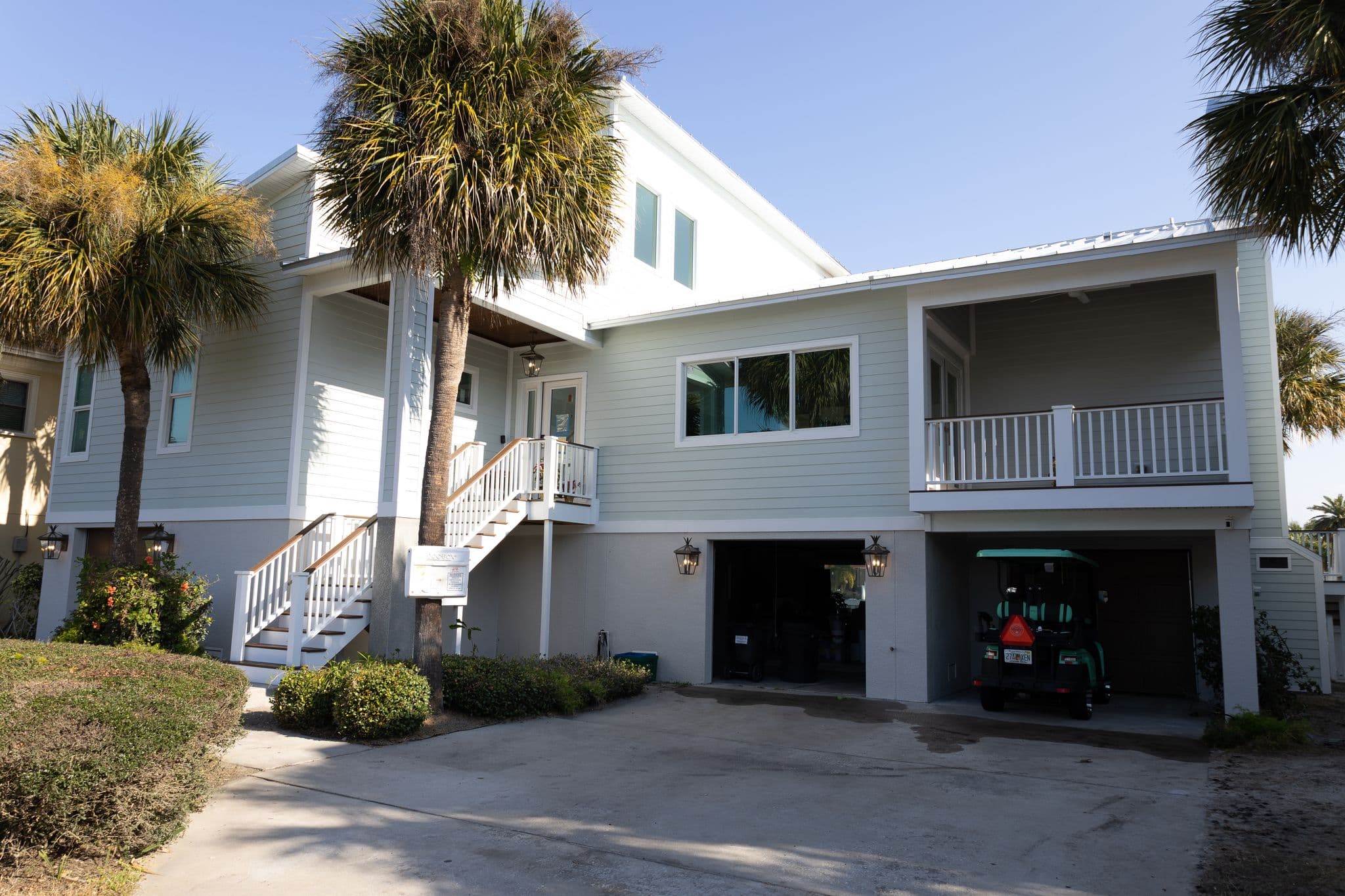
You already know the vocabulary — 50 percent rule, Base Flood Elevation, AE and VE zones, Elevation Certificate, freeboard. That means you have done the homework most Pinellas homeowners never do. The next step is a 15-minute phone screen to find out which contractors know this vocabulary as fluently as you do, and which will be learning on your project.
We built this list from the exact questions Pinellas homeowners search when they research flood-zone contractors: how the 50 percent rule works, what freeboard means, why AE and VE zones price differently, what Florida Building Code Section 1612.2 actually says. If a contractor cannot answer these from memory, they may still be a fine general contractor for a non-flood-zone project. They are not the right person to run FEMA compliance on your Pinellas waterfront home.
Ask these in the order below. The first four are conceptual — a contractor should answer without pausing. The middle four are procedural — how they actually run the work. The last four are edge cases — where less-experienced contractors expose gaps.
The 12 Questions
1. What is the FEMA 50 percent rule and how does it apply to my property?
The FEMA 50 percent rule says if renovation or repair costs exceed 50 percent of your structure's market value — building only, not the land — the entire structure must be brought into current flood code. In Pinellas that means elevating the lowest finished floor to Base Flood Elevation plus 1 foot of municipal freeboard. The threshold is cumulative over any 12-month window, so multiple smaller projects can add up to trigger it. A contractor should be able to walk you through the rule from memory: what counts toward the 50 percent, what the denominator is, and why the 12-month window matters more than most homeowners realize.
2. What is my Base Flood Elevation and how do I check it?
Base Flood Elevation, or BFE, is the flood height FEMA has determined your property could experience during a 1 percent annual chance flood — the so-called 100-year flood — measured in feet above sea level. You find it on your property's Flood Insurance Rate Map (FIRM) panel, published free by FEMA at msc.fema.gov. A flood-zone contractor should be able to pull your BFE for you if you provide your address, tell you which FIRM panel your property sits on, and translate it into the Design Flood Elevation your project will actually build to. If a contractor asks you to look it up yourself, that is a red flag on a project this consequential.
3. What is Design Flood Elevation and how much freeboard does Pinellas require?
Design Flood Elevation, or DFE, is what your architect actually builds to. It equals BFE plus your municipality's freeboard requirement. In Pinellas County, freeboard is 1 foot for most jurisdictions. If your BFE is 11 feet, your DFE is 12 feet, and every square foot of habitable finished floor must sit at or above 12 feet. Some Pinellas jurisdictions apply stricter thresholds — St. Petersburg and Redington Shores both enforce their 50 percent rule at 49 percent — and a flood-zone contractor should know which threshold applies to your specific parcel before they price the work.
4. What is the difference between an AE zone and a VE zone?
Both are Special Flood Hazard Areas — FEMA-designated with a 1 percent annual flood risk. AE zones handle rising-water flooding: spread footings or fill are typically allowed, flood vents required below BFE, breakaway walls not required. VE zones handle wave action — the V stands for velocity — and require open pile or column foundations with no fill, breakaway walls below BFE, and heavier structural elements rated for wave impact. In Pinellas, barrier islands and direct-waterfront parcels like Tierra Verde, St. Pete Beach, and Treasure Island are typically VE. Inland waterfront neighborhoods like Shore Acres, Snell Isle, and Venetian Isles are typically AE. VE construction runs $50,000 to $100,000 more than comparable AE construction on a 2,000-4,000 square foot home.
5. What is Florida Building Code Section 1612.2 and how does the contractor comply with it?
Section 1612.2 is the Flood Loads section of Chapter 16 (Structural Design) in the Florida Building Code. It is the state-level codification of the federal National Flood Insurance Program (NFIP) 50 percent rule and requires that structures in Special Flood Hazard Areas meet ASCE 24-14 (Flood Resistant Design and Construction) design standards whenever substantial improvement or substantial damage is triggered. Local Pinellas floodplain administrators enforce Section 1612.2 through the permit process. A contractor who can name the section and reference ASCE 24-14 without looking it up has actually pulled Pinellas flood-zone permits before. A contractor who cannot has not.
6. What is an Elevation Certificate and who pays for it?
An Elevation Certificate is a FEMA-standard form (FEMA Form 086-0-33) completed, signed, and sealed by a Florida-licensed Professional Surveyor and Mapper (PSM). It documents your property's flood zone designation, the FIRM panel it sits on, the applicable Base Flood Elevation, and the measured elevations of your building. Cost in the St. Petersburg market typically runs $400-$800 for a standard residential Certificate, $700-$1,500 for complex sites or post-construction certificates. A flood-zone contractor should coordinate the surveyor as part of pre-construction — not defer it to your permit application, and not expect you to hire the surveyor separately without guidance.
7. How does the contractor track substantial improvement across a 12-month window?
The 50 percent threshold is cumulative. A kitchen remodel and a bathroom remodel and a roof replacement staged across the same year add up. A flood-zone contractor should track total spend cumulatively — every line item including labor, materials, permits, architect and engineer fees, contractor markup, site prep, and demolition — against the pre-construction structure value from the Pinellas Property Appraiser. Weekly budget reports are the mechanism: they show the 40 percent checkpoint before the 50 percent cap bites, so scope decisions happen before you commit money that will retroactively trigger elevation requirements. If a contractor tracks cost monthly instead of weekly, or bundles subcontractor invoices into quarterly summaries, ask how they catch scope creep in time.
8. How does the contractor coordinate with the Pinellas Floodplain Administrator?
FEMA 50 percent rule enforcement varies by Pinellas jurisdiction. St. Petersburg routes flood-zone permits through its Floodplain Administrator, reachable at 727-893-7231 or floodplain@stpete.org. St. Pete Beach, Treasure Island, Madeira Beach, and Pass-a-Grille each run their own thresholds. Unincorporated Pinellas applies a fourth interpretation. A flood-zone contractor with real jurisdictional experience should be able to tell you which Floodplain Administrator your project will report to, what pre-construction submissions that jurisdiction requires, and whether they have working relationships with that jurisdiction plan-review staff.
9. What is the difference between substantial improvement and substantial damage?
Both trigger the FEMA 50 percent rule, but from opposite directions. Substantial improvement is voluntary — your planned renovation, addition, or repair whose cost exceeds 50 percent of the pre-construction structure value. Substantial damage is involuntary — a flood, hurricane, fire, or other event damages the building, and the repair cost to restore it exceeds 50 percent of pre-damage value. Both force the entire structure into current flood code: elevation to BFE plus local freeboard, flood-compliant materials below BFE, and in VE zones, open foundations with breakaway walls. A contractor who conflates the two, or who thinks storm damage is exempt from the rule, does not understand the enforcement mechanism.
10. What flood-compliant materials does the contractor use below Base Flood Elevation?
Everything below BFE has to withstand extended submersion without permanent damage. That means flood-resistant materials only: closed-cell foam insulation (not batt), pressure-treated framing lumber, concrete or masonry structural walls, marine-grade plywood or fiber-cement sheathing, ceramic or porcelain tile, stainless-steel or galvanized fasteners. Drywall, standard insulation, and OSB are prohibited below BFE — they fail and grow mold after even minor flooding. FEMA publishes the compliant-materials list; a Pinellas flood-zone contractor should be able to name the top five compliant materials by scope area (framing, sheathing, insulation, wall finish, floor finish) without checking. If they cannot, they are learning on your project.
11. How does the contractor handle Florida Building Code Section 1620 impact windows?
Section 1620 requires impact-rated windows and doors within one mile of the coastline. Almost every Pinellas waterfront flood-zone property triggers Section 1620 — Shore Acres, Snell Isle, Venetian Isles, St. Pete Beach, Treasure Island, Madeira Beach, and Tierra Verde all sit within the one-mile trigger. A flood-zone contractor should spec Florida Product Approval (NOA)-certified glazing like PGT WinGuard or a comparable brand on every flood-zone build. Ask which glazing product they use as their default, what the impact rating is (small missile, large missile, or both), and whether they include the FL Product Approval numbers in your permit submittal package. If they do not know the answer, they have not pulled a coastal permit recently.
12. What happens if the project accidentally crosses the 50 percent threshold mid-construction?
This is the scenario every homeowner fears and most contractors do not talk about honestly. If your project crosses 50 percent mid-construction, the Pinellas Floodplain Administrator can require the entire structure to be brought into current flood code before construction continues — which typically means stopping work, redesigning to elevate the lowest floor, and adding tens of thousands in cost. A flood-zone contractor should have contingency built into every flood-zone bid: a discussion of what happens at 40 percent (recalculate scope), at 45 percent (formal go/no-go conversation with you), and at 49 percent (stop the discretionary scope). Contractors who claim it cannot happen to their projects have not run enough of them to be trustworthy on this specific risk.
What the Answers Tell You
If a contractor answers all 12 from memory in a 15-minute phone screen, they have run enough Pinellas flood-zone work to be worth an in-person meeting. If they can answer 8 to 10, they know the vocabulary but may still be scaling up their flood-zone practice — worth a second call to understand their recent project history. If they can answer fewer than 8, they will be learning on your project. That is fine for a bathroom remodel in a non-flood-zone neighborhood. It is not fine for a Snell Isle or Tierra Verde or St. Pete Beach waterfront home where the 50 percent rule bites hard.
About Revolution Contractors
Revolution Contractors is a St. Petersburg design-build general contractor family-owned since 2016. We have completed $10-20M+ of coastal Pinellas flood-zone work with 20+ W-2 carpenters on payroll — not day-of subcontractors. Florida licenses CRC1331628 and CGC1522463. Owner Jeremy Wharton personally runs every substantial-improvement calculation on every flood-zone project we take. Free written FEMA assessment within 48 hours: (727) 888-6161.
If you want to see how the 50 percent rule plays out in practice, our FEMA 50 Percent Rule Florida guide walks through the math on a real Pinellas home. If you are ready to talk about your specific property, our flood zone construction service page covers our scope, process, and pricing.