Hurricane Damage Insurance Claim + GC Coordination Guide (Pinellas Homeowner 2026)
The window to preserve a strong hurricane insurance claim closes fast — file within 72 hours, document before cleanup, and get a licensed general contractor on-site for the adjuster inspection. If you have Helene, Milton, or 2025-2026 season damage in Pinellas that still needs coordination between insurance and construction, see our flood zone contractor page or call (727) 888-6161.

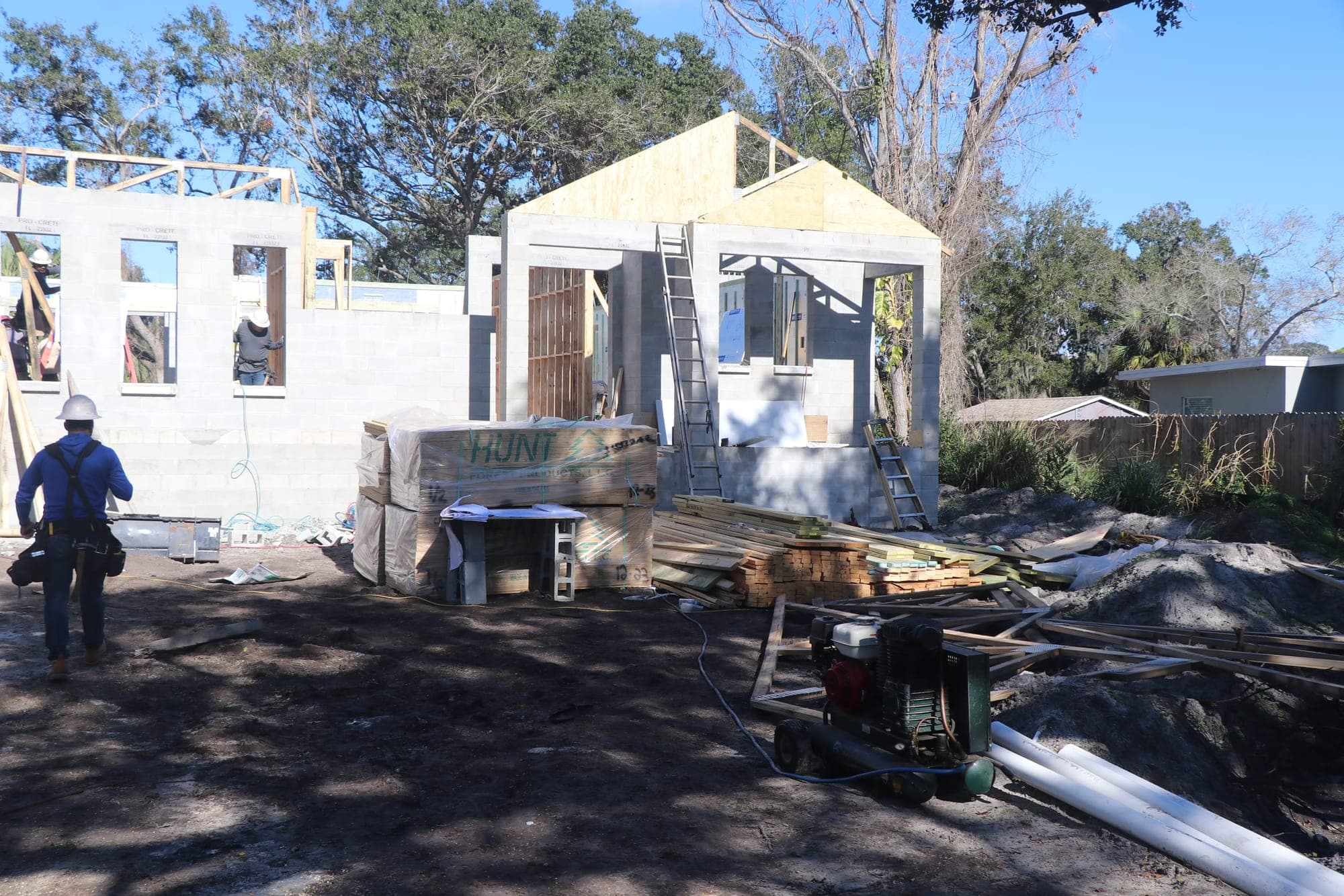
Hurricane insurance claims in Florida run on parallel tracks that most homeowners don't discover until they're inside the process. The windstorm policy pays for wind and rain damage. The separate NFIP flood policy pays for flood damage. If the property was substantially damaged, ICC pays for compliance upgrades. Citizens covers what private carriers won't. Each has its own claim number, its own timeline, its own adjuster, and its own paperwork. Coordinating between them — while also coordinating the general contractor who'll actually rebuild the house — is where a well-managed claim becomes a good outcome and a poorly-managed one leaves tens of thousands of dollars on the table.
The Short Version
File within 72 hours with every applicable carrier (windstorm, NFIP flood, Citizens, umbrella). Document everything with photos and video BEFORE any cleanup. Do emergency mitigation to prevent further damage; save receipts. Get a licensed general contractor on-site for the adjuster inspection. Compare the carrier's estimate against your contractor's estimate; file supplements for gaps. Coordinate phase invoicing to match phased disbursements. If your property is substantially damaged, activate the ICC $30,000 flood-insurance benefit on the NFIP policy.
In This Article
- The 3-Day Rule — File Before Evidence Is Compromised
- Documenting Damage Before Cleanup
- Adjuster Coordination — Rights and GC Role
- NFIP Flood vs Private Windstorm — Two Separate Claims
- Citizens Property Insurance Idiosyncrasies
- Public Adjuster vs GC Handles It
- Contractor Scope + Insurance Scope + Owner Scope
- Depreciation, ACV vs RCV
- Supplement Claims — Reopening After Discovery
- ICC $30,000 Flood-Insurance Coverage
- FEMA 50% Rule Interaction
- How Revolution Handles Hurricane-Damaged Homes
- FAQ
Hurricane Helene and Hurricane Milton produced thousands of substantial-damage claims across Pinellas County alone. We're actively rebuilding homes damaged by both storms, and the pattern we see over and over is homeowners discovering claim-handling rules for the first time weeks into the process — usually after making an early decision that hurts them later. This guide covers the mechanics before you need them, in the order they actually come up.
Revolution Contractors is a family-owned Florida CRC1331628 general contractor based in St. Pete since 2016. We've run $20M+ of Pinellas coastal work, including active Helene and Milton rebuilds now moving through the substantial-damage compliance track. Everything below is what we've learned coordinating with adjusters, floodplain administrators, NFIP claims processors, Public Adjusters, and homeowners across those recoveries.
The 3-Day Rule — File Before Evidence Is Compromised
Florida property insurance policies almost universally require “prompt notice” of a loss, which case law and standard practice interpret as filing within days, not weeks. NFIP flood policies specifically require a Proof of Loss within 60 days of the loss event (federally declared disasters can extend this window, but it should never be assumed). For homeowners, the operational rule is: file within 72 hours with every applicable carrier. The delay is expensive in three distinct ways.
Evidence gets cleaned up
After a hurricane, the natural instinct is to start cleanup immediately — drag wet furniture to the curb, rip out saturated drywall, tarp the roof. All of that is necessary for mitigation, but each action removes evidence the adjuster would otherwise inspect. The claim gets weaker every day cleanup progresses without documentation. Homeowners who filed the claim before starting cleanup have adjuster-verifiable scope of loss. Homeowners who filed a week later have to argue for scope items from photos alone.
Adjuster assignment queues
After a major hurricane, adjuster assignments run on a first-in, first-out queue. Filing on day 1 gets an adjuster within a week; filing on day 20 pushes the assignment into a queue behind thousands of other claims. In the Helene and Milton aftermath, some Pinellas homeowners waited 6-8 weeks for adjuster inspection because they filed late. Every additional week of delay is more damage progression, more cleanup, and more argument later about what was original storm damage vs consequential damage.
Florida's statutory response clock
Under Florida Statute 627.70131, once you file, the carrier is required to acknowledge receipt within 14 days and pay or deny the claim within 90 days of filing (specific hurricane-related timelines can vary). Filing early starts that clock. The sooner you file, the sooner the payment or denial arrives, and the sooner you can begin permanent repair or dispute proceedings.
Documenting Damage Before Cleanup
Photo and video documentation is the single strongest evidence in a hurricane claim. Do it before you touch anything. The documentation you take in the first 24 hours is what the adjuster will price against, what your contractor will scope against, and what any Public Adjuster or attorney will argue with if the claim ends up disputed.
Photo protocol
- Every damaged area, wide-shot and close-up.
- Include reference points (doorways, appliances, room labels) so the adjuster can locate each photo.
- Photograph water lines on walls (they show flood depth).
- Photograph roof damage from ground level; drone photos if a licensed operator can be arranged.
- Photograph exterior damage from all four sides.
- Photograph HVAC units, water heater, appliances, and any high-value contents.
- Photograph the electrical panel, plumbing fixtures, and mechanical systems (water damage often propagates through mechanicals invisibly at first).
Video walkthrough
A continuous video walkthrough narrating room by room is significantly stronger evidence than photos alone. Walk each room, describe the damage aloud, note the room name, note the pre-storm condition where relevant. Save both photos and video to cloud storage before any cleanup starts — local files can be lost, wet devices can fail, and re-photographing after cleanup gives the carrier ammunition to argue post-loss modification.
Contents inventory
Personal property claims (contents) require an inventory: what was damaged, when it was purchased, what it cost. Photograph every damaged item before disposal. Save any receipts you can find or reconstruct. Standard homeowners policies typically cover contents at ACV (actual cash value) by default and RCV (replacement cost value) if you carry the endorsement — the coverage type materially affects what you can recover, so check the declarations page before the adjuster arrives.
Adjuster Coordination — Rights and GC Role
When the adjuster arrives to inspect, the homeowner has clear rights and the general contractor has a specific supporting role. Understanding both up front prevents the common pattern where the adjuster produces an estimate that misses scope and the homeowner accepts it because they didn't know they could push back.
Homeowner rights at the inspection
- Right to have a licensed contractor, Public Adjuster, or attorney present.
- Right to a written copy of the adjuster's inspection report and estimate.
- Right to file a supplement if new damage is discovered later.
- Right to escalate through the Florida DFS Consumer Services hotline (1-877-693-5236) at any point.
- Right to reject the carrier's estimate and demand appraisal or invoke the policy's dispute-resolution procedure.
The GC's role at the inspection
A licensed general contractor walking the property alongside the adjuster is one of the most valuable moves a homeowner can make. The contractor does three things the homeowner can't always do alone:
- Points out damage the adjuster might miss (framing damage behind drywall, sheathing damage under intact roofing, mechanical damage that hasn't surfaced yet).
- Asks scope questions in real time so disputes surface at the inspection, not at settlement.
- Produces a written itemized cost estimate the adjuster can price against.
What the contractor can NOT do: negotiate claim value on the homeowner's behalf, file supplements or disputes on the homeowner's behalf, or represent the homeowner in the claim process. Florida Statute 626.854 reserves those functions for licensed Public Adjusters and attorneys. Contractors quote and perform work; they don't adjust claims.
NFIP Flood vs Private Windstorm — Two Separate Claims
Florida homeowners commonly assume “my hurricane insurance” is a single product. It isn't. Wind damage and flood damage are covered by two entirely different policies, sold by two different sets of carriers, with two different claim processes, two different adjuster networks, and two different sets of exclusions.
Private windstorm / homeowners policy
Standard homeowners policies cover wind damage, wind-driven rain (roof torn open by wind, then rain intrudes), fallen trees, and named-storm damage in general. In hurricane-exposed Florida counties, wind coverage may be carved out with a separate hurricane deductible (typically 2%-10% of dwelling limit). Some coastal homeowners have wind-only policies from Citizens or specialty carriers because private HO carriers won't write wind in their zone.
NFIP flood policy
The National Flood Insurance Program is administered by FEMA and sold through Write-Your-Own (WYO) private carriers. NFIP covers flood damage — specifically defined as water rising from ground level, including storm surge, tidal inundation, and rising-water flood. Wind-driven water on the upper floors is generally NOT flood; flood-marked water lines on lower walls typically are. NFIP claims are filed with the WYO carrier, follow NFIP-specific procedures, and can trigger ICC coverage if the property is declared substantially damaged.
The classic Pinellas hurricane scenario
A Pinellas coastal home in a hurricane may sustain damage from both wind (roof torn open, windows blown out, rain intrusion) AND storm surge (rising water from the Gulf pushing water into the first floor). Wind damage goes to the windstorm carrier. Surge/flood damage goes to NFIP. Both are claimed simultaneously. Coordinating between them — particularly at the “where's the line” disputes on rain vs surge on shared surfaces — is where a contractor's inspection matters most, because the contractor can help attribute damage to the right cause.
Citizens Property Insurance Idiosyncrasies
Citizens Property Insurance Corporation is the Florida state-created insurer of last resort. It provides property insurance coverage to homeowners who can't get coverage in the private market — a category that in Pinellas County includes many coastal, flood-exposed, and older-home properties. Citizens claims follow Florida statutory claim rules but have some Citizens-specific procedures.
Adjuster network
Citizens uses an internal adjuster team supplemented by third-party independent adjusters, particularly during major-event surges. In the Helene/Milton aftermath, Citizens dispatched independent adjusters from out-of-state to accelerate inspection timelines. The independent adjuster network is professional but has varying local Pinellas expertise; a contractor on-site during the inspection can bridge the gap on Pinellas-specific damage patterns (surge water lines, FEMA firm-line references, local floodplain administrator context).
Settlement pace and disputes
Citizens settlement pace mirrors private carriers under normal conditions and lags meaningfully during major-event surges. Disputes follow Florida statutory procedure — appraisal, mediation, DFS-mandated pre-suit notice, and lawsuit if unresolved. The DFS Consumer Services hotline (1-877-693-5236) is available for Citizens disputes just as for private-carrier disputes.
Public Adjuster vs GC Handles It
A common decision point for homeowners: hire a Public Adjuster (PA) or work directly with the carrier alongside a general contractor. Both approaches can produce good outcomes; the right choice depends on the scale of the loss and the homeowner's capacity to manage the claim in parallel with other post-storm demands.
When a Public Adjuster helps
Large losses ($100K+), disputed claims where the initial carrier offer is clearly light, complex multi-policy claims (wind + flood + Citizens), and homeowners without time or expertise to manage the claim themselves. Public Adjusters typically charge 10%-20% of the settlement, subject to Florida statutory caps during declared disaster events. Look for a Florida-licensed PA with strong Pinellas references and clear fee terms in writing before signing an agreement.
When homeowner + GC is enough
Smaller losses (< $50K), clear-cut single-carrier claims, or homeowners with the bandwidth and experience to walk the process themselves with a strong contractor providing scope and cost estimates. The contractor can't adjust the claim, but a good contractor produces itemized estimates and photo documentation strong enough that the carrier's estimate rarely misses scope by much.
The hybrid: GC + attorney (not PA)
For disputed high-value claims, some homeowners work with a contractor for scope-and-cost and a Florida property-insurance attorney for the claim-side representation. Attorneys typically work on contingency in Florida property-insurance disputes and can pursue statutory bad-faith remedies that Public Adjusters can't. This structure often produces the best outcomes for genuinely disputed high-value claims.
Contractor Scope + Insurance Scope + Owner Scope
Hurricane rebuilds virtually always involve three overlapping scopes that need to be kept accounting-separate: the insurance-approved repair scope, the code-required upgrade scope, and the owner-elected discretionary scope. Homeowners who don't enforce the separation end up with a bill that's hard to reconcile against multiple funding sources.
Insurance scope
The scope of work the carrier has agreed to pay for, per the approved estimate and any supplements. This is dollars from the windstorm claim, the flood claim, and any Citizens or other carrier claims. The contractor prices against this scope line-by-line and invoices against it directly.
Code-upgrade scope
The upgrades to current Florida Building Code that the local building department requires as a condition of the permit. If your Pinellas property was built to 1985 code and the reconstruction has to meet 2023 code (or 2026 code, whichever cycle is in effect at permit issuance), the difference is a code-upgrade scope. For flood-zone properties, ICC coverage funds this scope up to $30,000. For non-flood-zone properties, some standard homeowners policies include an Ordinance and Law endorsement that covers code upgrades; check your declarations page.
Owner discretionary scope
Everything the owner wants to add on beyond the insurance-approved repair and the code-required upgrade — kitchen upgrades, upgraded finishes, layout changes, aesthetic improvements. This is homeowner-funded (cash, HELOC, home equity loan, cash-out refi — see our renovation financing spectrum guide for the options).
Why the accounting separation matters
The carrier only pays for the insurance scope. The ICC benefit only pays for the code-upgrade scope. Elevate Florida (if in play) only pays for the elevation compliance scope. Mixing them at the invoice level produces disputes with every funding source. Revolution's T&M open-book billing codes every line item to its funding source specifically for this reason — the weekly budget reports show insurance-eligible dollars separated from code-upgrade dollars separated from owner-discretionary dollars.
Depreciation, ACV vs RCV
The single most common cause of homeowner surprise at settlement is depreciation. Understanding how the carrier calculates it — and how to recover the withheld portion — often means the difference between full and partial recovery.
Actual Cash Value (ACV) vs Replacement Cost Value (RCV)
ACV pays what the damaged property is worth today, factoring in age and wear. A 15-year-old roof at ACV pays significantly less than a new roof. RCV pays the cost to replace with new material of like kind and quality. If your policy is RCV, the carrier typically issues an initial payment at ACV (with depreciation withheld) and releases the depreciation once you demonstrate the repair is complete. If your policy is ACV, there is no depreciation-release event — the carrier keeps the depreciation. Check your declarations page. Older policies default to ACV; newer replacement-cost endorsements pay RCV.
Getting the depreciation released
On an RCV policy, once the repair is complete and paid for, submit proof of completion (contractor final invoice, before/after photos, permit close-out documentation) to the carrier. The withheld depreciation should release within the carrier's standard timeline — typically 30-60 days after documentation is submitted. Homeowners who fail to submit completion documentation forfeit the withheld depreciation, which on a $50,000 claim can easily be $8,000-$15,000.
Depreciation applied too heavily
Carriers sometimes apply depreciation more aggressively than the material age warrants. A 3-year-old vinyl plank floor should not be depreciated the same as a 15-year-old floor. If the carrier's estimate shows depreciation percentages that seem high relative to material age, request the depreciation schedule and dispute line items where the age doesn't justify the withheld amount.
Supplement Claims — Reopening After Discovery
Supplement claims reopen a settled claim when new damage is discovered or the repair scope exceeds the original estimate. This is one of the most common recoveries in hurricane rebuilds because so much damage isn't visible until demolition exposes the framing, sheathing, and mechanicals underneath.
Common supplement triggers
- Framing damage discovered after drywall removal.
- Sheathing damage discovered after roof removal.
- Water intrusion damage that surfaces weeks after initial dry-out.
- Code-required upgrades the adjuster didn't include (electrical service upgrade, framing to current wind-load, code-required accessibility).
- Subcontractor bid proposals that exceed the carrier's software-generated pricing.
- Missing Overhead and Profit (O&P) — carriers owe O&P when three trades or more are involved in the repair.
How to file
The contractor documents the newly-identified scope with photos and an itemized cost estimate. The homeowner (or Public Adjuster) submits the supplement to the carrier, referencing the original claim number and attaching the contractor's estimate and photo documentation. The carrier assigns an inspector for reinspection; the inspector verifies the new scope; the carrier issues a supplemental payment. Timeline typically 30-60 days from filing to supplemental payment.
How Revolution's billing supports supplements
Our weekly budget reports produce the supplement documentation as a natural byproduct. When our carpenters discover framing damage behind demolition, the labor hours to expose it and the material invoices for repair get logged that week. The photos our project managers take at every stage produce the visual evidence. When the homeowner files the supplement, the supporting documentation is already assembled.
ICC $30,000 Flood-Insurance Coverage
Increased Cost of Compliance is a $30,000 benefit built into every standard NFIP flood-insurance policy that pays for mandatory flood-code compliance upgrades when the property is declared substantially damaged. For Pinellas hurricane-damaged homes crossing the 50% substantial-damage threshold, this coverage is a critical funding piece that most homeowners don't discover in time.
ICC runs on a parallel track from the standard NFIP structure claim. It has its own trigger conditions, its own filing process, its own eligible activities (elevation, relocation, demolition, floodproofing for non-residential), and its own $30,000 ceiling that does not count against the standard structure limit. It stacks with Elevate Florida for full home elevation.
For the full ICC mechanics — trigger conditions, filing process, four compliance options, and how to stack with Elevate Florida — see our ICC $30,000 flood-insurance guide. For decision framework on whether elevation makes sense vs tear-down-rebuild vs deep remodel, see the tear-down vs elevate vs deep-remodel framework or the flood-zone decision calculator.
FEMA 50% Rule Interaction
When hurricane damage on a Pinellas flood-zone property equals or exceeds 50% of the pre-damage market value of the structure (49% in the City of St. Petersburg), the property is declared substantially damaged by the local floodplain administrator. Substantial damage forces the property into full flood-code compliance as a permit condition — typically elevation, relocation, or demolition for residential.
The interaction with the insurance claim: the insurance settlement value doesn't itself trigger the 50% Rule. The cost to restore the structure to pre-damage condition, as determined by the local floodplain administrator based on the adjuster's estimate and other evidence, is what triggers it. The two calculations are related but not identical — the floodplain administrator uses adjuster estimates as input, but adds any code-required upgrades that the standard structure claim wouldn't include.
If your Pinellas property receives a Substantial Damage Determination (SDD) letter from the floodplain administrator, that letter is the trigger for ICC coverage, and it's the point where the decision framework of elevation vs relocation vs demolition kicks in. Do not begin permanent repair until the SDD is resolved — repair that ignores the substantial-damage trigger creates a compliance violation the building department will catch at permit inspection.
See our FEMA 50% Rule help page for the specific Pinellas mechanics and how to work through an SDD, and our flood damage near me page if you have active hurricane damage and need a contractor on-site.
How Revolution Handles Hurricane-Damaged Homes
The way we run a hurricane rebuild is different from a standard remodel because the money is coming from multiple carriers on multiple schedules, the local building department is enforcing code that has changed since the property was built, and the homeowner is coordinating displacement, personal recovery, and construction in parallel. Everything has to be traceable, everything has to be phased against the disbursements, and the crew has to be present enough that the homeowner isn't waiting on subs.
T&M open-book billing pairs with phased insurance disbursements. Every line item on the project is coded to insurance-eligible scope, code-upgrade scope, or owner-discretionary scope. When the carrier releases a phase disbursement, our billing already documents the phase completion in a format the carrier's inspector can verify. When the homeowner files a supplement, the material invoices and labor logs supporting the supplement are already in the weekly budget report.
Weekly budget reports keep the insurer + homeowner + contractor aligned. Every Friday during construction, the homeowner receives a written budget report showing labor hours, material invoices, subcontractor invoices, and line-item spend by funding source. The same report goes to the adjuster on supplement filings, to the ICC claim reviewer on compliance phase closeouts, and to the local building department on permit inspections. One document, three audiences, one source of truth.
20+ W-2 carpenters in-house. Hurricane rebuilds run 6-18 months. Sub-contracted crews juggling multiple insurance jobs across multiple GCs create delays that don't match phased disbursement schedules. Our carpenters are on our payroll; the schedule follows the homeowner's timeline, not a sub's.
Florida CRC1331628 licensed to sign compliance certifications. The certifications the local building department requires at compliance closeout — elevation certificate, foundation stamping, code-compliance sign-off — require the general contractor of record to hold an active Florida license. Homeowners can verify us live at DBPR using our DBPR verification guide.
Family-owned in St. Pete since 2016. The same team runs the project from first walkthrough with the adjuster to final elevation certificate. Continuity matters for building-department relationships, adjuster coordination on supplements, and the ongoing conversation with the homeowner across a construction timeline that can span more than a year.
Frequently Asked Questions
How fast do I need to file a hurricane damage claim?
Same day if possible; within 72 hours at the latest. Most Florida property policies require prompt notice, and NFIP flood policies specifically require filing a Proof of Loss within 60 days of the loss event (that deadline can be extended by FEMA declaration but should never be assumed). Filing early preserves evidence, opens the claim number for the adjuster assignment, and starts the clock on the state-mandated 60-day acknowledgment and 90-day payment window (Florida Statute 627.70131). Delay hurts the claim in several ways: evidence gets cleaned up before the adjuster inspects, damage progression makes the causation harder to prove, and the carrier can argue the homeowner mitigated poorly.
Can my contractor negotiate with the insurance adjuster?
Yes and no. A licensed general contractor can (and should) walk the property with the adjuster, provide a written cost estimate for repairs, and communicate directly on scope questions. But contractors are not licensed to represent the homeowner in the claim itself — that role is reserved for the homeowner directly, a licensed Public Adjuster, or a licensed attorney. Florida Statute 626.854 draws the line: contractors can quote and perform the work, but they can't negotiate claim value or file supplements on the homeowner's behalf without the homeowner in the room. Revolution's role is scope and cost: we write a clean, itemized estimate the adjuster can price against and coordinate directly on any scope disputes.
What if the insurance offer is too low?
First step: request the adjuster's damage report and the carrier's estimate line-by-line. Compare against your contractor's estimate. Common gaps: missing hidden damage (framing, sheathing, insulation) that the adjuster didn't see; depreciation applied too heavily on materials less than 3-5 years old; scope items the adjuster misclassified as maintenance vs storm damage; missing overhead and profit (O&P) allowances that carriers owe when three trades or more are involved. If gaps are legitimate, file a supplement claim with the contractor's revised estimate and photo documentation. If the carrier still won't move, consider a licensed Public Adjuster or an attorney; the state's DFS Consumer Services hotline (1-877-693-5236) is a free intermediary.
Does my policy cover FEMA 50% Rule compliance?
Partially — the Increased Cost of Compliance (ICC) portion of your NFIP flood policy covers up to $30,000 toward the mandatory flood-code compliance upgrades triggered when the property is declared substantially damaged. That's separate from your standard structure claim and runs on a parallel track. If your Pinellas property received a Substantial Damage Determination (SDD) from the local floodplain administrator after the hurricane, ICC is active — file it. See our ICC $30,000 flood-insurance guide for the full trigger conditions and filing process. Standard windstorm and homeowner policies do NOT include an ICC-equivalent; only NFIP flood policies carry that benefit.
How do I coordinate a supplement claim with the contractor?
Supplement claims reopen a claim after the initial settlement when new damage is discovered or when the repair scope exceeds the initial estimate. Common triggers: framing damage discovered after drywall removal, water intrusion damage that surfaces weeks after the initial dry-out, code-required upgrades the adjuster didn't include, or subcontractor bid proposals that come in higher than the carrier's software-generated pricing. The contractor documents the newly-identified scope with photos and an itemized cost estimate. The homeowner (or their Public Adjuster) files the supplement with the carrier, attaches the contractor's estimate as supporting documentation, and awaits reinspection. Revolution's T&M open-book billing produces the supplement documentation as a natural byproduct — the material invoices and labor logs are already in the weekly budget report.
What if I have Citizens Insurance and my private policy denied?
Citizens Property Insurance is the Florida state-created insurer of last resort — it provides coverage to homeowners who can't get coverage in the private market, particularly in flood-prone and hurricane-exposed coastal areas. Citizens claims are governed by Florida Statute Chapter 627 with some Citizens-specific procedures. If your private windstorm policy was denied for a hurricane loss and you had Citizens as backup coverage, Citizens processes that claim under standard windstorm rules. If both were denied, the Florida Department of Financial Services (DFS) Consumer Services hotline (1-877-693-5236) is the first escalation point. For flood claims, NFIP is a separate coverage entirely and doesn't interact with private windstorm or Citizens; NFIP has its own claim process and its own dispute procedures.
The Bottom Line
Hurricane insurance claims in Florida reward homeowners who file fast, document thoroughly, and coordinate carefully across the parallel tracks of wind, flood, Citizens, and ICC. The single most valuable action in the first 72 hours: get an adjuster inspection scheduled with a licensed contractor on-site to walk the property alongside them. That one move typically shifts the initial estimate by tens of thousands of dollars on a substantially-damaged Pinellas home.
Keep the scopes separate at the invoice level: insurance scope, code-upgrade scope, owner discretionary. Match phased invoicing to phased disbursements. File supplements as new damage is discovered during demolition. Activate ICC if the property crosses the substantial-damage threshold. Escalate through DFS Consumer Services (1-877-693-5236) if a carrier stalls unreasonably.
Revolution Contractors is a family-owned Florida CRC1331628 general contractor based in St. Pete since 2016 with 20+ W-2 carpenters in-house and $20M+ of Pinellas coastal work behind us, including active Helene and Milton rebuilds now moving through the substantial-damage compliance track. If you have hurricane damage in Pinellas that needs coordination between insurance and construction, schedule a consultation or call us at (727) 888-6161.
Free 48-hour insurance-claim coordination walkthrough.
We'll walk your property, produce an itemized scope-and-cost estimate the adjuster can price against, flag whether the 50% substantial-damage threshold is in play, and help coordinate between windstorm, NFIP flood, Citizens, and ICC. No obligation — just a straight read on where you stand and what the next 30 days should look like.