What a Historic St. Pete Remodel Actually Takes — COA, Systems, T&M

If you own a 1920s bungalow in Old Northeast, a Mediterranean revival on Snell Isle, or a cottage in Old Southeast, you already know the answer to “is this house worth restoring.” What you probably don't know yet is what the restoration actually takes — and that's where most projects in St. Petersburg either get done right or quietly go sideways.
Historic home restoration in St. Petersburg has its own playbook — different from a standard remodel, different from a new build. We work on pre-1950 St. Petersburg homes year-round. Here's the honest version of what's involved.
The short version: A historic-district remodel in St. Pete adds three things a standard project doesn't have — (1) a Certificate of Appropriateness review through the City's Community Preservation Commission, which can add 6 to 12 weeks to your front-end timeline; (2) era-specific systems work on the cast iron, knob-and-tube, plaster, and foundation pieces that most newer-home contractors don't know how to evaluate; and (3) a pricing model honest enough to handle “you don't know what's behind the wall until you open it.” We use Time & Materials open-book with a flat 30% markup on labor and 15% on materials. The rest of this guide unpacks each piece.
Which St. Pete Neighborhoods Carry Historic-District Rules
Five St. Petersburg neighborhoods are on the National Register or have local historic-district overlays that affect exterior work: Old Northeast, Old Southeast, Roser Park, Historic Uptown, and Granada Terrace. Snell Isle and parts of Crescent Lake have homes that are individually eligible but no district-wide rule. If your house is in any of these, exterior changes route through the City of St. Petersburg's Community Preservation Commission and a Certificate of Appropriateness (COA) review.
What that means in practice: you can't pick a window without checking what's allowed. You can't change a porch column profile without documentation. You can't add a second story without a massing study. None of this is a bad thing — it's why these neighborhoods still look the way they do — but it adds a layer that newer-neighborhood remodels don't have.
The COA Process — Why It Stops Naive Contractors
A Certificate of Appropriateness application requires drawings, materials specifications, and often a hearing. Most general contractors in this city have either never been through one, have been through one and don't want to do it again, or quote the project assuming someone else will handle it. None of those work.
Our approach: we coordinate the COA submission with an independent historic-preservation architect (we partner with several in St. Pete who do this work full-time), get the application clean before it goes in, and show up at the hearing when one is required. The COA process can add 6 to 12 weeks to the front of a project. You'll hear that on day one, not month three.
What a 1920s Bungalow Remodel Usually Involves
Cast iron drain lines that have outlived their service life. Knob-and-tube electrical somewhere in the attic. Original heart-pine floors under three layers of vinyl. Plaster walls over diagonal sheathing. Foundation piers that have settled unevenly because the house has been there 100 years.
We don't strip these houses to studs unless we have to. The point is to keep what's worth keeping — the trim profiles, the doors, the floors, the windows where the glass is still wavy — and replace what's failed. That takes longer than a teardown rebuild. It costs more per square foot than a Bayway Isles new build. The result is a house that still feels like the house it was.
We price this work on a Time & Materials open-book basis with a flat 30% markup on labor and 15% on materials. You see every invoice. Weekly budget reports. No “change order surprise” — the open book is the surprise prevention. For a project where you don't know what's behind the plaster until you open it, T&M is the only honest pricing model.
A Recent Project — The King House, Old Southeast
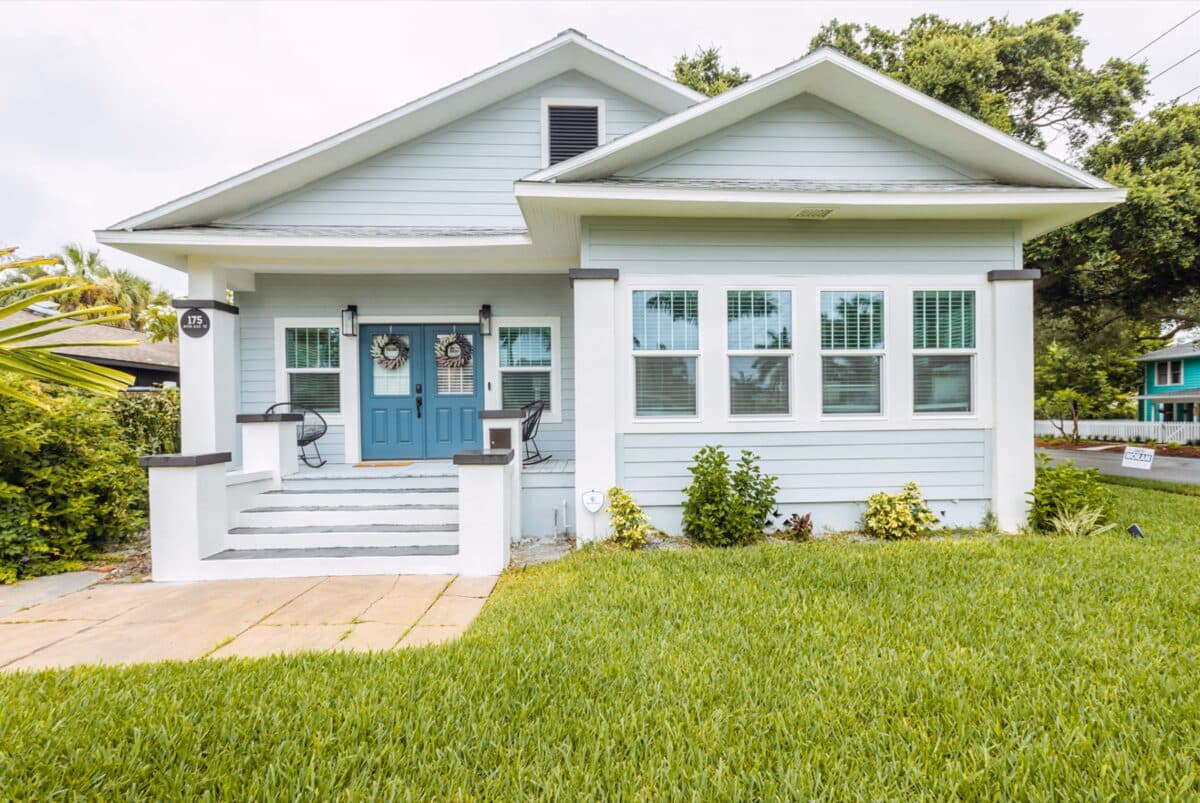
Last year we finished a whole-home remodel on the King House (175 19th Ave SE) in Old Southeast. Preserve the 'Burg recognized the project in their 2025 awards. Foundation work, full systems replacement, kitchen and bath rebuilds (our St. Petersburg kitchen remodel service handled the range wall, pantry rework, and finish carpentry inside the historic envelope), exterior restoration to original specifications. The owner's brief was “make it last another 100 years.” That's the kind of project this approach is built for. For the full structural-to-finish walkthrough with before/during/after photos, read our King House case study — or see all of our featured projects.
Thinking About a Historic Project?
We'll walk your house and tell you what the COA reality, the systems work, and the budget actually look like.
What to Expect When You Call Us
A site walk, free, scheduled inside 48 hours. We listen to what you've been thinking about, look at the house, talk through what's possible and what isn't given the district and the building's condition. No quote on the spot — we don't have enough information yet, and neither does anyone who quotes you on the spot. After that, if it makes sense to keep going, we put together a project scope and an open-book T&M estimate you can actually read.
We have 20+ W-2 carpenters on Revolution's payroll. Florida licenses CRC1331628 and CGC1522463. Family-owned since 2016, with nearly 20 years of combined construction and real estate experience across our leadership. About a third of our work is on pre-1950 homes — historic restoration isn't a side service for us.
Common Questions About Historic Restoration in St. Pete
Does every historic-district remodel require a Certificate of Appropriateness?
Exterior work in Old Northeast, Old Southeast, Roser Park, Historic Uptown, and Granada Terrace routes through COA review. Interior-only work usually doesn't trigger it. The City of St. Petersburg's Community Preservation Commission decides scope at intake — we walk you through what counts and what doesn't before any drawings get done.
How long does the COA process actually take in St. Pete?
For straightforward applications — replacement-in-kind windows, a porch rebuild, matching siding — figure 6 to 8 weeks from submission to approval. For projects requiring a public hearing (massing changes, second-story adds, material substitutions), plan on 10 to 12 weeks. Going in with documentation that matches what the Commission expects to see is what keeps you on the lower end of that range.
Can you update the interior of a 1920s bungalow without triggering historic review?
Usually yes. Kitchen and bath remodels, plaster repairs, mechanical-system replacements, even floor refinishing — none of those route through COA when they're interior-only. The trigger is exterior change visible from a public right-of-way. If you're touching windows, doors, siding, the roofline, or the footprint, that's COA territory.
What's the cost difference between historic restoration and a teardown rebuild?
Per square foot, restoration costs more than new construction — sometimes substantially more, depending on what's behind the walls. The trade-off: the finished house keeps the trim profiles, the heart-pine floors, the original windows, and the neighborhood character that made you buy it. New construction in a historic district is heavily restricted anyway, so for most pre-1950 St. Pete homes, restoration is the only path that preserves the asset.
Which St. Pete neighborhoods have the strictest historic-district rules?
Old Northeast and Historic Uptown have the longest-established local district overlays. Roser Park is on the National Register with locally-administered guidelines. Granada Terrace and Old Southeast sit in the middle. Even within a single district, individual block guidelines can vary — the Commission's review staff will tell you what applies to your specific address.
Related Services
- Historic Renovation — the hub page for the full service scope, district-by-district expertise, and project process detail
- Whole-Home Remodel — when a historic house needs everything updated at once (kitchen, baths, systems, exterior)
- Custom Home Construction — for the rare new-build that fits a historic-context lot
Find Us This Saturday
We're a sponsoring vendor at the Preserve the 'Burg Restoration & Design Expo this Saturday, May 16, 10 AM to 3 PM, downtown St. Pete. Free event. If you've been thinking about a historic-house project, bring the questions and bring the photos. We'll spend the time on it.
Register free: ptb.wildapricot.org/event-6368053
Or call anytime: (727) 888-6161
Revolution Contractors is a general contractor based in St. Petersburg, FL, family-owned since 2016, with nearly 20 years of combined construction and real estate experience and 20+ W-2 carpenters on payroll. About a third of our work is on pre-1950 St. Pete homes — Old Northeast, Old Southeast, Snell Isle, Roser Park, Historic Uptown. Florida licenses CRC1331628 and CGC1522463. We operate on Time & Materials open-book with weekly budget reporting. Contact us to talk through your project.