Commercial Bathroom ADA Compliance Guide for Pinellas Business Owners
Short version: if you own, operate, or lease commercial space in Pinellas, your bathroom has to meet the 2010 ADA Standards for Accessible Design. Florida layers its own accessibility code on top of that through Statute 553.5041. In pre-1990 Pinellas buildings, five common violations push a bathroom out of compliance. A full retrofit runs $15,000 to $60,000. If you get a formal pre-suit notice, you have 60 days to cure under Florida law before federal litigation can proceed. Revolution is a Pinellas general contractor (CGC1522463) that handles the full scope.

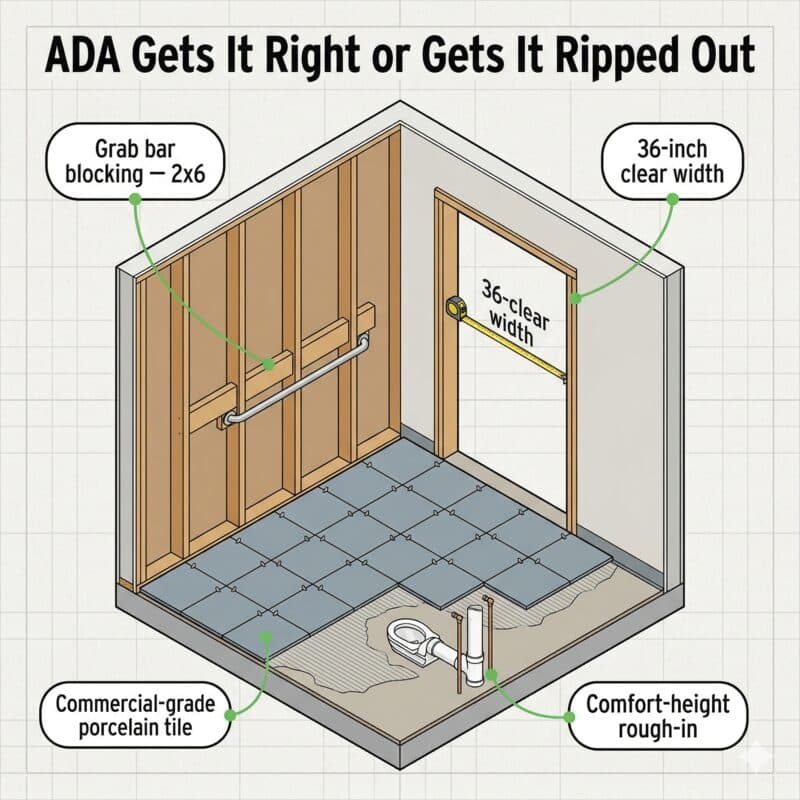
A tenant walks into your St. Pete restaurant, cannot fit a wheelchair through the bathroom door, and leaves. A week later a certified letter arrives from a Tampa law firm citing 2010 ADA Standards and giving you 60 days to respond. That is how most Pinellas commercial ADA cases actually start, and if you own or operate a business in a pre-1990 building, your bathroom is almost certainly out of compliance right now whether anyone has told you yet or not.
This guide walks through what the 2010 Americans with Disabilities Act Standards actually require for commercial bathrooms, where Florida Statute 553.5041 adds its own layer, the five violations we see most often in older Pinellas buildings, the cost ranges for a retrofit in 2026, and the 60-day pre-suit notice timeline under Florida law. It is written for building owners, facility managers, restaurant operators, medical and dental practice owners, and property managers who want to understand the rules before a letter lands on their desk.
Revolution Contractors is a Pinellas general contractor (CGC1522463, held by Brent Patterson) with 20+ W-2 carpenters on payroll. We handle commercial bathroom ADA retrofits across restaurants, offices, retail, and medical practices in St. Petersburg, Pinellas Park, Clearwater, and the beaches. We are not attorneys and this guide is not legal advice, but the construction standards and cost numbers below are current to 2026 Pinellas pricing.
What the 2010 ADA Standards Actually Require
The Americans with Disabilities Act of 1990 became federal law for places of public accommodation (Title III) and public entities (Title II). The current reference document for construction is the 2010 ADA Standards for Accessible Design, published by the Department of Justice. The two sections that matter most for commercial bathrooms are Section 213 (Toilet Facilities and Bathing Facilities) and Chapter 4 (Accessible Routes), plus Chapter 6 (Plumbing Elements and Facilities).
Section 213 scope: if you have toilet facilities in a place of public accommodation or commercial facility, at least one of each type must comply with Section 603 (Toilet and Bathing Rooms). In a single-user bathroom, that means the whole bathroom has to comply. In a multi-stall bathroom, at least one stall has to meet the ambulatory accessible stall standard plus one has to meet the wheelchair accessible stall standard.
Chapter 4 scope: the accessible route from the public entrance has to reach the accessible bathroom without stairs, with a minimum 36-inch clear width corridor and compliant door hardware every step of the way. You can build the most perfect ADA bathroom in Pinellas and still fail compliance if the path to get there has a 28-inch doorway or a 1-inch floor transition.
Here is the single-user accessible bathroom minimum per Chapter 6 and Section 603:
| Element | 2010 Standards Requirement | Standards Reference |
|---|---|---|
| Turning space | 60-inch diameter clear circle | 304.3.1 |
| Door clear opening | 32-inch minimum clear width | 404.2.3 |
| Toilet centerline | 16 to 18 inches from side wall | 604.2 |
| Toilet seat height | 17 to 19 inches above finished floor | 604.4 |
| Rear grab bar | 36 inches minimum, 33 to 36 inches above floor | 604.5.2 |
| Side grab bar | 42 inches minimum, 33 to 36 inches above floor | 604.5.1 |
| Sink knee clearance | 27-inch clear height, 30-inch clear width, 11 to 25-inch depth | 306 / 606 |
| Mirror | Bottom reflecting edge at 40 inches above finished floor max | 603.3 |
| Door hardware | Lever, loop, or push type. No pinch, twist, or grip required | 309.4 |
| Signage | Tactile characters plus Braille, 48 to 60 inches above floor, on latch side of door | 703 |
Every one of those requirements has a specific tolerance, and inspectors measure. A rear grab bar mounted at 32 inches above the floor is a violation. A mirror at 41 inches above the floor is a violation. A 31.5-inch clear opening at the bathroom door is a violation. The standards are not approximate.
Florida-Specific Rules: Statute 553.5041 and the FL Accessibility Code
Florida has its own accessibility code that layers on top of the federal ADA. Florida Statute 553.5041 sets the framework, and the 2023 Florida Accessibility Code (incorporating the 2010 ADA Standards by reference with Florida-specific amendments) is enforced through the Florida Building Code. In practice this means a Pinellas commercial bathroom has to meet both the federal ADA Standards and the Florida Accessibility Code at the same time. Where they differ, the stricter rule applies.
A few Florida-specific points that matter for commercial bathroom scope:
- Scope clarification on alterations. Florida Statute 553.5041 and the FL Accessibility Code require that any alteration to a primary function area trigger an accessible path of travel, including the bathrooms serving that area, up to 20 percent of the alteration cost.
- Permit enforcement. Pinellas County and City of St. Petersburg building officials review commercial permit applications against the Florida Accessibility Code during plan review. Your retrofit scope has to be documented and approved before a permit is issued.
- Private right of action. Florida allows private enforcement of accessibility standards. A claimant can file suit directly after the 60-day pre-suit notice period expires without further administrative process.
- Local code overlay. City of St. Petersburg and other Pinellas municipalities may have additional accessibility requirements in local codes for things like public restrooms in parks, municipal buildings, and licensed public accommodations.
The Five Violations We See Most in Older Pinellas Buildings
Pinellas County has a lot of commercial inventory built between 1950 and 1985. Those buildings pre-date the 1990 ADA, and most of them have never been retrofitted. Here is what we find when we walk into one of those bathrooms for a compliance audit:
- Footprint too small for the 60-inch turning radius. The single most common failure. Bathrooms built in 1970 are typically 5 feet by 6 feet or smaller. There is no way to fit a 60-inch clear turning circle inside those walls without moving at least one wall or expanding into an adjacent space.
- Bathroom door clear opening under 32 inches. Older commercial bathroom doors are often 28 or 30 inches wide. The clear opening (door width minus the stop and hinge thickness) has to be 32 inches minimum. Replacing the door usually means reframing the opening.
- Toilet centerline wrong distance from side wall. The waste stack was placed where the 1970 plumber felt like putting it, not at 16 to 18 inches from the side wall. Moving a toilet requires opening the slab or ceiling below and relocating the waste rough-in.
- Sink mounted over a cabinet. A base cabinet below the sink blocks the 27-inch knee clearance required for a wheelchair user. The fix is either a wall-hung lavatory or an ADA-compliant vanity with a removable or open front.
- Signage without Braille. Older commercial buildings have printed or engraved signage without Braille. Section 703 requires both tactile characters and Braille, mounted on the latch side of the door at 48 to 60 inches above the floor. Replacement signage runs $100 to $300 per bathroom.
Rounding out the top seven: grab bars absent or mounted without proper wall blocking, and mirrors mounted with the bottom edge well above 40 inches. Both are easier to fix than the first five.
Cost Ranges for a 2026 Pinellas Retrofit
Based on 2026 Pinellas commercial pricing, here is where most retrofits land:
- Hardware, signage, and grab bars only: $1,500 to $5,000. No permit in most cases. 1 to 2 weeks total.
- Finish-level retrofit inside existing framing: $8,000 to $18,000. New ADA toilet, wall-hung lavatory, grab bars, hardware, signage. Minor permit, 3 to 5 weeks construction.
- Framing and plumbing rebuild for the 60-inch turning radius: $20,000 to $45,000. Move a wall, relocate waste rough-in, full finish rebuild. Commercial permit, 3 to 5 weeks plan review, 4 to 6 weeks construction.
- Full rebuild in historic or multi-tenant building: $45,000 to $80,000+. Historic preservation review in Downtown St. Pete overlay, shared path of travel coordination, existing-condition surprises common in pre-1960 buildings.
Restaurant retrofits trend to the $15,000 to $25,000 range. Small office and retail land $25,000 to $45,000. Medical, dental, and hospitality retrofits often run $40,000 to $80,000 because the path-of-travel scope is larger. Revolution runs these projects on Time and Materials open-book pricing so the number you pay matches what the work actually cost.
When You Must Retrofit: The Four Trigger Events
The ADA does not require every commercial property to immediately rebuild its bathrooms to current standards. It requires full current-standard compliance when a trigger event lands:
- DOJ complaint or private demand letter. You receive a formal complaint from the Department of Justice or a verified pre-suit notice from a private plaintiff. You now have 60 days under Florida law to begin cure actions.
- Change of occupancy or use. A new tenant signs a lease, you buy the building, or the use classification changes (retail to restaurant, office to medical). The new occupancy triggers compliance.
- Major renovation touching a primary function area. Under 28 CFR 36.403, up to 20 percent of the renovation budget must go toward the accessible path of travel, which almost always includes bringing at least one bathroom to current standards.
- Voluntary compliance review or insurance audit. Your carrier conducts an accessibility audit as part of commercial liability underwriting, or you proactively audit during ownership transition. Not legally required but common in Pinellas commercial transactions.
In the absence of any trigger, the readily achievable barrier removal rule still applies to existing businesses. That is a lower bar (grab bars, signage, lever hardware) but it is enforceable. A plaintiff can bring a Title III action against an existing business that never did the readily achievable work.
The Florida 60-Day Pre-Suit Notice Timeline
Florida has one of the few state-level pre-suit notice laws for ADA Title III claims. Here is the typical timeline once a verified notice lands in your mailbox:
- Day 0: Verified pre-suit notice received by certified mail. The notice identifies specific barriers, cites the ADA provision, and names the property.
- Days 1 to 7: Engage an attorney who handles ADA Title III defense. Have a contractor walk the property and document each cited barrier plus any additional non-cited violations.
- Days 7 to 30: Draft a cure plan. Pull permits for structural scope. Begin construction on items that do not require a permit (signage, hardware, grab bars).
- Days 30 to 60: Execute the construction scope. Document every item with photos and receipts. Have an accessibility consultant or your attorney verify completion against the original notice.
- Day 60: Cure deadline. Submit a response to the claimant through your attorney documenting cure. If cure is complete and documented, the private suit cannot proceed on those cited barriers.
Two notes on the 60-day timeline. First, some plaintiffs skip the pre-suit notice entirely and file in federal court directly, in which case the 60-day cure window does not apply and you are already in litigation. Second, the pre-suit notice only insulates you against claims for the specific cited barriers. If the plaintiff later identifies additional barriers, those are not covered by the original cure.
Our full guide to responding to a DOJ letter or private demand letter walks through the response path in more detail. See Got a DOJ Letter About ADA Non-Compliance? What Pinellas Business Owners Need to Do.
Start With a Site Visit and a Compliance Measurement
Before you commit to a budget, pull a permit, or respond to any formal notice, the right first step is to have a contractor walk your bathroom with a tape measure and document exactly what passes and what fails against the 2010 Standards. We do that visit at no cost in Pinellas County. You get a written list of violations, a cost range for the retrofit, and a timeline estimate you can take to your attorney, your insurance carrier, or your CPA.
Contact Revolution Contractors to schedule a commercial bathroom ADA compliance walkthrough, or call us at (727) 888-6161. Let us handle the construction side so you can focus on running the business.
Related reading: Responding to a DOJ Letter About ADA Non-Compliance | Commercial ADA Bathroom Retrofit Cost in Pinellas County 2026 | Commercial Bathroom ADA Retrofit Contractor Guide
FAQ
Is My Bathroom Required to Meet the 2010 ADA Standards?
Any place of public accommodation built or altered after January 26, 1992 has to meet ADA Standards. Older buildings are subject to the readily achievable barrier removal rule plus current-standard compliance on any trigger event. FL Statute 553.5041 and the Florida Accessibility Code apply the 2010 Standards through Pinellas plan review.
What Is the 60-Day Pre-Suit Notice Law?
Florida law gives commercial property owners 60 days after a verified pre-suit notice to cure cited barriers and avoid federal litigation. Not every private attorney uses the notice process (some file in federal court directly), but most Pinellas demand letters cite this provision.
What Are the Most Common Violations?
Footprint too small for the 60-inch turning radius, door opening under 32 inches, toilet centerline wrong, sinks over base cabinets blocking knee clearance, signage without Braille. Grab bars and mirror height round out the top seven.
When Must I Retrofit?
Four trigger events: DOJ or private demand letter, change of occupancy or use, major renovation touching a primary function area, and (optionally) voluntary insurance or compliance audit. Buying a building alone is not a trigger, but any renovation after closing usually is.
What Does a Compliant Bathroom Actually Look Like?
60-inch turning circle, 32-inch clear door opening, toilet centerline 16 to 18 inches from side wall, rear grab bar 36 inches, side grab bar 42 inches, mounting height 33 to 36 inches, sink knee clearance 27 inches high, mirror at 40-inch max bottom edge, lever hardware, and tactile Braille signage at 48 to 60 inches above the floor.
Revolution Contractors is a St. Petersburg-based general contractor with 20+ W-2 carpenters on payroll. We handle commercial bathroom ADA retrofits, tenant improvements, and compliance-driven renovations across Pinellas County. We pair with certified accessibility consultants when a project calls for formal compliance documentation. This article is general information, not legal advice. For specific legal questions about ADA compliance or a pre-suit notice, consult an attorney licensed to practice in Florida. License: CGC1522463 / CRC1331628. (727) 888-6161.