Kitchen Retrofits for Limited Mobility in St. Petersburg: What Changes, What It Costs, What Funding Helps

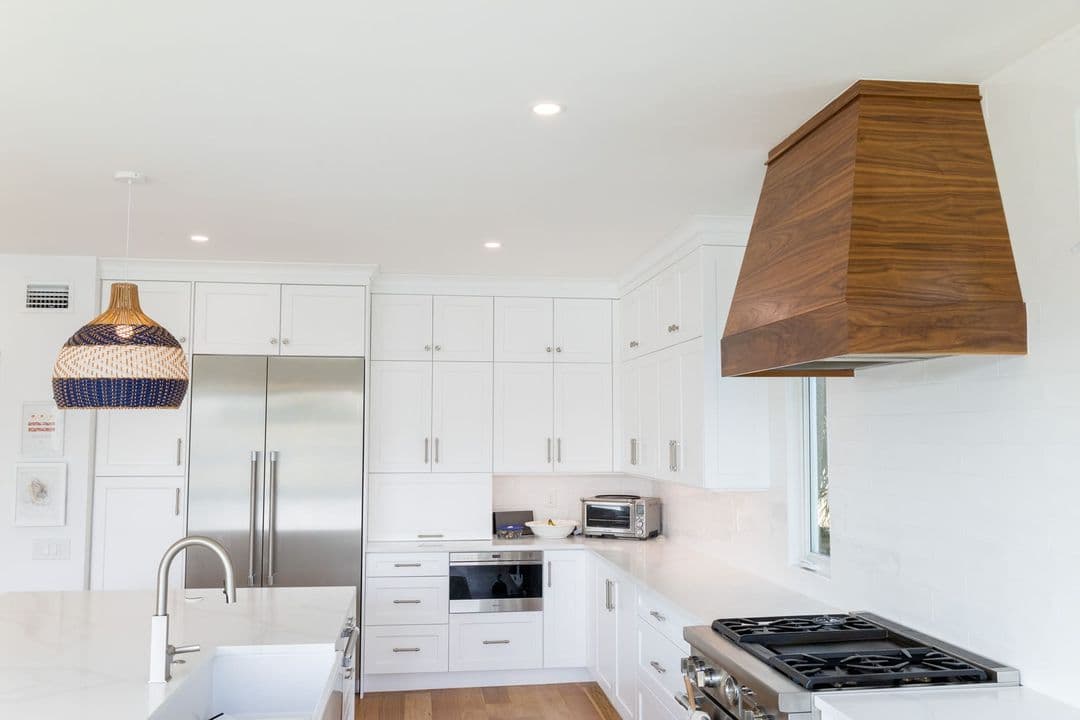
Most kitchens in St. Pete were built for someone standing up, walking through, opening a refrigerator with one hand and stirring a pot with the other. When a family member's mobility shifts — whether from age, an injury, a degenerative diagnosis, or planning ahead for a parent moving in — that kitchen layout starts working against them.
A limited-mobility kitchen retrofit doesn't have to mean a full teardown. Done right, it's a sequence of dimensional changes and appliance swaps that preserve most of what's there. Done wrong, it looks like a hospital and still doesn't function. Here's what actually changes when we retrofit a kitchen for limited mobility — and what it costs in St. Petersburg.
What “Limited Mobility” Actually Means in a Kitchen
The range runs from blocking-for-later — adding plywood inside walls during a remodel so grab bars and pull-out hardware can be added years from now — to full ADA conversion with a 60-inch turning radius, 34-inch counters, and roll-under sinks. Most of our St. Pete clients land in the middle: a partial retrofit driven by a specific user (a parent moving in, a spouse recovering from surgery, a homeowner planning for the next 20 years in place).
Jeremy Wharton frames it this way in our owner interviews: “The range from two or three minor modifications to full accessibility hinges mostly on the client’s mobility and whether they have a disease that’s going to impact them physically at a quicker rate. Adding in blocking for future handrails is a good example of minor. That’s different than creating a zero-curb roll-in shower with fixtures set low.”
The same spectrum applies to kitchens. Most cost-effective work happens when you know which side of that spectrum you're on before the cabinets are ordered.
The 60-Inch Turning Radius
The wheelchair turning radius is the single dimensional driver of an accessible kitchen layout. Standard kitchen aisle widths in St. Pete homes run 36 to 42 inches between counter runs and islands. ANSI A117.1 (the accessibility standard FBC references) calls for 60 inches of clear floor space at any point a wheelchair needs to pivot.
That one number cascades through everything: the island shrinks or disappears, the dishwasher relocates, the refrigerator door swing gets rechecked. On a kitchen that's already tight, this is the change that determines whether a retrofit is even possible without taking down a wall.
Counter Height: 34″ vs 36″ and the Cabinet Domino
Standard kitchen counters sit at 36 inches. ADA-accessible counters drop to 34 inches max — a 2-inch difference that sounds trivial and isn't. Every base cabinet, drawer face, toe-kick, and integrated appliance height shifts down with it. Stock big-box cabinets won't accommodate the change cleanly. Semi-custom or fully custom cabinetry is the realistic path, and the toe-kick gets pulled deeper to clear a footplate.
You don't have to drop every counter. A common compromise is a single 34-inch section with knee clearance underneath — usually adjacent to the cooktop or the sink — with the rest of the kitchen at standard height for ambulatory family members.
27-Inch Knee Clearance Under the Sink (and What Plumbing Has to Change)
If a wheelchair user is going to wash dishes or fill a pot, the sink needs knee clearance underneath: 27 inches minimum vertical clearance, 30 inches wide, 19 inches deep per ANSI A117.1.
The plumbing piece is where retrofits get expensive if it's not planned. Standard sink cabinets hide the trap, supply lines, and disposal behind doors. Knee clearance means either an open-front cabinet, a tilt-out front, or a removable apron — plus insulated supply lines and drain pipes so exposed legs can't get burned — plus an offset trap to push the drainage out of the knee space. None of that is a one-day plumbing call.
Appliances That Actually Work
A few appliance choices do most of the safety work:
- Side-opening (French door) wall oven — no reaching across a hot oven door to lift a roasting pan.
- Induction cooktop — no open flame, no residual surface heat once a pan is removed, and the glass is easier to clean from a seated position.
- Drawer-style dishwasher — mounted at counter height instead of the floor, so loading doesn't require bending.
- Side-by-side refrigerator with bottom freezer — frequently used items stay in the middle reach zone.
- Pull-down upper-cabinet hardware — brings the contents of upper cabinets down to a reachable height; expensive but transformative.
These appliances cost more than their standard counterparts. They're also the difference between a kitchen the user can actually operate and one they technically have access to.
Flooring, Lighting, and Reach
Matte luxury vinyl plank or large-format tile with a slip coefficient rated for wet conditions handles the floor question without making the kitchen look institutional. No thresholds between the kitchen and adjacent rooms. Outlets pulled up to 15 to 46 inches above the floor so they're reachable from a seated position. Under-cabinet task lighting on a motion sensor or a paddle switch instead of a small rocker. Lever hardware instead of knobs.
None of these are headline changes. Together, they're what make a kitchen feel usable instead of merely compliant.
What This Costs in St. Pete (and What Funding Helps)
A targeted limited-mobility kitchen retrofit — one knee-clearance sink section, custom cabinets for that run, two accessibility-rated appliances, lever hardware, slip-rated flooring — typically adds 10 to 20 percent to the cost of a standard kitchen remodel in our market. Jeremy's frame from the same interview: “Budget range might be a standard budget for a standard remodel, plus 10 to 20 percent for aging-in-place considerations.”
A full ADA conversion — 60-inch clear floor space throughout, all counters at 34 inches, complete custom cabinetry, three or more accessibility appliances, pull-down upper hardware — pushes higher and is closer to a ground-up kitchen rebuild than a retrofit.
Three funding sources are worth checking before scoping:
- VA Specially Adapted Housing (SAH) and Special Housing Adaptation (SHA) grants — for service-connected disabilities. Amounts and eligibility are set by VA; check current numbers at va.gov/housing-assistance.
- Medicare medical-necessity reimbursement — limited, but possible when a physician prescribes specific modifications. Talk to a Medicare-credentialed occupational therapist before assuming coverage.
- Pinellas County aging-in-place support programs — availability shifts year to year; the Pinellas County Office of Human Services can confirm current options.
We don't administer these programs, but we structure scopes and provide documentation that supports applications.
When to Retrofit vs. Remodel Completely
A targeted retrofit makes sense when the existing cabinets are in good shape, the layout has enough room to add a knee-clearance section without rerouting plumbing across the room, and the user's mobility needs are stable or progressing slowly. A full kitchen remodel is the better call when the cabinets are end-of-life anyway, the layout can't accommodate a 60-inch turn without walls coming down, or progressive mobility needs are likely within 3 to 5 years.
The cheapest accessibility work happens during a remodel that was already happening. The most expensive happens after the new cabinets are in.
Frequently Asked Questions
Can my existing kitchen be made wheelchair accessible without a full remodel?
Sometimes — depending on aisle widths, cabinet condition, and how many of the changes above are needed. A targeted retrofit (one knee-clearance section, swapped appliances, lever hardware) is achievable in many St. Pete kitchens. A full ADA conversion usually isn't, without significant structural and cabinet work.
What's the minimum aisle width for a wheelchair in a kitchen?
36 inches for a straight pass. 60 inches for a turning circle. Both numbers are in ANSI A117.1; the Florida Building Code references the same standard.
Do I need a permit for accessibility-only modifications?
Grab bars and lever hardware swaps don't require a permit in St. Pete. Anything that involves plumbing relocation, electrical work, or structural framing does. We handle the permitting.
How long does a limited-mobility kitchen retrofit take?
A partial retrofit with appliance swaps and one knee-clearance section runs 3 to 5 weeks including permit time. A full ADA conversion is closer to a standard kitchen remodel timeline — 8 to 12 weeks.
What to Do Next
If you're planning a kitchen remodel and want to build in accessibility for the future, see our aging-in-place service page. If you want broader accessibility context across the rest of the house, the accessible home renovations guide walks through the eight most common modifications and their ADA dimensions. For kitchen cost benchmarks generally, see kitchen remodel cost in St. Petersburg.
Revolution Contractors is a licensed general contractor (CGC1522463) serving Pinellas County. We work Time and Materials with open-book pricing and a 20-plus carpenter in-house team. Contact us or call (727) 888-6161.