Kitchen Remodeling Ideas That Actually Work in St. Pete Homes

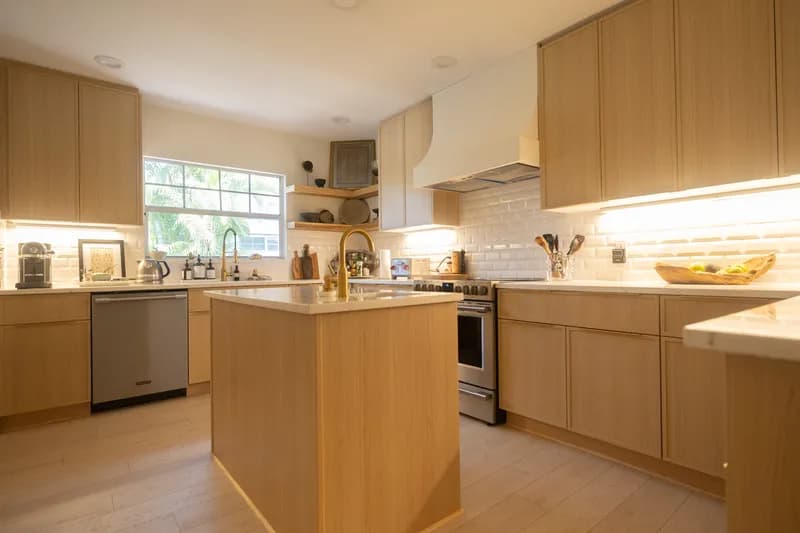
The kitchen remodeling ideas that look great on Instagram don’t always hold up in a St. Petersburg home built before 1990. Most of the housing stock in Old Northeast, Kenwood, Crescent Lake, and Historic Uptown has small galley kitchens stuffed into the back of the house, aging cast iron drain plumbing behind the walls, and layouts designed for utility — not entertaining. We’ve remodeled kitchens across Pinellas County for 20+ years, and the trends worth considering are the ones that solve real problems in your actual kitchen — not the ones that photograph well in a staged showroom.
Here’s what we’re seeing clients invest in across St. Pete remodels right now — from $40,000 facelifts in Bahama Shores ranches to six-figure full remodels in Snell Isle waterfront builds — and what we’d skip regardless of budget. Our 20+ in-house W-2 carpenters have installed every one of these trends on a jobsite, so what follows is what we’ve seen actually work, not what’s trending on Pinterest this quarter.
Natural Stone Is Replacing Engineered Quartz
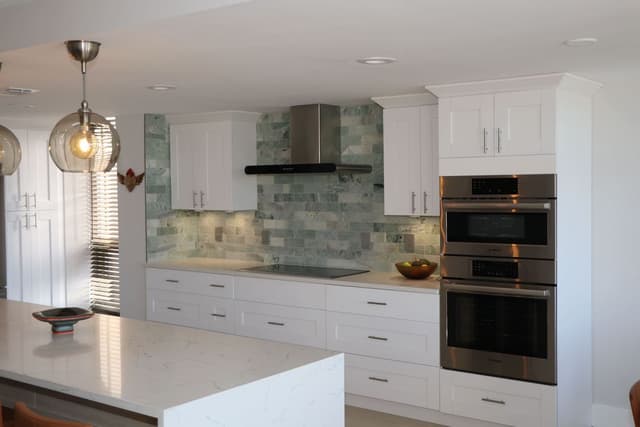
The short answer: natural quartzite and granite are replacing engineered quartz on St. Pete kitchen remodels in the $75,000–$100,000 range and above. Quartzite delivers the veining and character of marble with better impact resistance; granite is making a return in dramatic dark slabs after a decade of being dismissed as dated. Engineered quartz is still defensible on tight budgets and high-traffic households where consistency matters, but the design trend is decisively back toward natural stone for clients investing in a focal-point kitchen.
This is the biggest shift we’re seeing in kitchen countertops, and it’s one we’ve been advocating for years.
“White and gray quartz — I think it looks like plastic garbage,” says Jeremy Wharton, Revolution’s owner. “I’d much rather use a natural quartzite or granite, even a marble.”
That’s a strong opinion, but it’s backed by what we see on job sites. Engineered quartz dominated kitchens for the last decade because it was marketed as low-maintenance and consistent. But homeowners are noticing that it looks identical in every house — and it doesn’t age the way natural stone does. Quartzite offers the veining and character of marble with better durability. Granite, once dismissed as dated, is making a comeback in darker, more dramatic slabs.
For a mid-range kitchen remodel in the $75,000–$100,000 range, countertop material choice is one of your biggest budget levers. A quartzite waterfall island with thickened edges will cost more than a standard quartz slab, but it becomes the centerpiece of the room — and it’s something guests notice the second they walk into your kitchen.
Jeremy Wharton, Revolution’s owner, is direct about where the budget goes: “A realistic budget range for a kitchen remodel is gonna depend obviously on what’s being done. If it was just a facelift without a ton of layout changes, an entry-level basic RTA cabinet setup might be in the $40,000 to $60,000 range for the kitchen, and then $75,000 to $100,000 and up for a larger, nicer kitchen. It’s not uncommon for a luxury kitchen to spend $30,000 to $50,000 in appliances alone, so if we had a lot of stone, if the stone is gonna get thickened edges and get waterfalled off the island, that’s gonna add thousands of dollars there as well.”
That’s why countertop material is one of the first decisions we walk clients through during pre-construction — it cascades into appliance budget, cabinet finish selection, and even layout decisions about whether the island is the focal point or a working surface.
Workstation Sinks Are Worth the Investment
Workstation sinks — the oversized basins with built-in accessories like cutting boards, colanders, and drying racks — used to be a luxury-only item. Not anymore.
“They used to be really expensive a few years back when they started showing up, but now they’re not as big of a deal,” Jeremy says. Prices have dropped as more manufacturers entered the market, and the functionality is hard to argue with.
In older St. Pete kitchens where counter space is limited, a workstation sink effectively adds prep area without requiring a larger footprint. That’s a practical upgrade, not just a pretty one — especially in the small, cramped kitchens common in Old Northeast, Kenwood, Crescent Lake, and Historic Uptown homes built in the 1920s through 1940s.
Jeremy describes the typology directly: “A lot of the times in St. Petersburg, where we do most of our work, we see small cramped kitchens, old galley kitchens that sit on the back of the house. A lot of times, we saw one today that had the kitchen stuffed onto what used to be, I think, a sleeping porch, so it was part of an addition with a sloped floor, and the kitchen itself was an afterthought.” The workstation sink is one of the few upgrades that makes a real difference in a 7-by-10 galley without requiring you to blow out a wall — which in a 1925 bungalow with knob-and-tube wiring inside the wall is a $15,000 decision before you’ve even bought the sink.
The Open Floor Plan Is Getting a Reality Check
For years, every kitchen remodel started with “knock down the wall.” Open floor plans dominated, and the kitchen-living room merge became standard. That’s shifting.
“There’s actually a push away from super open floor plans,” Jeremy notes. “People are understanding they don’t necessarily want to watch the carrots get peeled and the disposal get run.”
We’re not talking about going back to closed-off galley kitchens. The trend is toward partial separation — a half-wall, a peninsula with higher counter, or strategic cabinet placement that defines the kitchen zone without fully walling it off. You get the sightlines and conversation flow without the cooking mess on full display.
This matters in St. Pete because many homeowners with older homes are still opening up their kitchens for the first time. The move now is to open things up thoughtfully, not completely. If you’re removing a load-bearing wall — which requires structural engineering, a permit from St. Petersburg’s building department (typically 2 to 5 weeks), temporary shoring, and a steel beam or LVL header — make sure the final layout gives you some visual separation where it counts.
We’ve seen it both ways: clients in Snell Isle who opened the wall fully and a year later wished they had a half-wall to hide a Saturday morning prep mess; clients in Shore Acres who kept a peninsula and now use it as a dedicated coffee bar that doubles as the visual break between cooking and the living room. Both decisions are valid; just don’t let “open floor plan” get treated as a default without thinking through how you actually live in the space.
Ready to Talk Kitchen Remodeling Ideas?
We'll walk through what makes sense for your specific kitchen, your budget, and your timeline.
Wood-Grain Cabinets Are Back — But Not the Oak You Remember
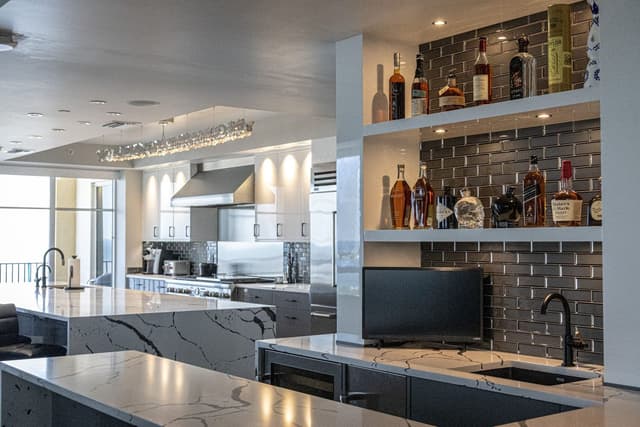
The short answer: white oak, walnut, and rift-sawn finishes are replacing all-white and all-gray cabinets on St. Pete kitchen remodels — but the new wood-grain looks nothing like the orange-toned oak that defined kitchens in the 1980s. Cabinets are also getting sleeker frames and thinner profiles, which subtly modernizes a kitchen without forcing a complete style overhaul. RTA (ready-to-assemble) and semi-custom options are both available in these finishes; the price difference is in the door construction and lead time, not the material itself.
The honey oak cabinets from the 1980s gave wood-grain a bad reputation. What’s replacing all-white and all-gray cabinets now is something different: white oak, walnut, and rift-sawn finishes in modern tones. Think warm, natural textures — not the orange-tinted oak of decades past.
The other cabinet trend worth noting is thinner profile frames. Cabinets are getting sleeker, with less visible frame and more clean lines. It’s a subtle shift that makes a kitchen feel more modern without a full style overhaul.
For an entry-level kitchen remodel in the $40,000–$60,000 rangecabinet selection is your single biggest line item — typically 29–40% of your total budget. RTA (ready-to-assemble) cabinets keep costs down, while semi-custom or custom options in these new wood tones push you into the mid-range and above. Lead times for custom cabinets run 6–12 weeks, so decisions need to happen early in the pre-construction phase.
One advantage of working with a contractor who keeps 20+ W-2 carpenters on payroll: installation quality stays consistent. Our same crew works the cabinet installation, custom trim, and millwork through one open-book budget — not a rotating cast moving between three other jobs. That matters more than most clients realize: a wood-grain cabinet finish reveals every misaligned reveal and uneven shadow line in a way that high-gloss white never does, so the install crew’s experience and the time they spend on each cabinet face is what makes a $40,000 cabinet investment look like a $60,000 one — or a $20,000 one.
The other reason cabinet selection has to happen early: lead times. Custom cabinets in white oak or walnut can run 6 to 12 weeks from order to delivery. Jeremy puts the pre-construction discipline this way: “If we spend an hour with selections and allowances trying to figure out how everything’s gonna look and where everything’s gonna go, it’ll save us two hours in the field of staring at a wall marking it with a Sharpie wondering where a light fixture should go or the break-in tile for a light fixture or switch or whatever.” That 1-hour-saves-2 ratio is why our T&M model encourages clients to slow down on selections during pre-construction and speed up everything that follows.
Skip the Gimmicks: What We’d Avoid
Not every trend is worth chasing. A few we’d steer clients away from after watching them age across hundreds of St. Pete kitchen remodels:
- Digital shower-style interfaces in kitchens. Touchscreen faucets and app-connected appliances sound futuristic but add failure points. A quality single-handle Brizo, Kohler, or Delta faucet will outlast any smart feature by a decade — and when the smart feature dies, you’re paying a plumber for a re-rough that wouldn’t have been needed.
- Ultra-thin countertop profiles. The razor-thin 3/4-inch edge look is striking in photos but fragile in practice — especially on natural quartzite or marble, where the edge is most vulnerable to chipping near the sink and dishwasher zones. Standard 1.25-inch eased edges or mitered 2-inch edges hold up far better in actual daily use.
- Full backsplash tile murals. These date quickly — what felt fresh in 2018 looks dated in 2026. A clean subway tile, natural stone slab, or large-format porcelain ages better and costs less to refresh when you want a change in five years. We’ve replaced more “feature wall” backsplashes than we’ve installed in the last three years.
- Touchscreen refrigerators with built-in tablets. Wolf, Sub-Zero, and Thermador all sell premium fridges without these — and your phone or a wall-mounted tablet does everything the fridge tablet does, except your phone gets software updates for more than 3 years.
What St. Pete Kitchens Actually Need Behind the Walls
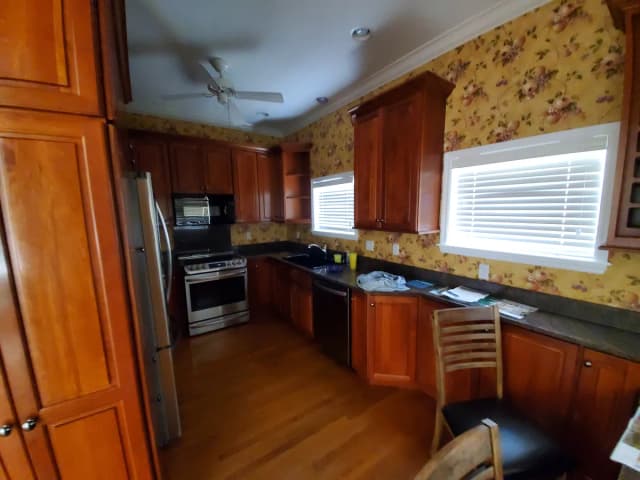
Most kitchen remodeling ideas articles are written for new-construction homes in master-planned communities with modern layouts, slab foundations poured in the last decade, and PEX or copper supply lines behind drywall installed when the studs were already at code. St. Petersburg’s housing stock is different — and it’s the difference that drives 70% of the actual cost of a kitchen remodel in a pre-1975 Pinellas home.
Jeremy frames the underlying shift this way: “The biggest problem we have is that kitchens from before about the 1990s were created for utility — to prepare food and store food — and since then, they’ve become a focal point of entertainment in the house. So for us insane people, our biggest problem is that we’re actually trying to change the whole concept of the kitchen and bring it up to modern standards, which means a lot of times we’ve got to make the kitchen larger — blow out walls, make structural changes, move plumbing and electrical. So beyond just the design of the cabinetry and the functionality of the kitchen is the physical plant needing significant upgrades.” That’s the part Pinterest doesn’t show.
If your home was built before the 1990s — anywhere from a 1920s bungalow in Old Northeast or Roser Park to a 1950s ranch in Bahama Shores or Crescent Lake to a 1970s split-level in Shore Acres — the best remodeling ideas for your kitchen might not be trending on Pinterest. They’re more practical: relocating the kitchen to capture natural light from a south-facing window the original 1925 floor plan ignored, removing a wall to connect with the living space (partially, after structural engineering and a permit).
Beyond layout, the physical plant usually needs work too: upgrading cast iron drain plumbing in older St. Pete homes that’s been building up sediment for 80 years and can add $10,000 to $20,000 to a kitchen budget if it has to be replaced all the way to the street, and bringing electrical up to code for modern induction ranges and built-in convection wall ovens that draw amperage the original 60-amp service can’t carry.
When our crew finds cast iron, outdated 2-wire knob-and-tube wiring, or undersized supply lines during demo on a Snell Isle waterfront kitchen or a Kenwood bungalow, our T&M open-book billing means we talk through the cost openly with weekly budget reports rather than burying the surprise in a padded fixed-bid estimate. You decide how to proceed with full information — the alternative is finding out during a change order whether the contractor padded enough margin to absorb the find, which is how most fixed-bid kitchen remodels turn into adversarial conversations.
Those aren’t glamorous upgrades, but they’re what transform the way you actually use the room. Everything else — the countertop material, the cabinet finish, the sink style — is the fun part that comes after the bones are right.
We’ve been remodeling St. Petersburg kitchens for over 20 years across every neighborhood from Old Northeast and Snell Isle to Shore Acres and Tierra Verde. Seventy percent of our projects come from repeat clients and referrals — not because we say we’re good, but because clients who’ve seen the work send their neighbors. Our 20+ in-house W-2 carpenters mean the same crew that demoed your neighbor’s 1925 Old Northeast bungalow back to studs and rebuilt it with a workstation sink, white oak cabinets, and a quartzite island will be the crew on your jobsite — not subcontractors rotating between three other projects across Pinellas County.
Frequently Asked Questions
What kitchen trends are actually worth the money?
Workstation sinks, more functional and prices have dropped significantly. Natural stone countertops (quartzite, granite) over engineered quartz, they look and feel like a real kitchen, not a showroom. Wood-grain cabinets in white oak or walnut with thinner profiles for a cleaner look. And a slight pullback from fully open floor plans, some separation between cooking and living space is making a smart comeback.
What's the difference between a kitchen refresh and a full remodel?
A refresh keeps your existing layout, new cabinets, countertops, fixtures, paint, flooring, for $40,000–$60,000 in St. Pete. A full remodel changes the layout, moves walls, reroutes plumbing and electrical, and redesigns how the space functions, $75,000–$100,000+. If your kitchen's layout works but the finishes are dated, a refresh is the move. If the layout is the problem, you need a full remodel.
What are the biggest cost drivers in a kitchen remodel?
Cabinets are the single largest line item (29–40% of total budget). After that: countertops, especially natural stone with waterfall edges, and appliances. Luxury brands like Wolf, Thermador, and Sub-Zero run $30,000–$50,000 for a full suite. Moving plumbing or removing load-bearing walls adds structural engineering costs. The most expensive mistake: changing your design after construction has started.
Do I need a permit for a kitchen remodel in St. Pete?
If plumbing or electrical is being moved: yes. If it's purely cosmetic, new cabinets, countertops, backsplash, appliances in the same spots, no permit required. Permitting in St. Petersburg takes 2–5 weeks. We handle all submittals and inspections.
What decisions should I make before kitchen construction starts?
Lock in these during pre-construction: cabinet style and finish (white oak, walnut, or shaker; RTA vs. semi-custom vs. custom), countertop material (quartzite, granite, marble, or quartz), appliance brands and models (Wolf, Sub-Zero, and Thermador for high-end; KitchenAid, GE Café, or Bosch for mid-tier), tile for backsplash and floors, fixture styles (Brizo, Kohler, Delta), lighting plan, and final layout approval. Custom cabinet lead times run 6 to 12 weeks, so early decisions keep your timeline on track. An hour with selections during pre-construction saves two hours in the field, Jeremy's 1-to-2 ratio shows up on every jobsite from Old Northeast bungalows to Snell Isle waterfront builds.
Key Takeaways
- Natural quartzite and granite are replacing engineered quartz as homeowners look for character over uniformity
- Workstation sinks have dropped in price and add functional prep space — especially valuable in smaller St. Pete kitchens
- Fully open floor plans are softening toward partial separation — open enough for conversation, defined enough to hide the mess
- Wood-grain cabinets are back in white oak and walnut tones, with sleeker, thinner frames
- In older St. Pete homes, the most impactful upgrades are structural and mechanical — not just cosmetic
Ready to dig deeper? See what these trends cost in our kitchen remodel cost guide. Have an older St. Pete home? Read our guide to small kitchen remodels in older homes. Planning your timeline? See how long a kitchen remodel takes. Working through layout decisions like the open vs. partial-separation trade-off above? Our kitchen layout planning guide walks through galley, U-shape, L-shape, and island configurations specific to St. Pete housing stock. For local-area-specific service pages, see our St. Pete kitchen remodeling page, or explore our broader kitchen remodeling services to see how our 20+ in-house W-2 carpenters approach these projects.
Your Kitchen Has Its Own Quirks
A trend list can't account for what's behind your walls. Call us or request a free consultation to walk through what your specific kitchen needs.