Kitchen Remodel ROI: What St. Petersburg Homeowners Actually Recoup

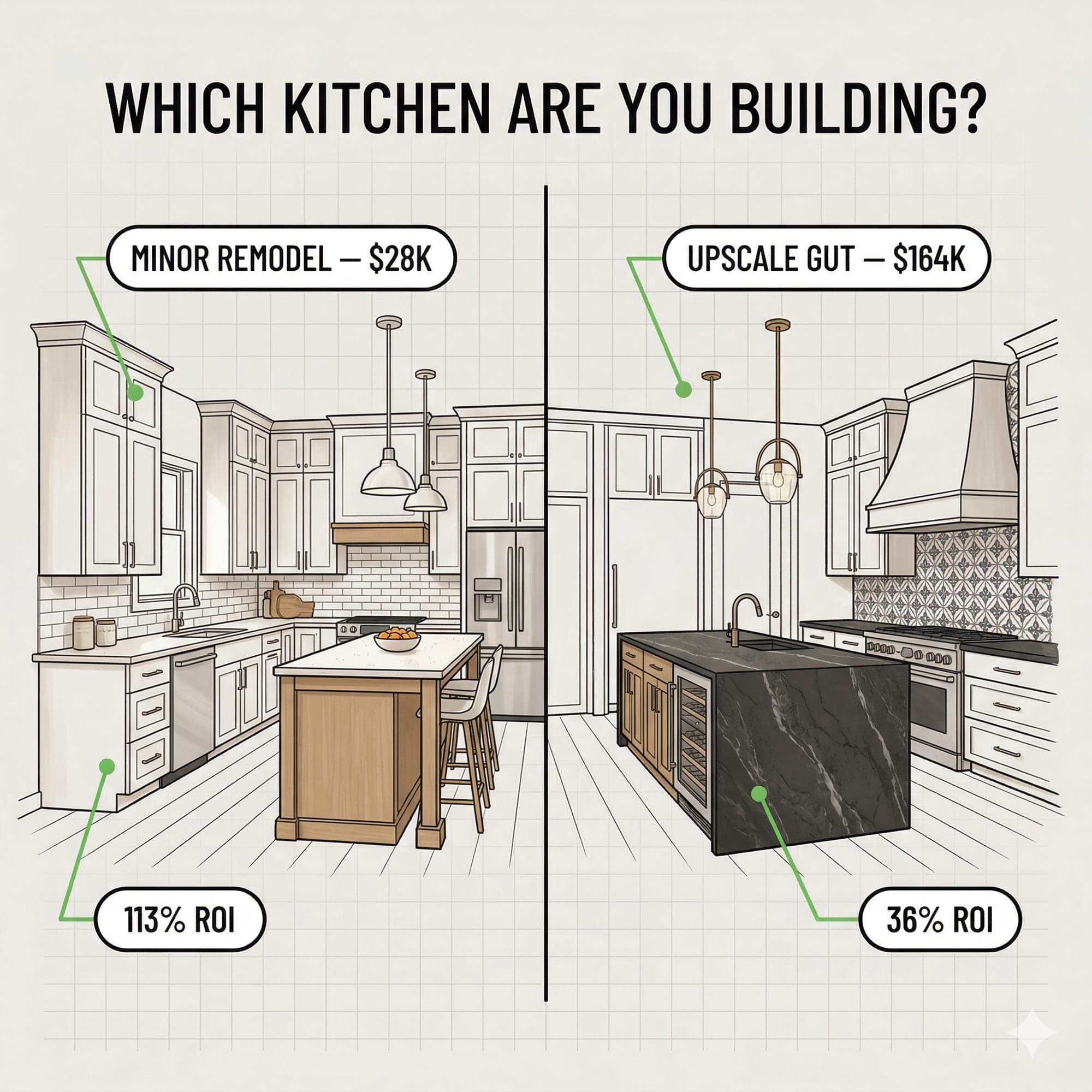
Your kitchen remodel ROI depends entirely on what you do — and most homeowners get this wrong. A minor kitchen remodel returns 113% at resale per the 2026 Remodeling Magazine Cost vs. Value Report, making it one of only five projects nationally that actually puts money back in your pocket. A major upscale remodel? Per the same report, you’ll recoup about 36%, losing roughly 64 cents on every dollar in St. Petersburg or anywhere else.
The difference isn’t about quality. It’s about knowing which upgrades drive value and which ones you’re doing purely for yourself. Here’s what the numbers look like in the St. Petersburg market.
One source-discipline note before we go further: the headline ROI percentages on this page come from the Remodeling Magazine 2026 Cost vs. Value Report, which the National Association of REALTORS® (NAR) and the National Association of Home Builders (NAHB) reference as the standard benchmark for remodel resale value. Where we cite a specific percentage, we cite the source. Where the data isn’t in that report — like specific upgrade-tier ROI or appliance-related sale-speed lift — we hedge with industry-consensus framing rather than invent a number. Your home’s actual recoup depends on neighborhood comps, market timing, and buyer pool composition, none of which a national report can predict for your specific St. Petersburg house.
The 2025 Cost vs. Value Data
The Remodeling Magazine Cost vs. Value Report (referenced annually by the National Association of REALTORS® and the National Association of Home Builders) is still the cleanest national ROI benchmark for kitchen and bath remodels. The 2025/2026 report breaks kitchen remodels into three tiers:
| Remodel Type | Average Cost | Value Added at Resale | ROI |
|---|---|---|---|
| Minor (midrange) | $28,458 | $32,141 | 112.9% |
| Major (midrange) | $82,793 | ~$45,000 | ~54% |
| Major (upscale) | $164,104 | ~$58,561 | ~36% |
The minor remodel — cabinet refacing, new countertops, updated lighting, modern hardware, fresh backsplash, and new appliances — is the only interior project in the national top five for ROI. It beats bathroom remodels, finished basements, and home additions.
The pattern is clear: every additional dollar you spend on a kitchen renovation returns less than the one before it. That doesn’t mean a full remodel is a bad decision — it means you should know whether you’re renovating for resale value or for the way you want to live.
What These Numbers Mean in St. Petersburg
National averages are a starting point. Your return depends on your local market.
St. Petersburg’s median home sale price has held in the low $400,000s through 2025-2026 (per Stellar MLS / Zillow market data), with prices appreciating in the 3–5% annual range typical of post-2024 Florida coastal-metro markets. Three-bedroom homes — the core of kitchen remodel demand — have run ahead of that range over the past 12 months. That appreciation matters because a kitchen remodel today is worth more next year purely from market growth, in Pinellas County and across the Tampa Bay region.
The standard rule of thumb (widely referenced by NAHB and Houzz Kitchen Trends data): spend 5–15% of your home’s value on a kitchen remodel. For a $400,000 St. Pete home, that’s $20,000–$60,000. A $28,000 minor remodel sits right in the sweet spot at 7% of home value — close to the $28,458 national average for a minor remodel in the 2026 Cost vs. Value Report.
Here’s where St. Pete gets different from the national data:
- Pre-1970s housing stock — common across Old Northeast, Kenwood, Historic Uptown, Crescent Lake, and Roser Park — means your kitchen walls may hide cast iron plumbing, knob-and-tube wiring, or asbestos tile. A “minor” remodel can become a major one once you open things up. Cast iron drain replacement back to the street can add $10,000-$20,000 on its own, per the realities of working in 80-year-old St. Pete bungalows. Budget 10–15% for contingency, and pull a permit on any work that touches a drain or panel — St. Petersburg building department flags unpermitted kitchen work at resale inspection more often than people realize.
- Florida’s humidity and salt air accelerate material wear. Your countertops, cabinet finishes, and appliances take more abuse here than in a Minnesota kitchen. Choosing durable materials is a form of ROI protection.
- No state income tax. When you sell your home, your capital gains are taxed only at the federal level. Combined with the $250K/$500K primary residence exclusion, most St. Pete homeowners keep significantly more of their home sale profits than homeowners in income-tax states. Your kitchen renovation ROI is effectively higher in Florida.
How Your Contractor’s Pricing Model Affects ROI
Here’s something no other ROI guide will tell you: your contractor’s pricing model directly impacts your return.
Traditional fixed-price contracts build in a markup cushion to cover the contractor’s risk. From our own pricing intel: fixed-price competitors in our market typically run a 40% markup, which protects the contractor, not the client. You’re paying for problems that may never happen — and that money doesn’t show up in your home’s value.
“Our time-and-materials approach for kitchens works really well. It allows us a collaborative approach from the very beginning. As soon as the client and we decide that we want to work together, we’re able to start working on design. There are so many questions and so many different levels of quality inside of a kitchen that need to be sussed out that a collaborative approach works best rather than giving someone arbitrary allowances. We can begin really drilling down on the specific costs that we’re going to encounter and implement during the project.”
With Revolution’s open-book Time & Materials (T&M) model — currently 30% markup, fully transparent line by line — you see every invoice, every material receipt, every labor hour. There’s no hidden risk cushion. And because we run 20+ W-2 carpenters on payroll instead of juggling outside crews, more of your budget goes to actual carpentry — not sub markups or scheduling gaps. We’re not claiming a universal industry savings rate; what we’ll say is that on our T&M math, the spread between a transparent 30% markup and an opaque 40% fixed-bid markup is meaningful — on a $50,000 kitchen, that’s roughly $5,000 of cushion that either funds finish upgrades or stays in your pocket. Either way, your ROI improves.

Weekly budget reports also let you make informed decisions during the project. If you’re approaching your limit on countertops, you can adjust before the money’s spent — not after. That kind of control is how you protect your investment.
Which Kitchen Upgrades Actually Pay Back
Not all upgrades are created equal. Here’s what the data says about which components drive the most return per dollar spent:
Cabinet Refacing or Painting — Highest return per dollar in the cabinet category
At $7,000–$12,000, refacing your existing cabinet boxes with new doors and hardware is widely cited (NAHB, Houzz, This Old House cost-vs-value coverage) as the single highest-return-per-dollar kitchen upgrade in the cabinet category. Full replacement ($15,000–$25,000) returns less per dollar because you’re paying for demolition, disposal, and installation labor on top of the materials. Specific recoup percentages on cabinet-only work aren’t broken out in the standard Remodeling Magazine Cost vs. Value tiers, so we won’t put a number on it — the directional reality is what matters: refacing pays back better than replacing, dollar for dollar, at the cabinet line item.
Countertop Replacement — Strong recoup, particularly on aged surfaces
A 40-square-foot quartz countertop runs $3,000–$4,500 installed in our St. Pete project history. Industry estimates from NAHB and Houzz Kitchen Trends suggest quartz and granite remain the buyer preferences and that countertop replacement on aged surfaces typically returns a meaningful share of the install cost — though the specific recoup percentage isn’t in the standard Cost vs. Value report and varies by neighborhood comp. Avoid exotic stone that requires specialized maintenance — buyers see it as a liability, not a feature. Jeremy on the material-trend reality: “the wood-grain cabinets are coming back, but the modern, more blonde and gray — not the old-school yellow oak and hickory and pine cabinets from the ‘70s and ‘80s.”
Energy-Efficient Appliances — Recoup plus tax credit
A new appliance suite (refrigerator, range, dishwasher, microwave) costs $3,500–$7,000 in our recent St. Pete project history. The hard-dollar ROI win on energy-efficient models is the federal tax credit, not a specific value-add percentage: federal tax credits up to $3,200 qualify on certain energy-efficient appliances — direct cash back that improves your return. Industry observations (NAHB, NAR Profile of Home Buyers) suggest updated appliances also correlate with faster sale timelines and stronger first-impression scoring among buyers, though the specific lift varies by market and listing photography quality. For high-end appliances — Wolf, Thermador, Sub-Zero — lead times can run 8-16 weeks, so plan the order ahead of cabinet-install if your remodel timeline matters. (For St. Pete homeowners planning to age in place, see our aging-in-place modifications overview — appliance-height, accessible-reach, and ADA-benchmark choices that protect both daily use and resale value.)
Lighting — High Impact, Low Cost
Under-cabinet, pendant, and recessed lighting are among the cheapest upgrades with the biggest visual impact. Buyers consistently rate well-lit kitchens as more desirable. You can transform the feel of a kitchen for $1,500–$3,000.
Layout Changes — Variable, less predictable
Opening a wall or adding an island can dramatically improve how your kitchen functions. But structural work costs more and returns less predictably than cosmetic upgrades. Specific recoup rates on island additions and wall removals aren’t broken out in the standard Cost vs. Value categories — the data lumps them into “major remodel” tier ROI (~54% midrange, ~36% upscale per the 2026 report). Only worth the investment if your current kitchen layout genuinely doesn’t work — not just because you saw it on HGTV. Per Jeremy on the operational reality of layout changes: “if there’s a layout change to a kitchen that just got framed and had plumbing roughed in, that’s gonna cost some amount of thousands of dollars to backtrack and move it all around again, much less the time that it takes to remobilize the plumber.”
“A realistic budget range for a kitchen remodel is gonna depend obviously on what’s being done. If it was just a facelift without a ton of layout changes, an entry-level basic RTA cabinet setup might be in the $40,000 to $60,000 range for the kitchen, and then $75,000 to $100,000 and up for a larger, nicer kitchen. It’s not uncommon for a luxury kitchen to spend $30,000 to $50,000 in appliances alone, so if we had a lot of stone, if the stone is gonna get thickened edges and get waterfalled off the island, that’s gonna add thousands of dollars there as well. So a very high-end kitchen — it’s not weird for it to go well above $100,000.”

What NOT to Over-Invest In
- Ultra-custom cabinetry. Your taste is personal. Buyers may not share it.
- Exotic countertop materials that require sealing, special cleaners, or careful use. Buyers see maintenance, not luxury.
- Smart kitchen tech that dates quickly. Today’s touchscreen fridge is tomorrow’s obsolete appliance.
- Structural changes without functional improvement. Moving a wall just to move a wall has the worst ROI in the kitchen.
Your Kitchen Remodel Budget Tells You Your ROI Before You Start
Most homeowners think about ROI after the project. You can calculate it before.
If your home is worth $400,000 and you’re planning a $50,000 kitchen remodel, you need that kitchen to add at least $50,000 in value just to break even — and that’s a 100% return, which only minor remodels achieve at the national level. A $50,000 remodel will likely return $25,000–$35,000 at resale (50–70% ROI).
That doesn’t make it a bad investment. It means $15,000–$25,000 of that spend is paying for the years you’ll enjoy the kitchen yourself. If you’re planning to stay in your home for 5+ years, that daily enjoyment has real value — the NARI 2024 Remodeling Impact Report (joint with NAR Research) found that kitchen renovations score among the highest “joy scores” of any interior remodel, with the overwhelming majority of homeowners reporting significantly increased home enjoyment after completion.
The real question isn’t “Will I get my money back?” It’s “How much of this investment is for resale value, and how much is for me?” Knowing that number before you start changes how you make decisions throughout the project.
Ready to Figure Out Your Kitchen ROI?
We’ll walk you through the numbers before any work begins. See what your kitchen remodel will actually cost in St. Pete — and what it’ll return.
When a Kitchen Remodel Is NOT Worth It
Honesty time. A kitchen remodel doesn’t always make financial sense:
- You’re selling within 6 months. A minor refresh might help, but a full remodel won’t recoup costs in a quick sale. Focus on cosmetics only.
- You’re over-improving for your neighborhood. A $150,000 kitchen in a $350,000 neighborhood pushes you past what the market will pay. You’ll never recoup the premium.
- The rest of the house needs work too. A stunning kitchen surrounded by dated bathrooms, worn flooring, and an aging roof creates a disconnect. Spread your budget across the house for better total return — starting with the bathroom.
- Your foundation, roof, or systems need attention. Structural and mechanical issues always come first. No buyer pays extra for a beautiful kitchen in a house with a failing roof.
Based on our own project history, mid-market St. Pete homes ($350,000–$600,000) tend to be where kitchen ROI math works best — proportionate spend ($25,000–$50,000) on a fundamentally sound house in a stable neighborhood like Old Northeast, Crescent Lake, Historic Uptown, or Euclid-St. Paul’s. For a deeper look at which home remodels add the most value, see our full breakdown. For specific kitchen cost framing in the same St. Pete market, see our kitchen remodel cost guide for St. Petersburg. For the bathroom side of the equation, compare with our bathroom remodel ROI data for Florida.
Frequently Asked Questions
What is the average ROI on a kitchen remodel?
A minor kitchen remodel (cabinet refacing, new counters, updated appliances) returns about 113% nationally — one of the few home improvement projects that’s actually a net positive investment. Major midrange remodels return 50–60%, and luxury gut jobs return about 36%.
Does a kitchen remodel increase home value in St. Petersburg?
Yes. With a median home price around $403,000 and 3–5% annual appreciation, St. Pete is a strong market for kitchen ROI. Updated kitchens also help homes sell faster — buyers consistently rank the kitchen as one of the three most important rooms when evaluating a purchase.
How much should I spend on a kitchen remodel based on my home’s value?
The standard guideline is 5–15% of your home’s current value. For a $400,000 St. Pete home, that’s $20,000–$60,000. Staying within this range protects you from over-improving relative to your neighborhood. For a detailed breakdown of what drives those costs, see our kitchen remodel cost guide for St. Petersburg.
Is it worth remodeling a kitchen before selling?
It depends on the scope. A minor refresh (paint cabinets, new hardware, updated lighting, fresh countertops) almost always pays back. A full gut remodel before a sale rarely recoups its cost — you’re better off pricing the home to let the buyer renovate to their own taste.
What adds the most value in a kitchen remodel?
Cabinet refacing (highest return per dollar in the cabinet category, per NAHB and Houzz industry coverage; specific recoup % varies by market), countertop replacement, and energy-efficient appliances deliver the best return per dollar. Lighting upgrades are the cheapest way to transform a kitchen’s feel. Layout changes and structural work have the lowest and most unpredictable returns.
Kitchen remodel vs. bathroom remodel — which has better ROI?
Minor kitchen remodels outperform minor bathroom remodels in ROI (113% vs. roughly 70–80%). However, a bathroom addition can return 40–50% while also increasing your home’s functional square footage. The best strategy depends on what your home needs most. See our full breakdown of home remodels that add the most value.
What is the biggest waste of money in a kitchen remodel?
Over-customization that limits buyer appeal. Ultra-specific cabinet configurations, exotic stone that requires special care, and trendy design choices that date quickly all reduce your return. Choose classic, functional upgrades over personal statements if ROI matters to you.
Ready to Start Your Kitchen Remodel?
Get a free estimate from St. Petersburg’s trusted remodeling experts. Open-book pricing means you see exactly where every dollar goes.