Commercial Renovation in St. Petersburg FL: What Business Owners Actually Need to Know

If you're renovating a commercial space in St. Pete — tenant buildout, restaurant, storefront, office — you're going to deal with more review layers, more code triggers, and more hard costs than most contractors will tell you upfront. This post covers what those actually are: cost ranges by project type, the ADA requirements you can't skip, how the St. Pete permit process works, and what separates a real commercial contractor from someone who occasionally takes commercial work.
In This Article
- What Commercial Renovation Actually Costs
- The Permit Process for Commercial Work
- ADA Compliance Requirements
- Why Your Contractor's License Type Matters
- The Advantage of In-House Labor
- T&M for Commercial Work
- Can You Stay Open During a Remodel?
- St. Pete's Commercial Market Right Now
- Frequently Asked Questions
What Commercial Renovation Actually Costs in St. Petersburg
No competitor publishes this data locally. Here's what commercial renovation in St. Pete actually runs:
| Project Type | Cost Range | What's Included |
|---|---|---|
| Storefront Refresh | $100–$150/sqft | Paint, flooring, custom millwork, lighting — minimal MEP work |
| Tenant Buildout | $150–$250/sqft | Raw space to open-for-business — ADA compliance, full MEP rough-in, framing, finishes |
| Restaurant Build | $200–$300+/sqft | Commercial kitchen, vent hoods, fire suppression, walk-in coolers, custom bars |
A 2,000-sqft tenant buildout runs $300,000–$500,000 at those per-sqft figures. A restaurant build in the same footprint can push $400,000–$600,000 before you get to custom millwork, signage, or specialty equipment. A 3,000-lb pizza oven, for example, requires structural reinforcement before it ever gets rolled through the door.
These numbers are based on what we see on actual St. Pete projects — not a national average or a square-foot estimate from a bid sheet. They include permits, ADA compliance costs, and the mechanical and electrical surprises you typically find in downtown St. Pete's pre-1990 building stock.
Why Commercial Can Cost Less Per Sqft Than High-End Residential
Commercial clients are often surprised that a buildout runs lower per sqft than a luxury kitchen remodel. The math makes sense when you look at what's in the scope:
- ADA-compliant bathrooms are functional, not finished in marble
- Back-of-house areas don't need residential-grade finishes
- Open floor plans mean fewer interior partition walls
- Business owners make decisions faster — less rework from change-of-heart
The complexity comes from regulatory requirements, not finish level. ADA, fire suppression, commercial HVAC — those are real cost drivers. The finishes are often straightforward.
The Permit Process for Commercial Work in St. Pete
Commercial work in St. Petersburg goes through the City of St. Petersburg Building Department — not Pinellas County — for any project within city limits.
Any renovation over $500 in value requires a permit. That includes structural changes, any electrical or plumbing modification, interior partition changes, ADA upgrades, and fire suppression work.
The Four Review Layers
Commercial projects in St. Pete can require four independent review layers:
- Building Department — primary permit review, handles structural and general code compliance
- Fire Department — independent review for fire suppression systems, egress, kitchen suppression. They operate on their own schedule with minimal coordination with the building department. Factor this into your timeline — fire review can add weeks even after the building permit clears.
- Health Department — restaurant and food service projects only, separate from the building permit process entirely
- Zoning — triggered by change-of-use projects (when you're switching a space from one business classification to another)
HB 267 (effective May 2024)
Florida now requires local governments to approve or deny complete commercial permit applications within 60 business days for non-residential buildings under 25,000 sqft. Applications not processed within that window can be deemed approved by default. That's useful context, but it doesn't eliminate the fire department's independent review clock — plan 10–30+ business days for plan review depending on complexity.
Change of Use: The Project Type That Surprises People
If you're converting a space from one business classification to another — a former restaurant becoming a medical office, or a retail space becoming a restaurant — you've triggered a full code reset. ADA compliance, zoning variance review, complete MEP reconfiguration. Change-of-use projects are among the most complex commercial renovations in terms of permit burden, and most business owners don't realize that's what they're walking into until a contractor tells them mid-negotiation.
Planning a Commercial Renovation?
Get a free estimate from St. Pete's dual-licensed commercial contractor
ADA Compliance Is Not Optional
This is the number one cost item that business owners underestimate: any project that goes to permit triggers ADA compliance requirements under the Florida Building Code (Chapter 11, 7th Edition) and 28 CFR 36. There is no grandfather exception for older buildings.
If your bathroom doesn't have a 60-inch turning radius, grab bars, and correct fixture heights — that's in the scope. If your entry door is 30 inches wide instead of the required 36 inches — that's in the scope. If your entry doesn't have accessible approach — ramp or lift — that's in the scope.
What ADA compliance costs depend on the existing condition of your space:
- Newer spaces (post-2000): Often partially compliant already. Minor upgrades only.
- Older downtown St. Pete spaces (pre-1990): Expect door width changes, bathroom gut and rebuild, and often entry modifications. Budget $15,000–$40,000 for ADA work alone depending on scope.
- Change-of-use projects: Full ADA review against current code, not prior occupancy standards.
The business owners who plan for ADA upfront aren't surprised. The ones who get an “and also” email two weeks into permit review are.
Why Your Contractor's License Type Actually Matters
In Florida, a Certified General Contractor (CGC) license is required to legally take unlimited-scope commercial projects. A residential Certified Residential Contractor (CRC) license alone doesn't cover commercial work.
Revolution holds both: CRC1331628 (residential) and CGC1522463 (general). Most local contractors operate on one license only. If your contractor is primarily a residential GC who “also does commercial,” verify their CGC license before you sign anything. You're not just protecting yourself legally — you're ensuring the person running your project knows commercial code, not just residential code. They're different documents.
The Real Advantage of In-House Labor on Commercial Projects
Commercial construction moves faster than residential. Business owners make decisions without the emotional attachment that slows residential projects down. You want your contractor to match that pace.
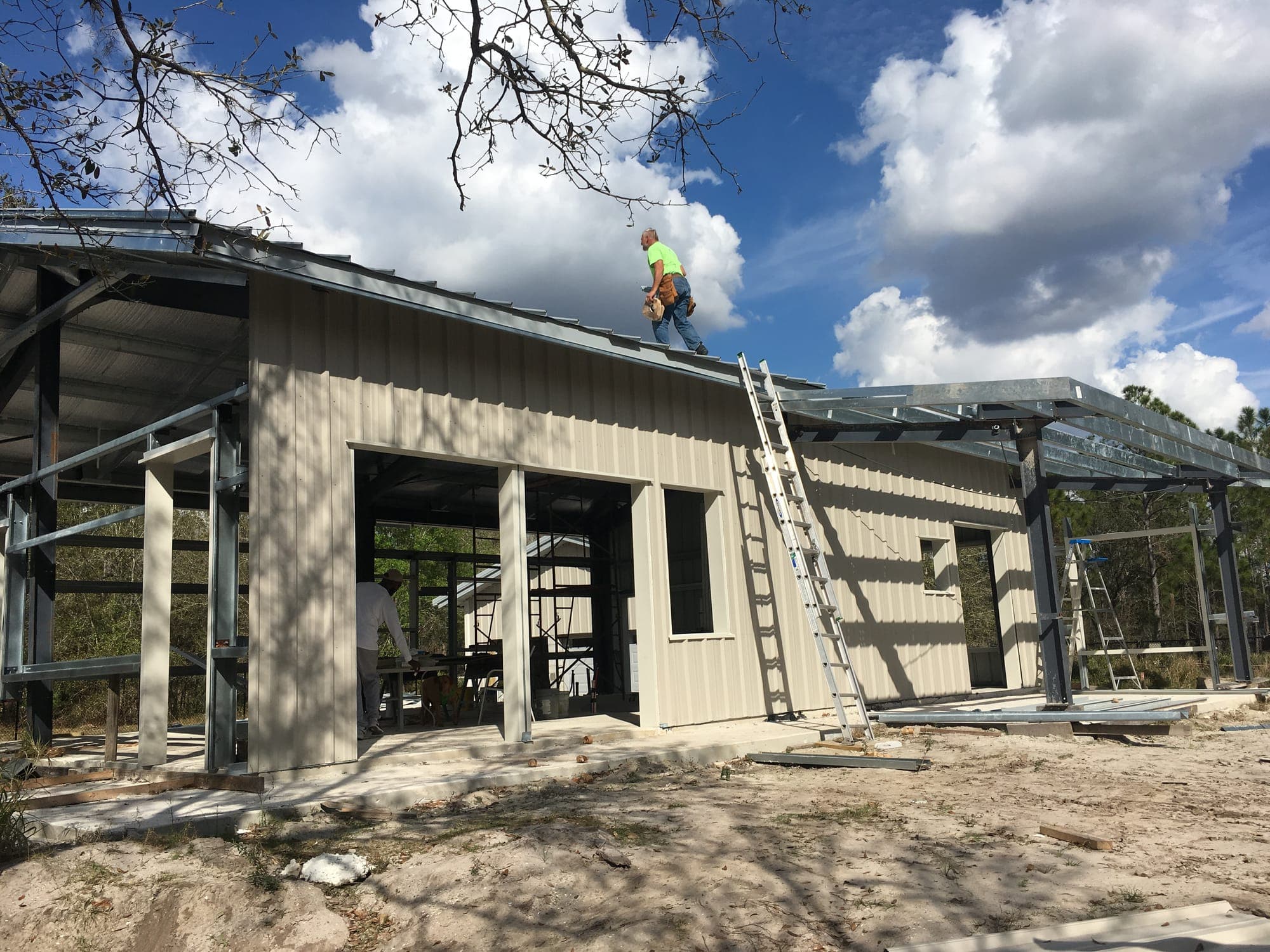
When your GC's carpenter crew are their own W-2 employees — not subs with three other job commitments — schedule control is real. Revolution has 20+ carpenters on payroll. When a commercial project is ready for the next phase, the crew is there. No scheduling window, no call-back, no waiting for a sub whose other job ran long.
That's not a marketing claim — it's a function of payroll structure. Subs go where the next job is. Employees go where the superintendent sends them.
T&M for Commercial Work: Why It's the Better Model for Business Owners
Fixed-bid contracts on commercial projects have a dirty secret: the contingency is baked in whether the surprises happen or not. You're paying for the contractor's risk premium regardless of what actually occurs in your walls.
Time & Materials (T&M) means you pay for what the project actually uses. On a downtown St. Pete commercial project in a building from the 1970s or 1980s, where the electrical panel is original and the plumbing is on borrowed time, that's the model that makes financial sense. You get:
- Weekly budget reports — you know where the project stands every Friday, not at closeout
- Open-book invoicing — every material cost and labor hour is visible
- No contingency padding — if the unknowns don't materialize, you don't pay for them
The objection we hear from commercial clients who've only ever done fixed-bid work: “But what about budget certainty?” The answer is that T&M gives you better budget certainty because you're seeing actuals weekly instead of a black box with a finish-line number you can't verify.
Can You Stay Open During a Commercial Remodel?
Usually yes — but it requires the right contractor and the right setup.
Contained construction means:
- Negative air pressure barriers between work zones and occupied space (prevents dust migration)
- HEPA filtration in active demo areas
- After-hours and weekend scheduling for high-disruption phases (demo, rough-in)
- Phased construction so you're never fully offline
The “can you keep us open?” question is one of the most important things to ask before you hire. A contractor who hasn't done this before will figure it out on your dime. One who does it regularly already has the containment protocol and the crew trained to execute it.
St. Pete's Commercial Market Is Moving Right Now
This isn't a soft market. St. Pete is in an active expansion cycle: 1.7 million sqft of Class A office downtown with 9% vacancy and zero new major multi-tenant towers since 1990. Restaurant openings running six-plus in the Q4 2025–Q2 2026 window alone. Foot Locker relocated their global HQ here in 2025. ARK Invest planted institutional roots downtown.
Business owners coming into this market are competing for buildout space, and existing operators are repositioning to justify the rental rates that the new tenants are paying. Commercial contractors who know the St. Pete permit process, know the code triggers, and have the crew to keep projects moving have real work right now.
Frequently Asked Questions
How long does a commercial renovation in St. Petersburg take?
Timelines by project type: raw tenant buildout, 2–3 months; standard remodel (finish updates, layout changes), 3–4 months; complex remodel with ADA, fire suppression, and HVAC work, 4–6 months. These run permit-to-opening. The variables that stretch timelines are fire department review cycles, health department review for restaurants, and change-of-use zoning work. Projects that go in clean — complete drawings, no scope creep — hit the shorter end of those ranges.
Does every commercial renovation require ADA compliance upgrades?
Any project that pulls a permit triggers ADA compliance review under the current Florida Building Code. There's no grandfather exception for older buildings. The scope of required upgrades depends on the existing condition of your space — newer spaces may need minor work, older buildings often require bathroom rebuilds and door width changes. Budget for it upfront rather than treating it as an add-on.
What's the difference between a tenant buildout and a tenant improvement?
A tenant buildout (TI) is taking raw or shell space — concrete floors, exposed ceilings, no MEP — and building it out to a finished, functional space. A tenant improvement is renovating an existing finished space: updating layouts, refreshing finishes, upgrading systems. Buildouts cost more and take longer because you're starting from nothing. Improvements typically run faster and at lower cost because the bones are already in place.
Why do I need a contractor with a BC license for commercial work?
Florida requires a Building Contractor (BC) license for commercial projects. A residential Certified Roofing Contractor (CRC) license doesn't cover commercial scope. Hiring a primarily residential contractor for commercial work — even if they claim experience — means your project is running under the wrong license classification. Beyond the legal exposure, it often means the contractor's knowledge of commercial code is thinner than their residential code knowledge, which surfaces during permit review.
What makes a restaurant buildout more expensive than a standard tenant buildout?
Three systems: commercial kitchen MEP (vent hoods, gas lines, commercial cooking equipment rough-in), fire suppression (the kitchen hood suppression system is a standalone fire department review item), and walk-in refrigeration (structural load, condensation management, dedicated electrical). Add health department review as an independent fourth layer on top of the building permit. A restaurant build is essentially three projects running in parallel — commercial construction, commercial kitchen installation, and fire/life safety systems — all of which have to coordinate on a single floor plan.
Is Revolution the right fit for my commercial project?
Our sweet spot is $1–5 million commercial projects in St. Pete and Pinellas County where the relationship and the work quality matter. We're not chasing eight-figure deals with national developers. If you want owner-level attention on a tenant buildout, restaurant, storefront, or office renovation — with T&M transparency and a crew that actually shows up — that's the fit. Let's take a look at what you're working with.
Revolution Contractors LLC is dual-licensed in Florida: CRC1331628 (residential) and CGC1522463 (general). We've been navigating St. Pete permitting since 2016, with nearly 20 years of combined construction and real estate experience across our leadership.
Ready to talk through your project? Visit our commercial general contractor services page or contact us directly.
Related Articles
- 8 Essential Tips for Hiring a Remodeling Contractor in St. Petersburg
- The Home Remodeling Process: What to Expect
- Home Remodels That Add Value
- ADA Bathroom Costs and Compliance
Our Commercial Services
Ready to move forward on your commercial project? View our commercial general contractor services for a full breakdown of what we handle — tenant buildouts, restaurant builds, storefronts, and office renovations across St. Pete and Pinellas County.